
Agama picticauda
Agama picticauda, also known as Peters's rock agama or the African redhead agama, is a species of lizard native to West Africa. This agamid lizard is characterized by its presence in various West African countries and has also become an invasive species in parts of Florida, the Comoros, and La Réunion. Its diet primarily consists of insects and other invertebrates.
Key Facts
- ›Native to West Africa, ranging from Mauritania to Nigeria.
- ›Introduced populations are established in Florida, USA, La Réunion, and the Comoros.
- ›Preys on other invasive species like the brown anole in Florida.
- ›May indirectly increase the risk of mosquito-borne diseases by altering predator-prey relationships.
- ›Sightings have been reported in the British Virgin Islands, the Bahamas, and Saint Barthélemy.

Peters's Rock Agama, African Redhead Agama
Mauritania, Nigeria, West Africa, Florida, La RéUnion, Comoros, British Virgin Islands, the Bahamas, Saint BarthéLemy
Various West African Environments
Insects, Other Invertebrates
Invasive Species, Potential Increase In Mosquito-Borne Diseases
About Agama picticauda
Agama picticauda, commonly referred to as Peters's rock agama or the African redhead agama, is a species of lizard belonging to the family Agamidae. This species is a native inhabitant of West Africa, with its natural range extending across countries from Mauritania in the west to Nigeria in the east.
Geographic Range and Invasive Status
Beyond its native West African territories, Agama picticauda has established a significant presence in other parts of the world, primarily due to human introduction. It was first introduced to Florida in the United States in 1976, initially colonizing areas within Miami-Dade County. Since then, its population in South Florida has expanded considerably, with sightings increasing rapidly and its range extending northward into Central Florida. Invasive populations are also well-established in La Réunion and the Comoros. Sporadic sightings have been noted in other locations such as Cape Verde, Madeira, and Madagascar, suggesting a potential for further dispersal.
Ecological Impact
The presence of Agama picticauda in introduced regions can have notable ecological consequences. In Florida, studies suggest that this invasive lizard may indirectly contribute to an increased risk of mosquito-borne diseases. By preying on other invasive species, such as the brown anole, Agama picticauda can reduce the population of these anoles, which serve as a food source for mosquitoes. This shift could potentially lead mosquitoes to seek human hosts more frequently, thereby increasing the transmission of diseases like West Nile virus. Concerns have also been raised by biologists regarding the potential threat Agama picticauda poses to reptile populations in the Caribbean Lesser Antilles should it become established there.
Source: Wikipedia ↗
Frequently Asked Questions
Where is Agama picticauda naturally found?
Agama picticauda is naturally found in West Africa. Its native range extends from Mauritania in the west to Nigeria in the east.
Has Agama picticauda spread beyond its native range?
Yes, Agama picticauda has been introduced to several regions outside of its native West African habitat. Established invasive populations exist in Florida, USA, as well as on the islands of La Réunion and the Comoros.
What is the potential impact of Agama picticauda in Florida?
In Florida, Agama picticauda has been observed to prey on the invasive brown anole. This reduction in anole numbers could indirectly increase the risk of mosquito-borne diseases, as mosquitoes may turn to humans for blood meals if their primary food source is reduced.
Are there any other notable introduced locations for Agama picticauda?
Besides Florida, Agama picticauda has established populations in La Réunion and the Comoros. Single specimens have also been reported from Cape Verde, Madeira, and Madagascar, indicating potential for further spread.
What are some common names for Agama picticauda?
Agama picticauda is commonly known as Peters's rock agama and the African redhead agama.
Related Lizards

Ablepharus
Ablepharus, commonly known as snake-eyed skinks, are small lizards distinguished by fused eyelids that prevent blinking, similar to snakes. They inhabit dry fields, hills, and rocky areas, often concealed within leaf litter. These skinks possess shiny, bronze scales and a characteristic dark stripe along their sides, feeding primarily on small insects and mollusks.

Acanthocercus atricollis
The black-necked agama, Acanthocercus atricollis, is a species of tree agama found across East, Central, and southern Africa. These lizards are known for forming structured colonies and are often found in high densities near human settlements due to reduced predator presence. They are primarily insectivorous ambush predators.
Acanthodactylus boskianus
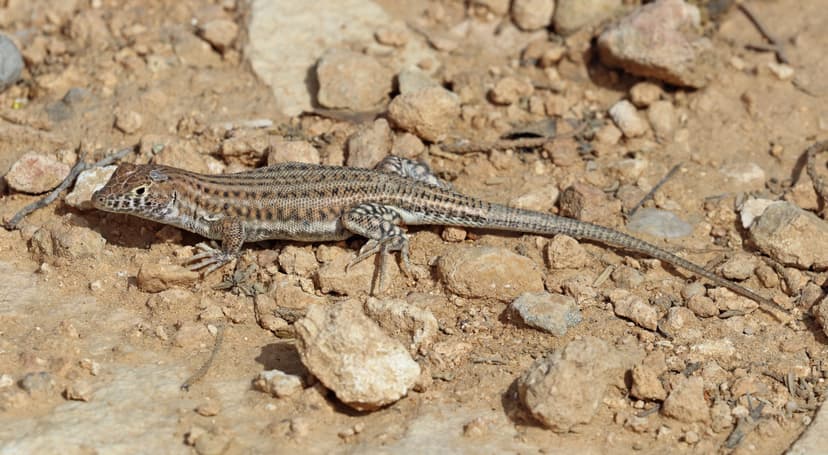
Bosc's fringe-toed lizard (Acanthodactylus boskianus) is a medium-sized lizard found across North Africa and Western Asia. It is characterized by its olive-grey dorsal surface with dark stripes and distinctive long, fringed digits on its feet. This fast-moving lizard inhabits diverse environments, from coastal plains to oases, and is a common diurnal species within its extensive range.