
Ablepharus
Ablepharus, commonly known as snake-eyed skinks, are small lizards distinguished by fused eyelids that prevent blinking, similar to snakes. They inhabit dry fields, hills, and rocky areas, often concealed within leaf litter. These skinks possess shiny, bronze scales and a characteristic dark stripe along their sides, feeding primarily on small insects and mollusks.
Key Facts
- ›Eyelids are fused into a translucent capsule, preventing blinking.
- ›Scales are shiny and bronze with a dark lateral stripe.
- ›Prefer habitats of dry fields, hills, rocky areas with leaf litter.
- ›Diet consists mainly of small arthropods, mollusks, and snails.
- ›Females are generally larger and heavier than males.
- ›Average total length is around 13 cm, with a maximum of 15 cm.

Snake-Eyed Skinks, Common Snake-Eyed Skink
Southern European Countries, Northern African Countries, Southeast Asia, China, Kyrgyzstan, Uzbekistan, Tajikistan, Kazakhstan, Azerbaijan, Turkey, Armenia, Iran, Turkmenistan, Syria, Lebanon, Cyprus, India, Afghanistan, Nepal, Slovakia, Serbia, Hungary, Croatia, Albania, Greece, Romania, Macedonia, Tibet, Israel, Egypt, Jordan, Bhutan, Bangladesh
Dry Fields, Hills, Rocky Areas, Leaf Litter, Thorny Shrubbery, Grasslands, Rocky Slopes, Woodlands, Forests, Open Areas, Desert Lands, Dry Slopes, Arid Regions, Meadows, Scrubland, Woodland Clearings, Heavily Forested Areas, Dense Vegetation, Oases
- Scales Are Shiny and Bronze In Appearance.
- A Characteristic Dark Stripe Runs the Length of the Dorsal Surface of the Body.
- Short, Weak Front Legs Contribute To Serpentine Movement.
- Females Are Generally Longer and Weigh More Than Males.
- Have Thick Tails Relative To Their Body Sizes and Lengths.
- Fully Mature Individuals Can Reach A Total Length of Up To 15 cm .
- On Average, Individuals Reach A Total Length of Up To About 13 cm .
- Eyelids Are Fused Into A Translucent Capsule, Preventing Blinking.
Small Insects, Small Arthropods, Mollusks, Small Snails
- Generally Shy Creatures.
- Bask In the Sunlight During the Daytime.
- Become More Active As Dusk and Darkness Approach.
- Move In A Serpentine-Like Manner.
Unknown
About Ablepharus
Ablepharus: The Snake-Eyed Skinks
Ablepharus, commonly referred to as snake-eyed skinks, are a genus of small lizards belonging to the skink family. Their most striking characteristic, which gives them their common name, is their fused eyelids. These eyelids form a translucent capsule, rendering them physically incapable of blinking, a trait shared with snakes. This unique feature, along with their shimmering bronze scales and a characteristic dark stripe running along their sides, makes them distinctive.
These skinks are typically found in dry, open environments, preferring to inhabit the leaf litter of fields and hills. They are shy creatures that bask in the sun during the day and become more active as light fades. Their diet primarily consists of small insects, other small arthropods, mollusks, and snails, positioning them as generalist predators within their ecosystems.
Ablepharus skinks exhibit sexual dimorphism, with females generally being longer and heavier than males. Their average adult total length is around 13 cm, though some individuals can reach up to 15 cm. In the wild, these lizards typically live for about two and a half years, a lifespan shortened by predation, while in captivity they can survive up to three and a half years. Females lay between two and four eggs, which take approximately nine weeks to hatch, and hatchlings reach reproductive maturity in about two years.
Source: Wikipedia ↗
Frequently Asked Questions
What does the name 'snake-eyed skink' refer to?
The name 'snake-eyed skink' refers to their fused eyelids. These eyelids have transformed into a translucent capsule, preventing the skink from blinking, much like snakes.
What kind of habitats do Ablepharus skinks prefer?
Ablepharus skinks generally prefer to live in the leaf litter of dry fields and hills. They are often found in rocky areas with little soil, and some species can tolerate damper habitats up to 2,000 meters above sea level.
What do Ablepharus skinks eat?
Analysis of stomach contents indicates that Ablepharus skinks are generalist predators. Their diet mainly consists of small arthropods, mollusks, and small snails.
How long do Ablepharus skinks live?
In captivity, common snake-eyed skinks are known to survive up to three and a half years. In the wild, where they are subject to predation, their lifespan is approximately two and a half years.
What is the physical appearance of Ablepharus skinks?
Ablepharus skinks have shiny, bronze-colored scales. A distinctive dark stripe runs the length of their dorsal surface. They also have short, weak front legs which aid in their serpentine movement and thick tails relative to their body size.
When are Ablepharus skinks most active?
Ablepharus skinks are generally shy creatures that bask in the sunlight during the daytime. They become more active as dusk and darkness approach.
Related Lizards

Pygopodidae
Pygopodidae, commonly known as snake-lizards or flap-footed lizards, are a family of legless geckos native to Australia and New Guinea. They possess unusually long, slender bodies resembling snakes, but are distinguished by external ear holes, flat tongues, and vestigial hind limbs. These adaptations allow some species to burrow or navigate dense vegetation, with their diet primarily consisting of insects.
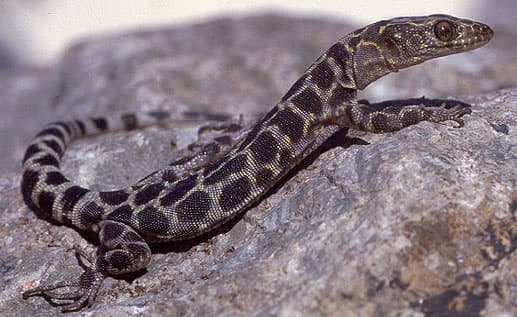
Xantusia henshawi
The granite night lizard (Xantusia henshawi) is a flat-bodied lizard endemic to North America, found in Baja California, Mexico, and southern California, USA. It is characterized by its soft skin, rounded dark dorsal spots on a pale background, large eyes with vertical pupils, and lack of eyelids. This species is often found in rocky slopes with boulders and crevices, and exhibits crepuscular and nocturnal activity.

Trachylepis vittata
The bridled mabuya, scientifically known as Heremites vittatus, is a species of skink native to North Africa and the Middle East. These lizards inhabit open, sandy or stony areas with sparse vegetation, often found near water sources like wetlands and oases. They are characterized by their smooth, shiny bodies, cone-shaped heads, elongated forms, and easily breakable yet regenerative tails.