
Amphiglossus punctatus
Brachyseps punctatus is a species of skink found exclusively on the island of Madagascar. Little is documented about its specific characteristics or behaviors beyond its geographic origin.
Key Facts
- ›Endemic to Madagascar.
- ›Belongs to the skink family.
- ›Specific ecological role and behaviors are not widely detailed.
- ›Conservation status is not specified in available records.

Madagascar
About Amphiglossus punctatus
Brachyseps punctatus
What is known
Brachyseps punctatus is a species of skink that is endemic to the island of Madagascar. This means that its natural habitat is confined solely to Madagascar, and it is not found in the wild anywhere else on Earth. As a member of the skink family (Scincidae), it shares general characteristics common to this diverse group of lizards, which often include smooth scales and a streamlined body shape.
However, beyond its taxonomic classification and its specific geographic origin, detailed information regarding the physical characteristics, specific habitat preferences, diet, behavior, or conservation status of Brachyseps punctatus is not widely documented in readily available records. Further scientific study would be necessary to provide a more comprehensive understanding of this species.
Source: Wikipedia ↗
Frequently Asked Questions
Where is Brachyseps punctatus found?
Brachyseps punctatus is found exclusively on the island of Madagascar. This means it is endemic to this specific region and not naturally found anywhere else in the world.
What kind of lizard is Brachyseps punctatus?
Brachyseps punctatus is a type of skink. Skinks are a widespread group of lizards known for their smooth scales and often elongated bodies.
Are there any notable features of Brachyseps punctatus?
The provided information does not detail any specific or notable physical features of Brachyseps punctatus. Further research would be required to identify distinctive characteristics.
Related Lizards
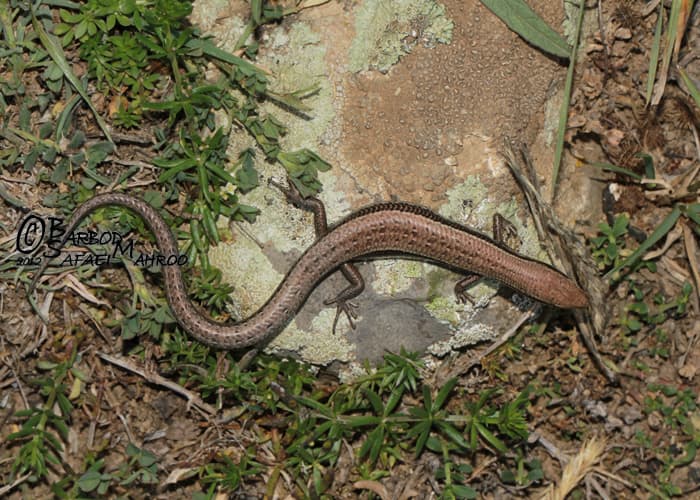
Ablepharus bivittatus
The twin-striped skink (Ablepharus bivittatus) is a species of skink found in mountainous regions of Armenia, Azerbaijan, Turkmenistan, northwestern Iran, and Turkey. It is distinguished by its habitat in high elevations, typically between 2,300 and 3,300 meters.
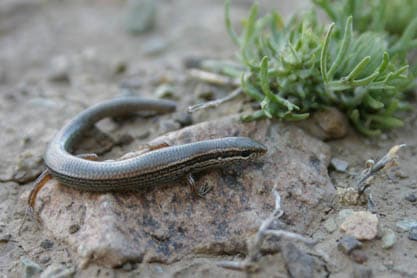
Ablepharus pannonicus
The Asian snake-eyed skink (Ablepharus pannonicus) is a species of skink native to a wide range across Asia and parts of the Middle East. It is characterized by its snake-like appearance and is found in diverse arid and semi-arid environments.

Adam's dravidogecko
Adam's dravidogecko (Dravidogecko douglasadamsi) is a species of gecko native to India. Little is documented about its specific characteristics, habitat, or behaviors, making it a relatively understudied species.