
Amphisbaena prunicolor
The plum-colored worm lizard (Amphisbaena prunicolor) is a moderately large, thin species found in Argentina, Brazil, and Paraguay. Its most striking feature is its coloration, typically a dark purplish-brown on its back and a variable mix of white and purplish-brown on its underside, sometimes forming a checkerboard pattern. This species is known to be preyed upon by the plush-crested jay.
Key Facts
- ›Found in Argentina, Brazil, and Paraguay.
- ›Characterized by a dark purplish-brown back and a variable white and purplish-brown underside.
- ›Adults can reach a snout-vent length of 141.0–238.0 mm (5.55–9.37 in).
- ›The underside coloration can sometimes form a checkerboard pattern.
- ›The plush-crested jay is a known predator.

Plum-Colored Worm Lizard
Argentina, Brazil, Paraguay
- Moderately Large and Thin For Its Genus.
- Snout-Vent Length: 141.0–238.0 mm .
- Back Is Usually Unicolor Dark Purplish-Brown.
- Underside Is A Mix of White and Purplish-Brown, With Variable Extent of White.
- White Coloration On the Underside Can Be Present From Snout To Tail Tip, Or Centered On the Head and Throat.
- Some Individuals Exhibit A Checkerboard Pattern On the Venter Due To Differently Colored Scales.
Plush-Crested Jay
About Amphisbaena prunicolor
Amphisbaena prunicolor: The Plum-Colored Worm Lizard
The plum-colored worm lizard, scientifically designated as Amphisbaena prunicolor, is a species of amphisbaenian native to South America. This reptile is recognized for its distinctive coloration and moderate size within its genus. It inhabits regions across Argentina, Brazil, and Paraguay, contributing to the biodiversity of these South American countries.
Taxonomy and Description
Formally described in 1885, Amphisbaena prunicolor has undergone taxonomic revisions throughout its history. It is characterized as a moderately large and slender species, with adults typically reaching a snout-vent length between 141.0 and 238.0 millimeters (approximately 5.55 to 9.37 inches). The dorsal side of the lizard is predominantly a uniform dark purplish-brown, often with a similarly colored tail. The ventral side presents a more variable appearance, being a mix of white and purplish-brown scales. The distribution of white coloration can range from the snout to the tail tip, or be concentrated around the head and throat. In some individuals, these contrasting scales on the underside create a striking checkerboard pattern.
Distribution and Habitat
Amphisbaena prunicolor is found in Argentina, Paraguay, and Brazil. Within Argentina, it has been recorded in the provinces of Corrientes and Misiones, while in Paraguay, it is known from the department of Itapúa. In Brazil, its range extends from Espírito Santo in the south to Rio Grande do Sul. Specific details regarding its preferred microhabitat within these regions are not extensively documented, though its classification as a worm lizard suggests a fossorial or semi-fossorial lifestyle.
Ecology and Behavior
Information regarding the diet and specific behavioral traits of Amphisbaena prunicolor is limited in available records. However, it is known to be preyed upon by the plush-crested jay, indicating its place within the local food web. Further research would be beneficial to fully understand its ecological role, reproductive strategies, and daily activities.
Source: Wikipedia ↗
Frequently Asked Questions
What is the scientific name for the plum-colored worm lizard?
The scientific name for the plum-colored worm lizard is Amphisbaena prunicolor. This binomial name is derived from Latin, with 'prunus' meaning plum tree and 'color' meaning color, referring to its distinctive purplish-brown hue.
Where is Amphisbaena prunicolor found?
Amphisbaena prunicolor is naturally found in South America, specifically in Argentina, Brazil, and Paraguay. Its distribution within these countries includes regions like Corrientes and Misiones in Argentina, and from Espírito Santo south to Rio Grande do Sul in Brazil.
What does Amphisbaena prunicolor look like?
This worm lizard is described as moderately large and thin for its genus. Its back is usually a uniform dark purplish-brown, while the underside features a mix of white and purplish-brown scales. The extent of white on the underside can vary significantly among individuals.
What is the typical size of an Amphisbaena prunicolor?
Amphisbaena prunicolor is considered moderately large for its genus. Adult specimens typically reach a snout-vent length ranging from 141.0 to 238.0 millimeters, which is equivalent to 5.55 to 9.37 inches.
Does Amphisbaena prunicolor have any known predators?
Yes, the plush-crested jay has been identified as a predator of the plum-colored worm lizard. This indicates that Amphisbaena prunicolor is part of the food chain within its native South American habitats.
Related Lizards
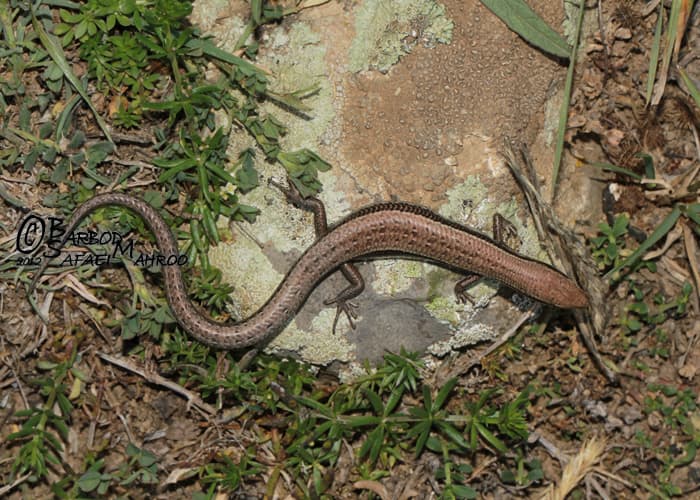
Ablepharus bivittatus
The twin-striped skink (Ablepharus bivittatus) is a species of skink found in mountainous regions of Armenia, Azerbaijan, Turkmenistan, northwestern Iran, and Turkey. It is distinguished by its habitat in high elevations, typically between 2,300 and 3,300 meters.
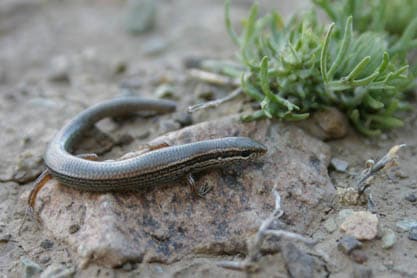
Ablepharus pannonicus
The Asian snake-eyed skink (Ablepharus pannonicus) is a species of skink native to a wide range across Asia and parts of the Middle East. It is characterized by its snake-like appearance and is found in diverse arid and semi-arid environments.

Adam's dravidogecko
Adam's dravidogecko (Dravidogecko douglasadamsi) is a species of gecko native to India. Little is documented about its specific characteristics, habitat, or behaviors, making it a relatively understudied species.