
Anan's rock agama
Anan's rock agama is a species of lizard found exclusively in Tibet, preferring rocky environments and freshwater wetlands at high altitudes. It is characterized by its distinct coloration and a tail that is longer than its body.
Key Facts
- ›Endemic to Tibet.
- ›Inhabits rocky areas and freshwater wetlands.
- ›Can reach a snout-to-vent length of 15 cm, with a tail of 24 cm.
- ›Reproductively oviparous, meaning it lays eggs.
- ›Named in honor of Russian herpetologist Natalia Borisovna Ananjeva.

Anan's Rock Agama
Tibet
May Attain A Snout-To-Vent Length of 15 cm ., Tail Length Can Be Up To 24 cm .
About Anan's rock agama
Anan's rock agama, scientifically known as Laudakia sacra, is a lizard species belonging to the family Agamidae. This species is notable for its restricted geographic range, being endemic to the high-altitude regions of Tibet.
Habitat and Description
The preferred natural habitats of Laudakia sacra are characterized by their rugged terrain, specifically rocky areas, and also include freshwater wetlands. These lizards are typically found at significant elevations, ranging from approximately 3,300 to 4,400 meters (10,800 to 14,400 feet) above sea level. Physically, Anan's rock agama can achieve a snout-to-vent length of up to 15 centimeters (5.9 inches). Its tail is considerably longer, measuring around 24 centimeters (9.4 inches).
Taxonomy and Naming
The common name, Anan's rock agama, serves as an honorific, referring to the Russian herpetologist Natalia Borisovna Ananjeva, who was born in 1946. Historically, the species has been classified under different scientific names, including Agama himalayana sacra as a subspecies and Stellio sacra before its current placement within the genus Laudakia.
Reproduction
Regarding its reproductive strategy, Laudakia sacra is oviparous, meaning that individuals reproduce by laying eggs.
Source: Wikipedia ↗
Frequently Asked Questions
Where is Anan's rock agama found?
Anan's rock agama is endemic to Tibet. Its preferred natural habitats include rocky areas and freshwater wetlands within this region.
What is the typical size of Anan's rock agama?
This lizard can reach a snout-to-vent length of up to 15 cm. Its tail is notably longer, measuring approximately 24 cm.
How does Anan's rock agama reproduce?
Anan's rock agama is oviparous, which means it reproduces by laying eggs.
What kind of environment does Anan's rock agama prefer?
The species thrives in rocky areas and freshwater wetlands. These habitats are typically found at high altitudes, ranging from 3,300 to 4,400 meters.
Who is Anan's rock agama named after?
The common name, Anan's rock agama, honors the Russian herpetologist Natalia Borisovna Ananjeva.
Related Lizards

Asian water monitor
The Asian water monitor (Varanus salvator) is a large lizard native to South and Southeast Asia, recognized as the second-largest lizard species after the Komodo dragon. These semiaquatic reptiles are excellent swimmers and inhabit riparian areas, adapting well to environments near human civilization. They are carnivorous, with a diverse diet, and play a role in ecosystems by consuming carrion.
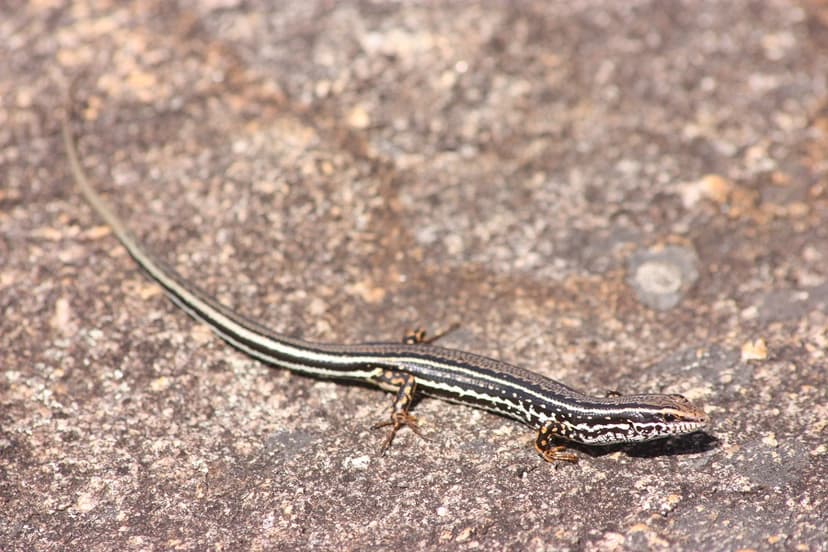
Ctenotus labillardieri
Ctenotus labillardieri, also known as the common south-west ctenotus, is a skink species endemic to Western Australia. It is characterized by its reddish-brown legs marbled with black, an uninterrupted pale dorsolateral stripe, and yellow ventral surfaces. This species inhabits forests, shrublands, and freshwater wetlands.

Trachylepis boettgeri
Trachylepis boettgeri, commonly known as Boettger's mabuya, is a species of skink found in Madagascar. This terrestrial and diurnal lizard inhabits grasslands, shrublands, and freshwater wetlands.