
Ctenotus labillardieri
Ctenotus labillardieri, also known as the common south-west ctenotus, is a skink species endemic to Western Australia. It is characterized by its reddish-brown legs marbled with black, an uninterrupted pale dorsolateral stripe, and yellow ventral surfaces. This species inhabits forests, shrublands, and freshwater wetlands.
Key Facts
- ›Endemic to the Australian state of Western Australia.
- ›Features reddish-brown legs marbled with black.
- ›Possesses an uninterrupted pale dorsolateral stripe.
- ›Ventral surfaces are typically yellow.
- ›Found in forests, shrublands, and freshwater wetlands.
- ›Reproduction is oviparous (egg-laying).
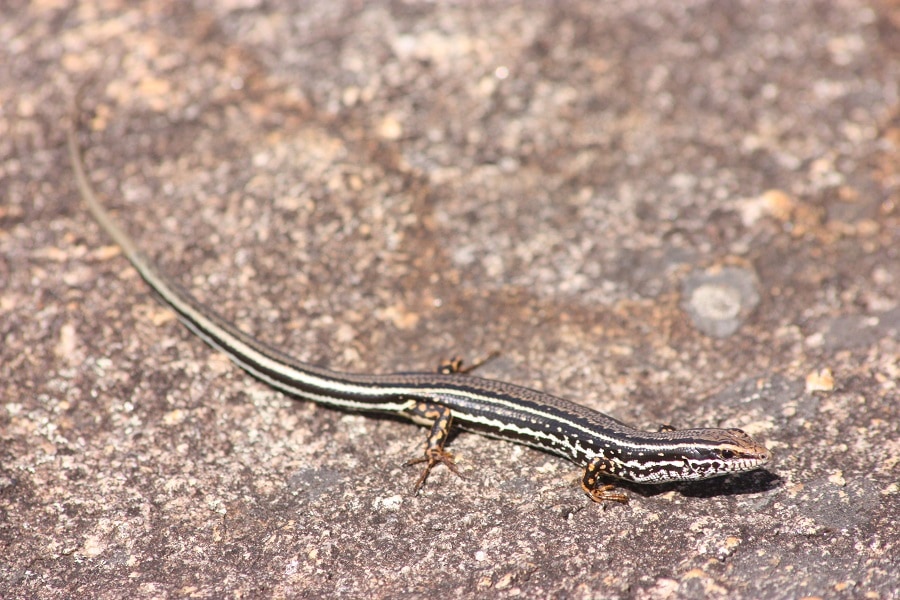
Common South-West Ctenotus, Labillardier's Ctenotus, Red-Legged Ctenotus
Western Australia
Reddish-Brown Legs Marbled With Black., Uninterrupted Pale Dorsolateral Stripe., Yellow Ventral Surfaces., May Attain A Snout-To-Vent Length of 7.5 cm .
About Ctenotus labillardieri
Ctenotus labillardieri: The Common South-West Ctenotus
Ctenotus labillardieri, commonly referred to as the common south-west ctenotus, Labillardier's ctenotus, or the red-legged ctenotus, is a species of skink found exclusively in the Australian state of Western Australia. This lizard belongs to the family Scincidae.
Description and Habitat
The physical characteristics of Ctenotus labillardieri include distinctive reddish-brown legs that are boldly marbled with black. It features a pale dorsolateral stripe that remains uninterrupted along its body, and its ventral surfaces are a notable yellow. Adult specimens can reach a snout-to-vent length of up to 7.5 centimeters (3.0 inches). The preferred natural habitats for this species are varied, encompassing forests, shrublands, and freshwater wetlands. These areas can range in altitude from sea level up to approximately 1,095 meters (3,593 feet).
Reproduction
Ctenotus labillardieri is oviparous, meaning that it reproduces by laying eggs. Further details regarding its reproductive cycle, such as clutch size or incubation periods, are not extensively documented in available records.
Etymology
The specific name, labillardieri, honors the French botanist Jacques Labillardière, recognizing his contributions to the field of botany.
Source: Wikipedia ↗
Frequently Asked Questions
What are the common names for Ctenotus labillardieri?
Ctenotus labillardieri is commonly known as the common south-west ctenotus, Labillardier's ctenotus, and the red-legged ctenotus.
Where is Ctenotus labillardieri found?
This species is found in southwestern Western Australia, including some offshore islands. Its natural habitats range from sea level up to 1,095 meters in altitude.
What does Ctenotus labillardieri look like?
It has reddish-brown legs that are boldly marbled with black. A pale dorsolateral stripe runs uninterrupted along its body, and its ventral surfaces are yellow. Adults can reach a snout-to-vent length of up to 7.5 cm.
What kind of environments does Ctenotus labillardieri prefer?
The preferred natural habitats for Ctenotus labillardieri include forests, shrublands, and freshwater wetlands. It can be found in these areas at various altitudes.
How does Ctenotus labillardieri reproduce?
Ctenotus labillardieri is oviparous, meaning it reproduces by laying eggs.
Related Lizards

Trachylepis boettgeri
Trachylepis boettgeri, commonly known as Boettger's mabuya, is a species of skink found in Madagascar. This terrestrial and diurnal lizard inhabits grasslands, shrublands, and freshwater wetlands.

Anan's rock agama
Anan's rock agama is a species of lizard found exclusively in Tibet, preferring rocky environments and freshwater wetlands at high altitudes. It is characterized by its distinct coloration and a tail that is longer than its body.

Asian water monitor
The Asian water monitor (Varanus salvator) is a large lizard native to South and Southeast Asia, recognized as the second-largest lizard species after the Komodo dragon. These semiaquatic reptiles are excellent swimmers and inhabit riparian areas, adapting well to environments near human civilization. They are carnivorous, with a diverse diet, and play a role in ecosystems by consuming carrion.