
Anatolian rock lizard
The Anatolian rock lizard, scientifically known as Anatololacerta anatolica, is a common lizard species found in western Anatolia and adjacent Greek islands. This lizard inhabits temperate forests and rocky environments, characterized by its flattened body and variable markings, often featuring pale spots on a dark olive-brown base.
Key Facts
- ›Endemic to western Anatolia (Turkey) and nearby Greek islands.
- ›Inhabits rocky outcrops, cliffs, boulders, and dry stone walls.
- ›Possesses a flattened head and body, with variable pale markings.
- ›Typically grows to a snout-to-vent length of 7.5 cm, with a tail twice its body length.
- ›Listed as 'least concern' by the IUCN due to its wide range and stable population.
- ›Primary threat identified is wildfires.
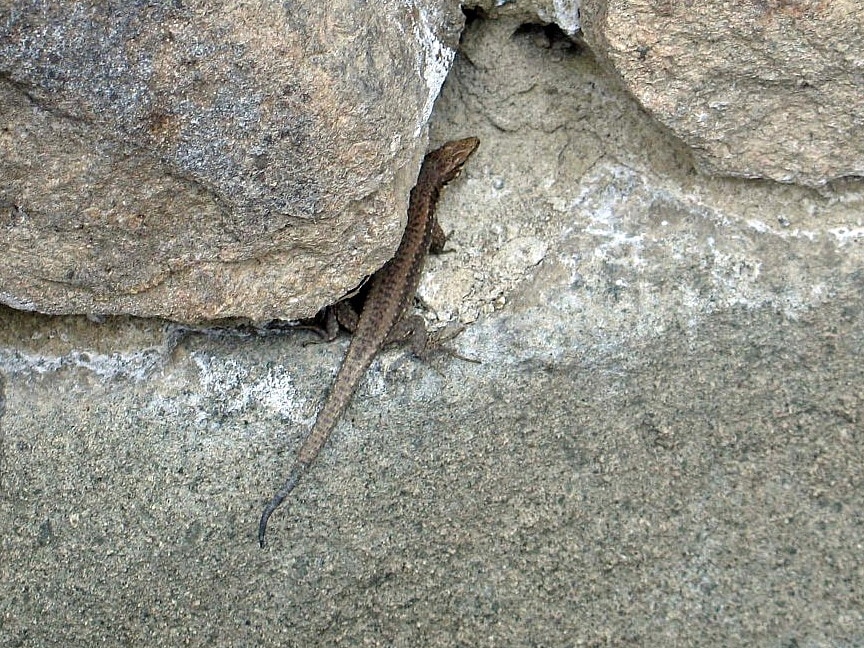
Anatolian Lizard
Western Anatolia, Greek Islands
Temperate Forests, Rocky Outcrops, Cliffs, Boulders, Dry Stone Walls, Woodlands, Arid Locations Near Streams
- Snout-To-Vent Length of About 7.5 cm .
- Tail Approximately Twice the Length of the Body.
- Head and Body Are Somewhat Flattened.
- Markings Are Variable.
- Basal Color Is Dark Olive-Brown.
- Usually Two Series of Pale Dorso-Lateral Spots, Which May Merge Into Lines.
- Further Pale Speckling In Areas Between Stripes.
- Throat May Be Reddish.
- Underparts Are Pale, Sometimes With A Few Dark Spots On the Flanks.
- Lizards On Icaria Exhibit Particularly Bold, Contrasting Markings.
Insects, Other Small Invertebrates
- Active In Temperate Forest and Rocky Habitats.
- Likely Exhibits Typical Lizard Behaviors For Thermoregulation and Foraging In Its Environment.
Wildfires
About Anatolian rock lizard
The Anatolian rock lizard, scientifically classified as Anatololacerta anatolica, is a species of lizard belonging to the Lacertidae family. It is a commonly encountered species primarily found in western Anatolia, the western peninsula of Turkey, and on several Greek islands situated close to the coast. Its natural habitats are characterized by temperate forests and rugged, rocky terrain.
Description and Characteristics
This lizard typically measures around 7.5 centimeters from snout to vent, with a tail that is roughly twice the length of its body. The head and body of the Anatolian rock lizard are noted for being somewhat flattened. Its coloration and markings can be quite variable; the base color is generally a dark olive-brown. Most individuals display two rows of pale dorso-lateral spots, which can sometimes merge to form distinct lines. Additional pale speckling often adorns the areas between these stripes. The throat region may exhibit a reddish hue, while the rest of the underparts are pale, occasionally featuring scattered dark spots on the flanks. Lizards found on the island of Icaria are particularly known for their bold and contrasting patterns.
Distribution and Habitat
The species is endemic to the western Anatolian peninsula in Turkey, specifically in areas north of the Büyük Menderes River. Its range also extends to the Greek islands of Samos, Icaria, and Thymaina. The Anatolian rock lizard can be found at elevations up to 1,700 meters (5,600 ft). Its preferred habitat includes rocky outcrops, cliffs, large boulders, and man-made dry stone walls. It is frequently observed in rocky sections within woodlands and in proximity to streams, even in otherwise arid environments.
Conservation Status
The Anatolian rock lizard is considered a common species with a wide distribution and a large, stable population. Consequently, the International Union for Conservation of Nature (IUCN) has assessed its conservation status as 'least concern'. The primary threat identified for this species is wildfires, which can impact its habitat.
Source: Wikipedia ↗
Frequently Asked Questions
Where is the Anatolian rock lizard found?
The Anatolian rock lizard is endemic to the western Anatolian peninsula in Turkey, specifically north of the Büyük Menderes River. It is also found on some Greek islands close to the Turkish coast, including Samos, Icaria, and Thymaina.
What kind of habitat does the Anatolian rock lizard prefer?
This lizard species thrives in rocky environments such as outcrops, cliffs, boulders, and dry stone walls. It is often found in rocky areas within woodlands and can also be present near streams in otherwise arid locations, at altitudes up to 1,700 meters.
What are the physical characteristics of the Anatolian rock lizard?
The Anatolian rock lizard has a somewhat flattened head and body, typically reaching a snout-to-vent length of about 7.5 centimeters. Its tail is approximately twice the length of its body. The basal color is dark olive-brown, usually adorned with two series of pale dorso-lateral spots that may merge into lines, and further pale speckling.
What is the conservation status of the Anatolian rock lizard?
The Anatolian rock lizard is classified as 'least concern' by the International Union for Conservation of Nature (IUCN). This status is attributed to its wide geographic range, large and stable population, and common presence within its habitat.
What are the main threats to the Anatolian rock lizard?
The most significant threat identified for the Anatolian rock lizard is wildfires. While its population is generally stable, these events can negatively impact its habitat and survival.
Related Lizards

Sharp-snouted rock lizard
The sharp-snouted rock lizard, scientifically known as *Dalmatolacerta oxycephala*, is a slender, flattened lizard characterized by its pointed snout and distinctive hind toes. It inhabits diverse rocky and shrubby environments across the Balkans, exhibiting color variations adapted to its specific altitude and locale. This hardy species is well-camouflaged and known for its climbing abilities.

Pseudotrapelus sinaitus
The Sinai agama (Pseudotrapelus sinaitus) is a small lizard native to arid regions of the Sinai Peninsula, Israel, Jordan, and Syria. Known for its long legs and slender tail, males exhibit a striking blue coloration during the breeding season to attract females, while females and juveniles are typically brownish-grey. This diurnal species is an active hunter of insects and also consumes plants, utilizing its agility for climbing and running.

Iberolacerta horvathi
Horvath's rock lizard (Iberolacerta horvathi) is a reptile endemic to Europe, distinguished by its pale greyish-brown upper body, dark brown sides, and unspotted white or yellowish belly. It inhabits temperate forests, shrublands, and rocky areas, often at higher altitudes. This agile lizard is a rock specialist, noted for its ability to leap while hunting small invertebrates.