
Anolis carolinensis carolinensis
The Anolis carolinensis, commonly known as the green anole or Carolina anole, is a small to medium-sized lizard native to the southeastern United States. It is distinguished by its ability to change color from shades of brown to green, a trait that leads to its common nickname 'American chameleon,' though it is not a true chameleon. These arboreal lizards inhabit forests, grasslands, and can even adapt to urban environments with sufficient vegetation and insect prey.
Key Facts
- ›Can change color from green to brown, often used for social signaling and mood.
- ›Males are territorial and display a prominent, brightly colored dewlap (throat fan) for communication and courtship.
- ›Primarily insectivorous, feeding on a variety of small insects and arthropods.
- ›Possesses adhesive toe pads for excellent climbing ability on vertical surfaces.
- ›Males exhibit sexual dimorphism, being slightly larger than females and possessing a larger dewlap.
- ›Native to the southeastern United States but has been introduced to various islands in the Pacific and Caribbean.

Carolina Anole, Carolina Green Anole, American Anole, American Green Anole, North American Green Anole, Red-Throated Anole, Chameleon, American Chameleon
Southeastern United States, Bahamas, Hawaii, Ogasawara Islands, Northern Mariana Islands, Palau, Saint Vincent and the Grenadines, Canary Islands, Southern California, Mexico
- Small To Medium-Sized Lizard With A Slender Body.
- Males Are Slightly Larger Than Females.
- Head Is Long and Pointed With Ridges.
- Toes Have Adhesive Pads For Climbing.
- Adult Males Typically Range From 12.5–20.3 cm In Total Length, With Svl Up To 7.5 cm .
- Males Have A Large, Bright Orange To Red Dewlap ; Females Have A Much Smaller, Lighter-Colored Dewlap.
- Females and Juveniles Often Have A Prominent White Stripe Down Their Spine.
- Coloration Can Vary From Bright Green To Dark Brown.
- Males Can Develop A Pronounced Dorsal Ridge Behind the Head When Displaying Or Stressed.
- Rare Blue and Yellow Color Mutations Exist.
Small Insects, Arthropods, Occasionally Molluscs, Grains, and Seeds, Smaller Reptiles, Mealworms, Grubs, Maggots
- Diurnal and Active Throughout the Year, Peaking In Spring and Fall.
- Strongly Territorial, Especially Males.
- Use Jumping As Primary Locomotion.
- Exhibit Color Change For Mood, Stress, and Social Signaling.
- Males Display Elaborate Courtship Rituals Including Dewlap Extension and Head Bobbing.
- Can Autotomize Their Tails To Distract Predators.
- Can Be Observed On Steps, Trellises, and Railings.
- Known For Adaptation To Human Encroachment.
- Males Can Form Heavyweight and Lightweight Morphs.
Broadhead Skink, Snakes, Birds, Cats
Competition From Introduced Anole Species, Parasitism By Sarcophagid Flies
About Anolis carolinensis carolinensis
Anolis carolinensis
The Anolis carolinensis, commonly known as the green anole or Carolina anole, is a distinctive lizard species native to the southeastern United States. Its most striking characteristic is its ability to change color, typically shifting between vibrant green and various shades of brown. This color-changing ability often leads to it being colloquially referred to as the "American chameleon," although it is not a true chameleon.
Description and Physical Traits
This species is a small to medium-sized lizard with a slender build. Adult males are generally larger than females and exhibit notable sexual dimorphism. A prominent feature in males is their large, brightly colored dewlap, which is bright orange to red and used extensively for communication and courtship displays. Females and juveniles often possess a distinct white stripe running along their dorsal side. The anole's toes are equipped with adhesive pads, allowing for adept climbing on vertical surfaces, a key adaptation for its arboreal lifestyle.
Habitat and Distribution
Anolis carolinensis is primarily found in the subtropical southeastern regions of North America, inhabiting diverse environments such as forests, grasslands, and temperate zones. They are adaptable and can thrive in urban settings, often found on shrubs, trees, fences, and even the sides of buildings, provided there is sufficient vegetation and insect prey. While native to the continental United States, it has also been introduced to various islands in the Pacific and Caribbean, where it can sometimes be considered an invasive species.
Behavior and Diet
These lizards are diurnal, meaning they are active during the day, with peak activity often observed in spring and fall. Male anoles are highly territorial and will defend their space against rivals using visual displays, including extending their dewlap and bobbing their heads. Their diet consists mainly of small insects and arthropods, making them insectivores. When threatened, they can shed their tails to distract predators and rely on their excellent climbing skills to escape.
Reproduction
The breeding season typically spans from spring to late summer. Females lay one to two soft-shelled eggs in shallow depressions in soil, leaf litter, or rotting wood. The eggs incubate for approximately five to seven weeks, relying on environmental warmth. Hatchlings are independent from birth and must immediately fend for themselves.
Conservation and Interactions
While not currently considered threatened as a species, green anoles face increasing competition from introduced species, such as the brown anole (Anolis sagrei). This competition has led to shifts in territory use, with green anoles often retreating to higher arboreal levels. The species is also a model organism in genomics research due to its ease of laboratory breeding and evolutionary significance.
Source: Wikipedia ↗
Frequently Asked Questions
What is the scientific name for the green anole?
The scientific name for the green anole is Anolis carolinensis. It belongs to the genus Anolis within the family Dactyloidae, commonly known as anole lizards.
Why is the green anole sometimes called an American chameleon?
The green anole is often called an American chameleon due to its remarkable ability to change color, typically ranging from green to brown. However, it is important to note that it is not a true chameleon, as they are a distinct group of reptiles.
What do green anoles eat?
The diet of the green anole consists primarily of small insects and other arthropods, such as crickets, grasshoppers, flies, spiders, and cockroaches. They may occasionally consume small mollusks, grains, or seeds.
Where are green anoles found?
Green anoles are native to the southeastern United States, inhabiting areas like the Atlantic Coastal Plains and Gulf Coast. They have also been introduced to various islands in the Pacific and Caribbean.
How do male green anoles defend their territory?
Male green anoles are strongly territorial. They will compress their bodies, extend their dewlap, inflate a dorsal ridge, and bob their heads to intimidate rivals. If necessary, they will engage in biting and scratching.
What is the typical lifespan of a green anole?
In the wild, their lifespan is not precisely documented. However, when cared for properly in captivity, green anoles can live up to 8 years.
Are green anoles venomous?
No, green anoles are not venomous. While they can bite if provoked or stressed, their bite is not medically significant to humans.
Related Lizards

Anolis carolinensis
The Anolis carolinensis, commonly known as the green anole or Carolina anole, is a small to medium-sized lizard native to the southeastern United States. This arboreal species is recognized for its ability to change color from green to brown, a trait that, along with its expandable throat fan, plays a role in communication and social signaling. It inhabits forests, grasslands, and urban areas with sufficient vegetation and insect prey.
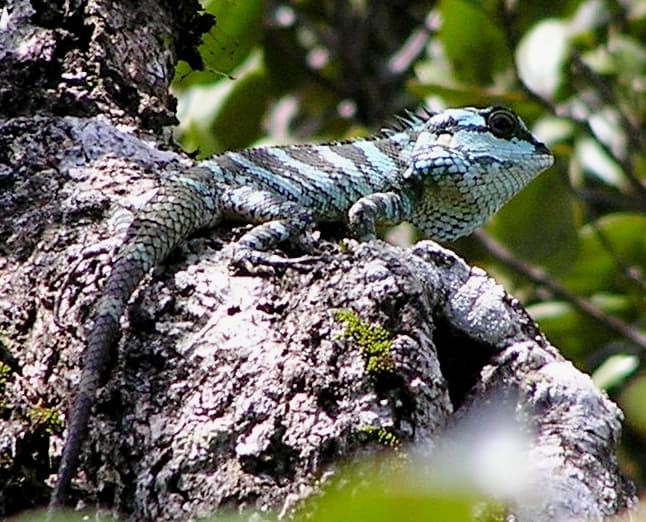
Crestless lizard
The Crestless lizard, also known as the spineless forest lizard or lionhead agama, is an agamid lizard endemic to Sri Lanka. It is characterized by its cryptic coloration, which aids in camouflage among treetops, and the notable absence of spines above its ear, distinguishing it from related species. This arboreal species is diurnal and feeds primarily on insects and other small animals.

Common wall gecko
The common wall gecko, scientifically known as Tarentola mauritanica, is a robust gecko species native to the western Mediterranean region of North Africa and Europe. Characterized by enlarged, tubercules that give it a spiny, armored appearance, this nocturnal insectivore is frequently observed on walls in urban and coastal areas. It has a long history of cohabitation with humans, particularly in Spain, where it acts as an insect hunter.