
Aspidoscelis hyperythrus
The orange-throated whiptail (Aspidoscelis hyperythrus) is a lizard species native to southern California and parts of Mexico. It is characterized by its black, brown, or gray dorsal side with five or six light-colored stripes, a whitish-yellow or cream underside, and a distinctive orange throat, particularly prominent in males during the breeding season. Juveniles display vibrant cobalt blue legs and tails, and the species exhibits a unique, jerky gait.
Key Facts
- ›Found in southern California, Baja California, and Baja California Sur.
- ›Possesses five or six light-colored stripes on a dark dorsal side.
- ›Characterized by an orange throat, especially in breeding males.
- ›Juveniles have cobalt blue legs and tails.
- ›Exhibits a distinctive, jerky gait.
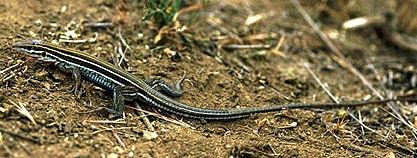
Orange-Throated Whiptail
United States, Mexico
- Black, Brown, Or Gray Dorsal Side With Five Or Six Light-Colored Stripes.
- Middle Stripe May Be Forked At Both Ends.
- Whitish-Yellow Or Cream Venter.
- Orange Throat .
- Yellow-Brown To Olive-Colored Head.
- Forked Tongue, Flicked Continually.
- Snout-To-Vent Length of 5–7.2 cm .
- Juveniles Have Cobalt Blue Legs and Tails.
- Males May Have Orange Entire Ventral Surface, Including Tail.
- Gravid Females May Have Some Orange, Especially Lining the Lower Jaw.
- Colors Are Most Distinct In the Breeding Season.
- Males Have Larger Femoral Pores Than Females.
Distinctive, Jerking Gait., Continually Flicks Forked Tongue.
About Aspidoscelis hyperythrus
The Orange-Throated Whiptail
The orange-throated whiptail, scientifically known as Aspidoscelis hyperythrus, is a distinctive lizard species found in the arid and semi-arid regions of southern California in the United States, and extending into the Mexican states of Baja California and Baja California Sur. Previously classified under the genus Cnemidophorus, this species is recognized for its unique coloration and behavior.
Physical Characteristics
Adult orange-throated whiptails typically exhibit a dark dorsal side—ranging from black to brown or gray—adorned with five or six pale longitudinal stripes, the central one sometimes bifurcating at its ends. The underside is generally a pale yellowish-white or cream color. A hallmark feature, particularly pronounced in males and during the breeding season, is a vibrant orange throat. The head is usually colored yellow-brown to olive, and like many lizards, it possesses a forked tongue that it flicks frequently. Their snout-to-vent length typically measures between 5 and 7.2 centimeters (2.0–2.8 inches). Juveniles present a striking visual contrast with their bright cobalt blue legs and tails, a coloration that fades as they mature. Males often display more extensive orange coloration on their ventral surfaces, including the tail, and possess larger femoral pores compared to females.
Behavior and Habitat
The orange-throated whiptail is known for its characteristic jerky gait, a distinctive way of moving that sets it apart. While specific details on their preferred microhabitats within their geographic range are not extensively detailed, their distribution suggests an adaptation to environments typical of southern California and the Baja Peninsula. Information regarding their diet, reproductive methods, lifespan, and conservation status is limited within available records.
Source: Wikipedia ↗
Frequently Asked Questions
What is the scientific name for the orange-throated whiptail?
The scientific name for the orange-throated whiptail is Aspidoscelis hyperythrus. It was previously classified under the genus Cnemidophorus.
Where does the orange-throated whiptail live?
This lizard species is native to the southern California region of the United States, as well as the Mexican states of Baja California and Baja California Sur.
What are the distinguishing physical features of the orange-throated whiptail?
Aspidoscelis hyperythrus typically has five or six light stripes on its dark back, a yellowish-white to cream belly, and an orange throat. Its head is yellow-brown to olive, and it has a forked tongue. Juveniles are notable for their bright blue legs and tails.
Are there any differences between males and females of this species?
Males of the orange-throated whiptail often display a more pronounced orange coloration on their throat and entire ventral surface, especially during the breeding season. Males also have larger femoral pores than females.
How does the orange-throated whiptail move?
This species is known for its distinctive, jerking gait. The flicking of its forked tongue is also a notable behavioral trait.
Related Lizards
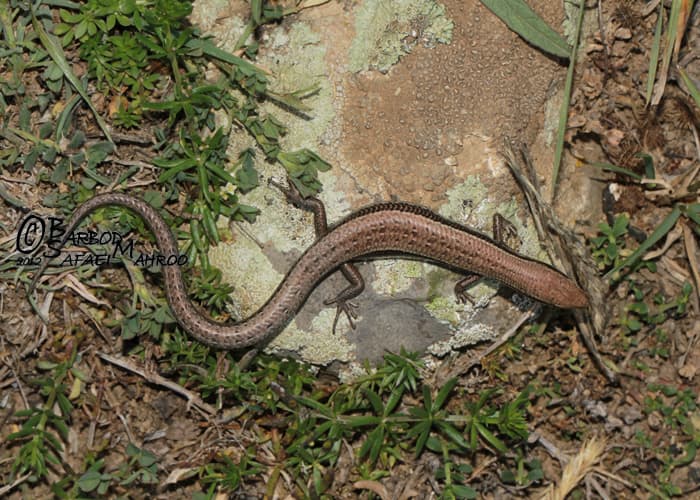
Ablepharus bivittatus
The twin-striped skink (Ablepharus bivittatus) is a species of skink found in mountainous regions of Armenia, Azerbaijan, Turkmenistan, northwestern Iran, and Turkey. It is distinguished by its habitat in high elevations, typically between 2,300 and 3,300 meters.
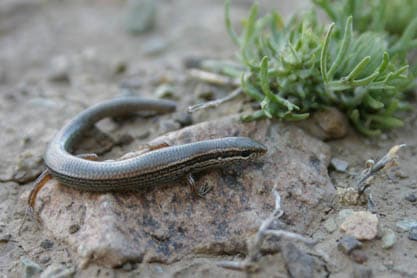
Ablepharus pannonicus
The Asian snake-eyed skink (Ablepharus pannonicus) is a species of skink native to a wide range across Asia and parts of the Middle East. It is characterized by its snake-like appearance and is found in diverse arid and semi-arid environments.

Adam's dravidogecko
Adam's dravidogecko (Dravidogecko douglasadamsi) is a species of gecko native to India. Little is documented about its specific characteristics, habitat, or behaviors, making it a relatively understudied species.