
Aspidoscelis uniparens
The desert grassland whiptail lizard (Aspidoscelis uniparens) is an all-female reptile native to North America, known for its unique parthenogenetic reproduction. These slender lizards are characterized by six yellowish lines running the length of their olive or brown bodies, which fade to a blue or gray tail. They inhabit desert grasslands and low valleys in Arizona, New Mexico, and northern Mexico.
Key Facts
- ›All individuals of this species are female.
- ›Reproduces asexually through parthenogenesis, creating clones of the mother.
- ›Ovulation is stimulated by female-female courtship and mating rituals (pseudo-copulation).
- ›Characterized by six yellowish longitudinal stripes on an olive or brown body.
- ›Inhabits desert grasslands, low valleys, and slight slopes in North America.
- ›Diet consists primarily of termites, ants, beetles, and other insects.

Desert Grassland Whiptail Lizard
Arizona, New Mexico, Northern Mexico
- Relatively Small Reptile, Size Ranging From 7.0 To 13.3 cm .
- Long and Slim Body With A Thin Tail That Is Longer Than the Body.
- Distinctive Feature: Six Yellowish Lines Running the Length of the Body.
- Body Coloration Is Typically Olive Or Brown, Fading To A Faint Blue Or Gray On the Tail.
- Adolescents Have A Very Bright and Vibrant Blue Tail.
- Bodies Have Small, Coarse Scales That Gradually Enlarge Towards the Tail.
- Belly Scales Are Much Larger and Smoother Than Body Scales.
Termites, Queen Ants, Beetles, Unidentified Insects, Grasshoppers, Butterflies
- Reproduces By Parthenogenesis .
- Undergoes Ovulation Enhanced By Female-Female Courtship and Mating Rituals .
- Uses Ambush and Stalk Hunting Tactics.
- Found In Low Valleys, Grasslands, and Slight Slopes.
Leopard Lizard
Overgrazing, Developed Areas, Livestock
About Aspidoscelis uniparens
Aspidoscelis uniparens: The Desert Grassland Whiptail Lizard
The desert grassland whiptail lizard, scientifically known as Aspidoscelis uniparens, is a fascinating reptile native to North America, distinguished by its all-female population and unique method of reproduction. Formerly classified under the genus Cnemidophorus, this species now resides in the genus Aspidoscelis, which groups North American whiptail lizards.
Description and Habitat
These lizards are relatively small and slender, measuring between 7.0 to 13.3 cm (2.75 to 5.25 inches) in body length, with a tail that is notably longer than the body. A key identifying characteristic is the presence of six yellowish lines that run longitudinally along their bodies. The typical coloration is an olive or brown hue that transitions to a faint blue or gray on the tail, with juveniles exhibiting a more vibrant blue tail. Their bodies are covered in small, coarse scales, which become larger towards the tail, while the belly scales are notably larger and smoother.
Aspidoscelis uniparens is most commonly found in the desert regions of southern and central Arizona, along the Rio Grande river in New Mexico, and in the deserts of northern Mexico. They prefer habitats such as low valleys, grasslands, and gentle slopes. There is some indication that their range may be expanding, possibly due to factors like overgrazing, though they are less common in developed areas or where livestock are present.
Reproduction and Genetics
A remarkable trait of the desert grassland whiptail lizard is its reproductive strategy: parthenogenesis. This means that the females reproduce asexually, with their eggs developing into new individuals without the need for fertilization by a male. The process involves a doubling of chromosomes after meiosis, resulting in offspring that are genetic clones of their mother. Interestingly, while reproduction is asexual, ovulation and the reproductive cycle are stimulated by pseudo-copulation, where females engage in courtship and mating behaviors that mimic those of sexually reproducing species. This ritualistic behavior, driven by hormonal changes, is crucial for enhancing ovulation. The species is believed to have originated from a hybridization event between two bisexual species, Aspidoscelis inornata and Aspidoscelis burti, leading to a triploid unisexual lineage.
Source: Wikipedia ↗
Frequently Asked Questions
How do desert grassland whiptail lizards reproduce?
Desert grassland whiptail lizards reproduce through parthenogenesis, a process where eggs develop without fertilization. This means they are clones of their mother. Ovulation is enhanced by female-female courtship and mating rituals, mimicking sexual behavior.
What do desert grassland whiptail lizards eat?
Their diet primarily consists of insects found by digging, such as termites, queen ants, and beetles. They also consume some above-ground prey like grasshoppers and butterflies.
What are the distinguishing physical features of this lizard?
These lizards are slender with a tail longer than their body. They are recognized by six yellowish lines running the length of their bodies. Their coloration is typically olive or brown, fading to a faint blue or gray on the tail, which is brighter blue in juveniles.
Where are desert grassland whiptail lizards found?
They are primarily found in the deserts of southern to central Arizona and along the Rio Grande river in New Mexico. Their range also extends into the deserts of northern Mexico.
What is the origin of the desert grassland whiptail lizard?
This species is believed to have originated from a hybridization event between two bisexual species, Aspidoscelis inornata and Aspidoscelis burti. This resulted in a unisexual lineage that reproduces asexually.
Are there male desert grassland whiptail lizards?
No, all known individuals of the desert grassland whiptail lizard are female. No male lizards have ever been discovered within this species.
Related Lizards

Desert grassland whiptail
The desert grassland whiptail lizard is a small, all-female reptile native to North America, characterized by its long, slim body and six yellowish stripes running the length of its olive-brown form. Reproducing through a unique form of parthenogenesis, these lizards are found in arid and semi-arid environments like deserts and grasslands in Arizona, New Mexico, and northern Mexico. Their diet primarily consists of insects, which they often forage for by digging.
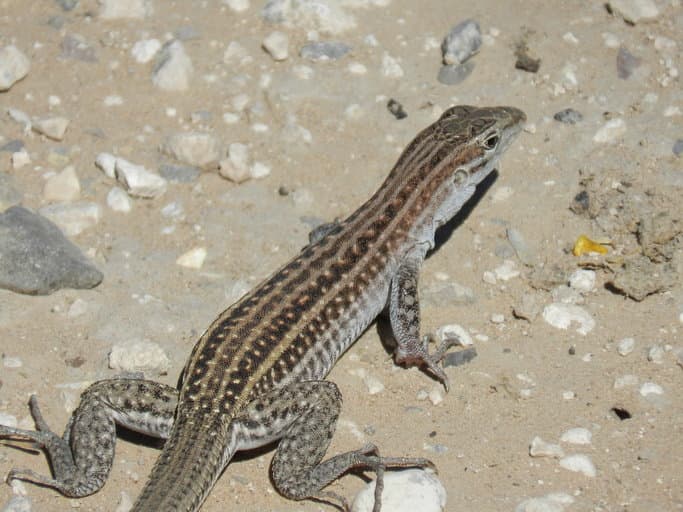
Aspidoscelis exsanguis
The Chihuahuan spotted whiptail (Aspidoscelis exsanguis) is a parthenogenetic lizard native to arid regions of the southwestern United States and northern Mexico. It is characterized by its reddish-brown coloration, six lighter stripes running the length of its body with spotting in between, and a slender build with a long tail. This diurnal and insectivorous species inhabits various dry environments, including deserts and woodlands.
Chihuahuan spotted whiptail
The Chihuahuan spotted whiptail is a parthenogenetic lizard native to arid regions of the southwestern United States and northern Mexico. It is characterized by its reddish-brown coloration, six lighter stripes, and a slender body with a very long tail. This diurnal and insectivorous species inhabits a variety of dry environments, including deserts and woodlands.