
Aspidoscelis exsanguis
Not threatened·Parthenogenetic (asexual reproduction)
The Chihuahuan spotted whiptail (Aspidoscelis exsanguis) is a parthenogenetic lizard native to arid regions of the southwestern United States and northern Mexico. It is characterized by its reddish-brown coloration, six lighter stripes running the length of its body with spotting in between, and a slender build with a long tail. This diurnal and insectivorous species inhabits various dry environments, including deserts and woodlands.
Key Facts
- ›Native to southern Arizona, New Mexico, Texas, and northern Mexico.
- ›Believed to be a hybrid species resulting from extensive hybridization.
- ›Parthenogenetic, meaning it reproduces asexually.
- ›Typically reddish-brown with six lighter stripes and spotting.
- ›Diurnal and insectivorous, feeding on insects.
- ›Inhabits arid habitats like deserts, grasslands, and woodlands.
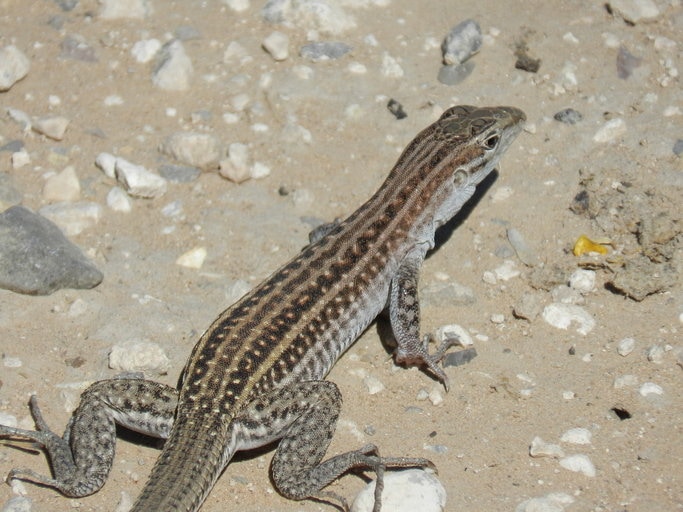
Chihuahuan Spotted Whiptail
United States, Mexico
- Length Ranges From 9.5 To 12 Inches.
- Typically Reddish-Brown In Color.
- Features Six Lighter Colored Stripes Running the Length of the Body.
- Has Spotting Between the Stripes.
- Underside Is White Or Sometimes Pale Blue.
- Slender-Bodied.
- Tail Is Nearly Three Times Its Body Length.
Insects
Diurnal, Insectivorous, Digs Holes To Lay Eggs
About Aspidoscelis exsanguis
The Chihuahuan Spotted Whiptail (Aspidoscelis exsanguis)
The Chihuahuan spotted whiptail, scientifically known as Aspidoscelis exsanguis, is a fascinating lizard species native to the arid landscapes of the southwestern United States and northern Mexico. Its range includes southern Arizona, New Mexico, and Texas, as well as the northern Mexican states of Chihuahua and Sonora. This species is notable for being parthenogenetic, a form of asexual reproduction where females produce offspring without fertilization.
Description and Habitat
Adult Chihuahuan spotted whiptails typically measure between 9.5 and 12 inches in total length. They are characterized by a reddish-brown body adorned with six lighter stripes that extend along their entire length, with distinct spotting between these stripes. Their undersides are usually white, though sometimes a pale blue. The lizard possesses a slender build and a tail that is remarkably long, often nearly three times the length of its body.
This species thrives in a variety of mostly arid habitats. These include desert environments, desert grasslands, dry basin forests, and woodlands dominated by oak, pine, and juniper. They are commonly found in washes and canyons within these regions, where they also dig burrows to lay their eggs.
Biology and Conservation
The Chihuahuan spotted whiptail is diurnal, meaning it is active during daylight hours, and insectivorous, feeding primarily on insects. Its reproductive strategy is unique, as it is one of many lizard species known to reproduce parthenogenetically. The species is not currently considered threatened, indicating healthy populations within its natural range.
Source: Wikipedia ↗
Frequently Asked Questions
What is the scientific name for the Chihuahuan spotted whiptail?
The scientific name for the Chihuahuan spotted whiptail is Aspidoscelis exsanguis. This binomial nomenclature is used by scientists to classify the species and differentiate it from others.
What does the Chihuahuan spotted whiptail eat?
The Chihuahuan spotted whiptail is insectivorous, meaning its diet primarily consists of insects. As a diurnal species, it actively hunts for its prey during the day.
Where does the Chihuahuan spotted whiptail live?
This lizard is found in arid environments across the southwestern United States, including parts of Arizona, New Mexico, and Texas, as well as in northern Mexico, specifically in Chihuahua and Sonora. It prefers habitats such as deserts, desert grasslands, and dry woodlands.
What are the physical characteristics of the Chihuahuan spotted whiptail?
The Chihuahuan spotted whiptail typically measures between 9.5 and 12 inches in length. Its coloration is usually reddish-brown, marked by six lighter stripes running along its body with spotting between them. It has a slender build and a tail that is nearly three times its body length, with a white or pale blue underside.
How does the Chihuahuan spotted whiptail reproduce?
Aspidoscelis exsanguis is a parthenogenetic species. This means that females reproduce without fertilization from a male, a process known as asexual reproduction. They dig holes to lay their eggs.
Is the Chihuahuan spotted whiptail endangered?
No, the Chihuahuan spotted whiptail is not considered a threatened species. Its populations are stable enough that it does not currently face conservation concerns.
Related Lizards
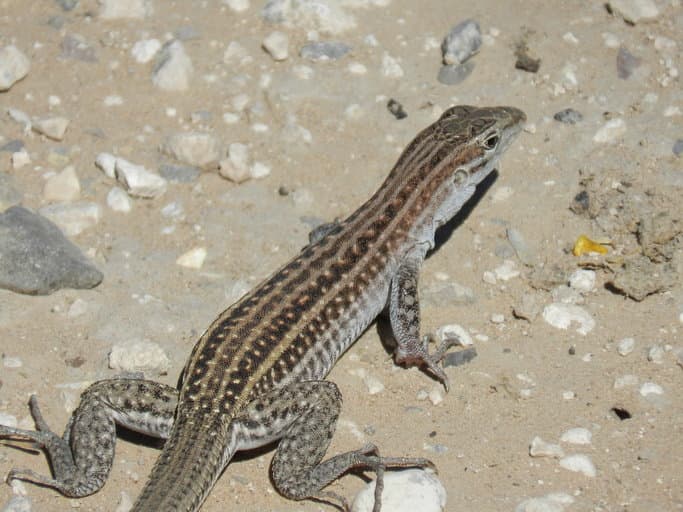
Chihuahuan spotted whiptail
The Chihuahuan spotted whiptail is a parthenogenetic lizard native to arid regions of the southwestern United States and northern Mexico. It is characterized by its reddish-brown coloration, six lighter stripes, and a slender body with a very long tail. This diurnal and insectivorous species inhabits a variety of dry environments, including deserts and woodlands.

Aspidoscelis uniparens
The desert grassland whiptail lizard (Aspidoscelis uniparens) is an all-female reptile native to North America, known for its unique parthenogenetic reproduction. These slender lizards are characterized by six yellowish lines running the length of their olive or brown bodies, which fade to a blue or gray tail. They inhabit desert grasslands and low valleys in Arizona, New Mexico, and northern Mexico.

Heloderma suspectum
The Gila monster (Heloderma suspectum) is a venomous lizard native to the Southwestern United States and northwestern Mexico. Known for its heavy, slow-moving nature and striking black and pink or yellow coloration, it is the only venomous lizard in the United States. Despite its fearsome reputation and potent venom, it is generally not dangerous to humans and is protected by state law.