
Blanford's rock lizard (Psammophilus blanfordanus)
Blanford's rock lizard (Psammophilus blanfordanus) is a species of agamid lizard found in Peninsular India, primarily east of its relative, P. dorsalis. This species is distinguished by physical features like a deeper fold on the front of the humerus and scale characteristics. Males exhibit striking scarlet or red coloration on their heads and anterior bodies during the breeding season.
Key Facts
- ›Endemic to Peninsular India.
- ›Males develop scarlet or red heads during the breeding season.
- ›Found mainly on rocks and hills.
- ›Diet primarily consists of insects.
- ›Reproduction is oviparous (egg-laying).
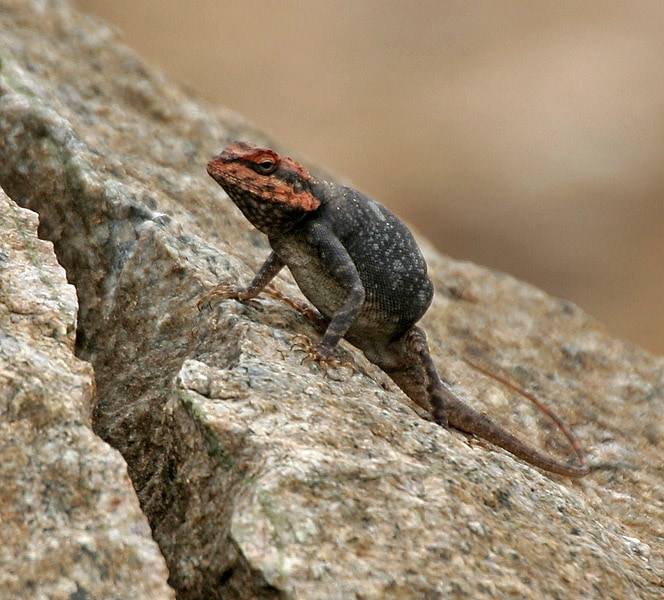
Blanford's Rock Agama
Peninsular India, Chota Nagpur, Madhya Pradesh, Eastern Ghats, Travancore
- Has A Deeper Fold On the Front of the Humerus Compared To P. Dorsalis.
- Scales On the Body Are Slightly Larger, Numbering 80-100 Around the Middle.
- Dorsal Scales Are Keeled and Imbricated.
- Hind Leg, When Stretched Forward, Reaches Or Extends Beyond the Eye.
- May Have A Small Spine Behind the Edge of the Brow-Ridge.
- A Few Enlarged Scales Are Scattered On the Sides.
- Young Lizards Are Olive-Brown Above, Spotted Or Marbled With Brown.
- Young Lizards Often Have Large, Lozenge-Shaped, Dark Brown Spots With Pale Centers On the Back and Tail.
- Adult Males In Breeding Season Have Scarlet Or Red Heads and Anterior Bodies, With Posterior Parts Nearly Black.
- Females Are Slightly Smaller Than Males.
Insects
- Spends Most of Its Time Resting Or Basking Under the Sun.
- Rests Inside Water Holes To Decrease Body Temperature When Excess Heat Is Experienced.
- Males Display By Head Nodding.
About Blanford's rock lizard (Psammophilus blanfordanus)
Blanford's Rock Lizard
Blanford's rock lizard, scientifically classified as Psammophilus blanfordanus, is a species of lizard belonging to the Agamidae family. This species is endemic to the Indian subcontinent, with its natural range predominantly located in Peninsular India. It is one of two species within the Psammophilus genus and is primarily found to the east of the distribution of its close relative, Psammophilus dorsalis.
Physical Characteristics
While closely resembling P. dorsalis, P. blanfordanus can be differentiated by several features. It possesses a deeper fold on the front of its humerus and has slightly larger scales around the middle of its body, typically numbering between 80 and 100. The scales along its back are described as keeled and imbricated. A diagnostic trait is that when the hind leg is extended forward along the body, it usually reaches or surpasses the eye. Some individuals may also exhibit a small spine behind the edge of the brow-ridge and scattered enlarged scales on their sides.
Juvenile Blanford's rock lizards are typically olive-brown above, marked with brown spots or marbling, similar to adult females. However, young specimens often display a series of large, dark brown, lozenge-shaped spots with pale centers along their backs and tails. The adult male undergoes a dramatic transformation during the breeding season; its head and the anterior portion of its body become a striking scarlet or red hue, contrasting with the nearly black posterior parts. Females are generally smaller than males.
Habitat and Behavior
Blanford's rock lizards are predominantly found on rocky terrains and hills. They are often observed resting or basking in the sun to regulate their body temperature. When exposed to excessive heat, they seek refuge in water sources to cool down. Males are known to engage in display behaviors, including head nodding.
Diet and Reproduction
The diet of P. blanfordanus consists mainly of insects, marking it as an insectivore. The species is oviparous, meaning it reproduces by laying eggs. The typical size of an adult Blanford's rock lizard is approximately 10 cm (3.9 inches) in snout-to-vent length, with a tail that can be as long as 20 cm (7.9 inches).
Distribution and Etymology
This species is common on many hills across regions such as Chota Nagpur, extending as high as Parasnath Hill, and through Madhya Pradesh. Its range continues south along the Godavari Districts and the hills of the Eastern Ghats. The southernmost recorded specimen was collected in Talayar, Travancore, at a significant elevation. Both the common name, Blanford's rock agama, and the specific epithet, blanfordanus, honor the English naturalist William Thomas Blanford, who was a member of the Geological Survey of India.
Source: Wikipedia ↗
Frequently Asked Questions
What is Blanford's rock lizard?
Blanford's rock lizard, scientifically known as Psammophilus blanfordanus, is a species of lizard belonging to the Agamidae family. It is native to Peninsular India and is known for its distinctive appearance, especially in males during the breeding season.
Where is Blanford's rock lizard found?
This species is endemic to Peninsular India. Its distribution includes areas like Chota Nagpur, Madhya Pradesh, and the hills of the Eastern Ghats, extending south to Travancore.
What does Blanford's rock lizard eat?
The diet of Blanford's rock lizard is primarily composed of insects. They are insectivorous by nature.
How does Blanford's rock lizard reproduce?
Blanford's rock lizard is oviparous, meaning it reproduces by laying eggs.
What are the distinguishing features of Blanford's rock lizard?
Key distinguishing features include a deeper fold on the front of the humerus and slightly larger scales compared to related species. Adult males in the breeding season display a scarlet or red coloration on their heads and the anterior part of their bodies.
What is the typical behavior of Blanford's rock lizard?
These lizards spend much of their time resting or basking in the sun. If they experience excess heat, they may retreat into water holes to regulate their body temperature.
Related Lizards

Ablepharus
Ablepharus, commonly known as snake-eyed skinks, are small lizards distinguished by fused eyelids that prevent blinking, similar to snakes. They inhabit dry fields, hills, and rocky areas, often concealed within leaf litter. These skinks possess shiny, bronze scales and a characteristic dark stripe along their sides, feeding primarily on small insects and mollusks.
Blanford's rock agama
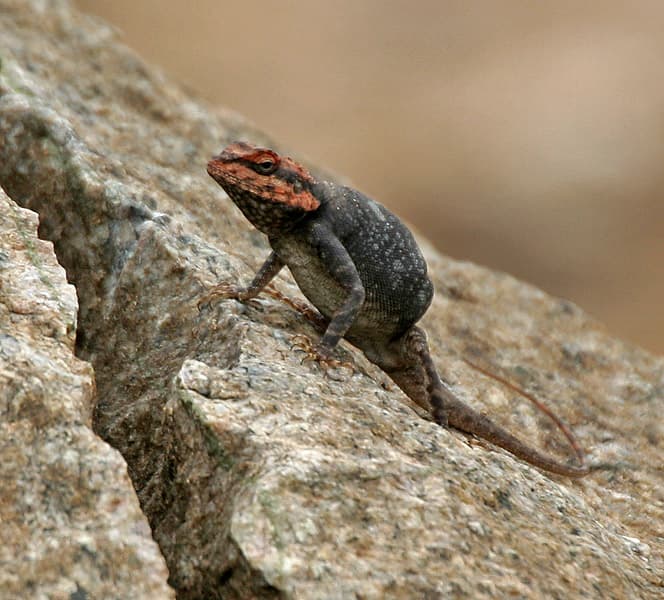
Blanford's rock agama is a species of lizard endemic to Peninsular India, easily recognized by its distinct coloration during the breeding season. Males develop a scarlet or red head and anterior body, while the rest of their body turns nearly black. This species primarily inhabits rocky areas and is known for its insectivorous diet and oviparous reproduction.

Southern Ghats slender gecko
The Southern Ghats slender gecko is a small gecko species found in the hills of southern India, characterized by its slender body and distinctive dark-brown undulating lines on its back. It inhabits rocky areas at higher elevations. Its coloration provides camouflage against its natural surroundings.