
Bronze mabuya
The bronze grass skink, also known as the bronze mabuya or speckled forest skink, is a common but shy, ground-dwelling lizard found across South and Southeast Asia. It inhabits various environments including forests, grasslands, and rocky areas, and is characterized by its cylindrical body, keeled dorsal scales, and distinctive dorso-lateral bands. This skink is an insectivore, active both day and night, and plays a role in its ecosystem by consuming invertebrates.
Key Facts
- ›Found in South and Southeast Asia, including India, Thailand, and Vietnam.
- ›Inhabits diverse environments such as forests, grasslands, and rocky areas.
- ›Feeds primarily on insects and other invertebrates.
- ›Active both during the day and at night.
- ›Females lay clutches of three to six eggs.
- ›Possesses a specialized group of scales above the ankle to house chigger mites.
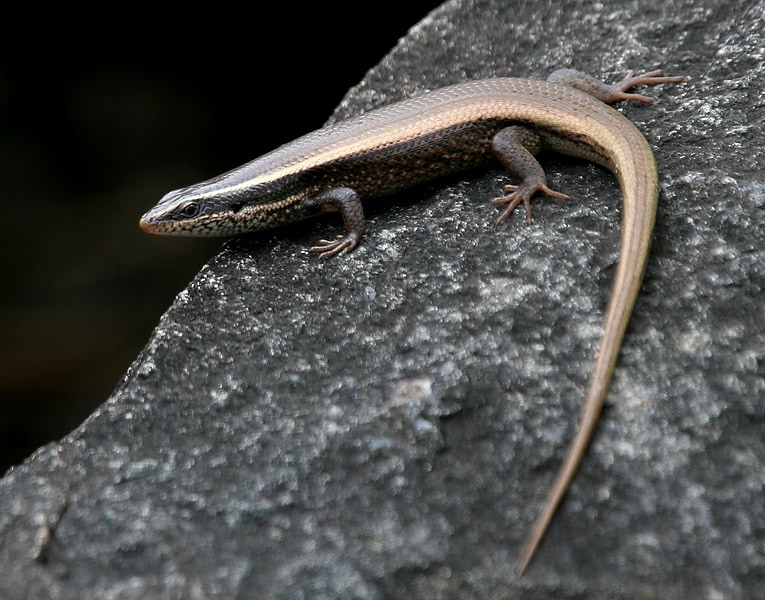
Bronze Grass Skink, Speckled Forest Skink
Bangladesh, Bhutan, Cambodia, India, Laos, Malaysia, Myanmar, Nepal, Pakistan, Sri Lanka, Thailand, Vietnam
- Cylindrical Body
- Dorsal Scales With 5–8 Keels
- Smooth Ventral Scales
- Dorso-Lateral Bands Extending From Above the Eye To the Base of the Tail
- Short, Obtusely Keeled and Acuminate Snout
- Scaly Lower Eyelid
- Oval Ear-Opening
- Scales Have Five To Seven Sharp Keels
- 26 To 30 Scales Around the Middle of the Body
- Adpressed Limbs Meet Or Overlap
- Short Digits With Smooth Lamellae
- Tail Is 1.25 To 1.75 Times the Length of the Head and Body
- Coloration Ranges From Brown Or Olive-Brown Above, With Darker Sides Often Featuring White, Black-Edged Spots
- Back Can Be Uniform, Black-Spotted, Or Have One Or Two Black Longitudinal Lines
- Underparts Are Yellowish In Preserved Specimens
- Deep-Brown, Olive, Or Bronze-Brown Overall Color
- Dorso-Lateral Bands Are Light Or Yellow
- May Have Black Spots On the Base of the Tail
- Breeding Males Exhibit Orange Coloration On the Lateral Sides of the Body
- Juveniles Are Grey With A Bronze Head
- Specialized Group of Scales On the Leg Above the Ankle Forming A Chigger-Mite Refuge
Insects, Other Invertebrates
- Shy
- Ground-Dwelling
- Active Both Day and Night
- Hides In Holes In the Ground, Crevices, and Under Rocks
- Strictly Terrestrial
About Bronze mabuya
The bronze mabuya, scientifically identified as Eutropis macularia, is a species of skink native to South and Southeast Asia. It is commonly known by other names such as the bronze grass skink or speckled forest skink. This lizard is characterized by its shy, ground-dwelling nature and is notable for being active during both daylight and nighttime hours.
Physical Characteristics
The bronze mabuya possesses a cylindrical body with dorsal scales that are keeled, featuring five to eight keels, while its ventral scales are smooth. Distinctive dorso-lateral bands begin above the eye and extend towards the tail's base. Its snout is short and obtusely keeled, and the lower eyelid is scaly. The coloration varies, but typically it is brown or olive-brown above, with darker sides that often display white, black-edged spots. The back may be uniform or marked with black spots or longitudinal lines, and the underparts are usually yellowish. Breeding males develop an orange hue on their lateral sides, and juveniles are grey with a bronze-colored head. A unique anatomical feature is a specialized group of scales located on the leg just above the ankle, which serves as a refuge for chigger mites.
Distribution and Habitat
This skink is found across a broad geographical area, including Bangladesh, Bhutan, Cambodia, India, Laos, northwestern Malaysia, Myanmar, Nepal, Pakistan, Sri Lanka, Thailand, and Vietnam. Its habitat preferences are diverse, encompassing deciduous and evergreen forests, plantations, grasslands, and rocky terrains with scattered trees. It is often found among leaf litter and can inhabit areas up to approximately 1,500 meters (5,000 feet) in altitude.
Ecology and Behavior
The bronze mabuya is a terrestrial reptile that primarily feeds on insects and other invertebrates. It exhibits a shy disposition and seeks shelter in ground holes, rock crevices, and beneath stones. The species reproduces by laying eggs, with females typically producing clutches of three to six eggs per year. Studies indicate its presence in various man-made and natural environments, favoring areas with dense canopy, abundant leaf litter, and thick shrubbery.
Size
While the maximum recorded length for the bronze mabuya is around 23 cm (9 inches), a more common total length is approximately 16 cm (6 inches). The snout-to-vent length usually measures about 7 cm (2.8 inches).
Source: Wikipedia ↗
Frequently Asked Questions
What is the bronze grass skink?
The bronze grass skink, scientifically known as Eutropis macularia, is a species of skink native to South and Southeast Asia. It is recognized for its ground-dwelling nature, shy disposition, and activity during both day and night.
Where can the bronze grass skink be found?
This skink has a wide distribution across South and Southeast Asia. Its range includes countries such as Bangladesh, India, Nepal, Sri Lanka, Thailand, Vietnam, and parts of Malaysia.
What kind of habitat does the bronze grass skink prefer?
The bronze grass skink thrives in a variety of habitats. These include deciduous and evergreen forests, plantations, grasslands, and rocky areas with scattered trees, often found among leaf litter or in crevices.
What does the bronze grass skink eat?
Like other skinks, the bronze grass skink is an insectivore. Its diet consists mainly of insects and other small invertebrates found within its habitat.
How large can a bronze grass skink get?
The maximum recorded length for a bronze grass skink is about 23 cm (9 inches), but more commonly, they reach around 16 cm (6 inches) in total length. The snout-to-vent length is typically around 7 cm (2.8 inches).
How does the bronze grass skink reproduce?
Females of this species lay several small clutches of eggs each year. Each clutch typically contains between three to six eggs.
Are there any unique physical features of the bronze grass skink?
Yes, the bronze grass skink has a cylindrical body with keeled dorsal scales and smooth ventral scales. Notably, there is a specialized group of scales located on the leg just above the ankle, which forms a refuge for chigger mites.
Related Lizards
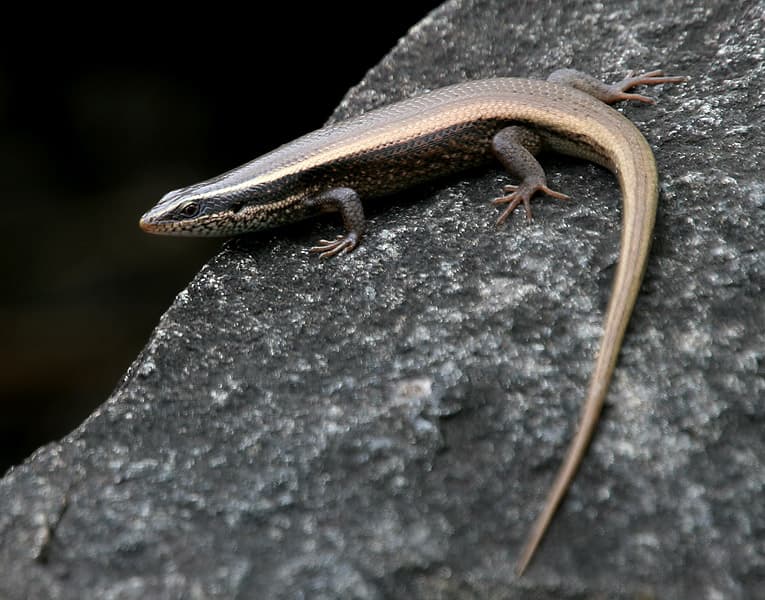
Eutropis macularia
The bronze grass skink (Eutropis macularia) is a common, ground-dwelling lizard found across South and Southeast Asia. It is characterized by its keeled dorsal scales, a cylindrical body, and distinctive dorso-lateral bands. This shy species inhabits a variety of environments, including forests, grasslands, and rocky areas, and is active during both day and night.
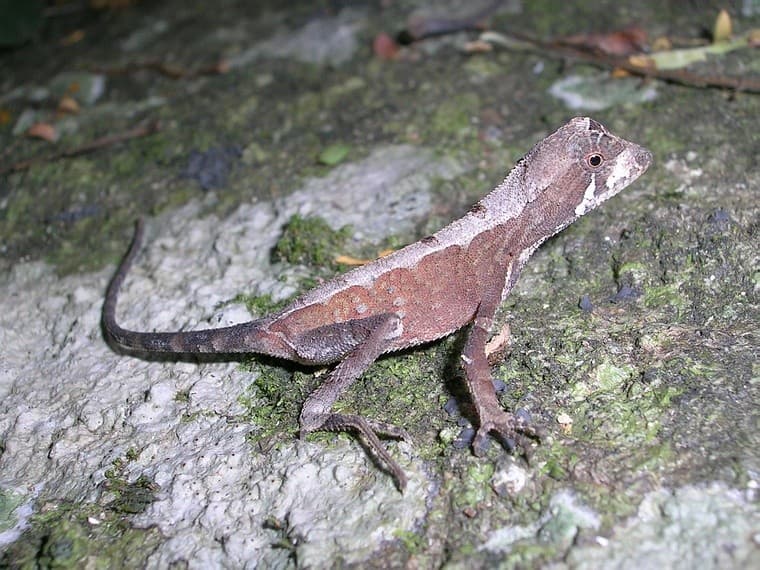
Indian kangaroo lizard
The Indian kangaroo lizard, scientifically known as Agasthyagama beddomii, is an insectivorous lizard endemic to the Western Ghats of South India. It is characterized by its habit of running on its hind legs with its body held upright, a behavior that gives it its common name. This diurnal species prefers moist leaf litter on the forest floor but can also be found on low vegetation.
Mabuya macularia
The bronze grass skink, also known as the bronze mabuya or speckled forest skink, is a common and shy lizard found across South and Southeast Asia. This ground-dwelling species is distinguished by its cylindrical body, keeled dorsal scales, and a distinctive pair of light dorso-lateral bands. It inhabits a variety of environments, including forests, grasslands, and rocky areas, and feeds primarily on insects and other invertebrates.