
Brookesia confidens
Brookesia confidens, also known as the leaf chameleon, is one of the world's smallest chameleon species, endemic to the Ankarana Nature Reserve in northern Madagascar. Discovered in 2012, this tiny reptile is comparable in size to a wedding ring and shares striking resemblances with several other small Brookesia species.
Key Facts
- ›One of the world's smallest chameleon species.
- ›Found exclusively in the Ankarana Nature Reserve in northern Madagascar.
- ›First described in 2012 by Glaw, Koehler, Townsend, and Vences.
- ›Adult size is comparable to a wedding ring.
- ›Males have a snout-vent length of 18.3-20.1 mm, females slightly larger at 20.6-22.6 mm.
- ›Looks very similar to Brookesia desperata, Brookesia micra, and Brookesia tristis.

Leaf Chameleon
Madagascar
- One of the World's Smallest Chameleons.
- Smaller Than Half of A Human Finger.
- Roughly the Size of A Wedding Ring.
- Males Snout-Vent Length: 18.3–20.1 mm .
- Males Total Length: 29.2–34.2 mm .
- Females Are Slightly Larger Than Males.
- Females Snout-Vent Length: 20.6–22.6 mm .
- Females Total Length: 32.5–36.2 mm .
- Looks Identical To Brookesia Desperata, Brookesia Micra, and Brookesia Tristis.
About Brookesia confidens
Brookesia confidens: The Leaf Chameleon
Brookesia confidens, commonly referred to as the leaf chameleon, holds the distinction of being one of the world's smallest chameleon species. This diminutive reptile is exclusively found within the Ankarana Nature Reserve, also known as Ankarana National Park, situated in the northern region of Madagascar. Its discovery and formal description occurred in 2012 by researchers F. Glaw, J. Koehler, T.M. Townsend, and M. Vences.
Physical Characteristics and Size
The leaf chameleon is remarkably tiny, measuring less than half the length of a human finger and often compared in size to a wedding ring. Males exhibit a snout-to-vent length ranging from 18.3 to 20.1 millimeters (0.72 to 0.79 inches), with a total length of 29.2 to 34.2 millimeters (1.15 to 1.35 inches). Females are slightly larger, possessing a snout-to-vent length between 20.6 and 22.6 millimeters (0.81 to 0.89 inches) and a total length of 32.5 to 36.2 millimeters (1.28 to 1.43 inches). A notable characteristic is its strong resemblance to several other small Brookesia species, including Brookesia desperata, Brookesia micra, and Brookesia tristis, making visual identification challenging without close examination.
Habitat and Conservation
Brookesia confidens is endemic to the Ankarana Nature Reserve, a protected area that provides a relatively secure environment for the species. The current level of habitat protection within the reserve suggests that significant habitat destruction impacting this chameleon is minimal. This well-preserved habitat is crucial for the survival of such a specialized and small species.
Source: Wikipedia ↗
Frequently Asked Questions
What is the common name for Brookesia confidens?
Brookesia confidens is commonly known as the leaf chameleon. This name likely refers to its small size and potential camouflage among leaf litter.
Where is Brookesia confidens found?
This species is endemic to the Ankarana Nature Reserve, also known as Ankarana National Park, located in northern Madagascar. The reserve is well-protected, which is beneficial for the species' survival.
How small is Brookesia confidens?
Brookesia confidens is exceptionally small, measuring less than half of a human finger. Its size is often compared to that of a wedding ring, making it one of the smallest chameleons globally.
When was Brookesia confidens first described?
The species was first formally described in 2012 by a team of researchers including F. Glaw, J. Koehler, T.M. Townsend, and M. Vences.
Are there other similar-looking species?
Yes, Brookesia confidens looks identical to Brookesia desperata, Brookesia micra, and Brookesia tristis. It is also the sister taxon to Brookesia tuberculata.
Related Lizards

Brookesia bonsi
Brookesia bonsi is a critically endangered species of chameleon endemic to the humid parts of Namoroka National Park in northern Madagascar. This small lizard is known for its restricted geographic range and declining habitat. It belongs to the family Chamaeleonidae and was first described in 1980.
Ablepharus bivittatus
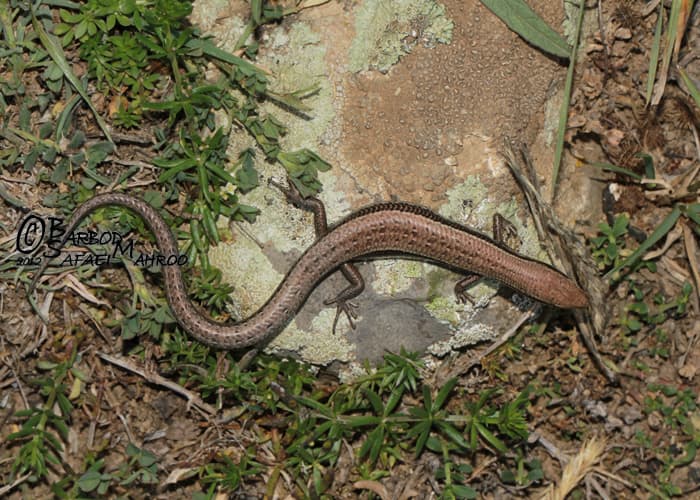
The twin-striped skink (Ablepharus bivittatus) is a species of skink found in mountainous regions of Armenia, Azerbaijan, Turkmenistan, northwestern Iran, and Turkey. It is distinguished by its habitat in high elevations, typically between 2,300 and 3,300 meters.
Ablepharus pannonicus
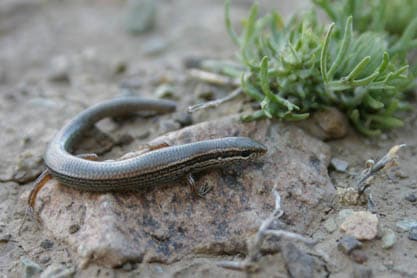
The Asian snake-eyed skink (Ablepharus pannonicus) is a species of skink native to a wide range across Asia and parts of the Middle East. It is characterized by its snake-like appearance and is found in diverse arid and semi-arid environments.