
Calumma jejy
Calumma jejy, also known as the Marojejy Peak chameleon, is a species of chameleon endemic to Madagascar. Information regarding its specific characteristics, habitat, and behavior is limited in available records.
Key Facts
- ›Found exclusively in Madagascar.
- ›Also referred to as the Marojejy Peak chameleon.
- ›Information on its biology is scarce.
- ›Its occurrence is tied to the Marojejy region.

Marojejy Peak Chameleon
Madagascar
A Species of Chameleon.
About Calumma jejy
Calumma jejy is a species of chameleon native to the island of Madagascar. It is also commonly referred to by its descriptive common name, the Marojejy Peak chameleon, which suggests a specific regional association within Madagascar.
Known Information
While recognized as a distinct species within the chameleon family, detailed biological and ecological information about Calumma jejy is not extensively documented. Its classification as a chameleon places it within a group known for their unique physical adaptations, such as independently moving eyes, prehensile tails, and the ability to change skin color. However, specific traits, behaviors, and ecological roles attributed to Calumma jejy remain largely unelaborated upon in available records. The species' distribution appears to be confined to Madagascar, with its common name pointing towards a potential habitat in the Marojejy mountainous area.
Source: Wikipedia ↗
Frequently Asked Questions
What is Calumma jejy?
Calumma jejy is a species of chameleon. It is also commonly known as the Marojejy Peak chameleon.
Where is Calumma jejy found?
This chameleon species is found in Madagascar. Its presence is specifically linked to the Marojejy region.
What are the distinctive features of Calumma jejy?
Detailed physical descriptions and distinctive features of Calumma jejy are not widely documented. It is recognized as a chameleon species native to Madagascar.
What is the habitat of Calumma jejy?
While precise habitat details are limited, its common name, Marojejy Peak chameleon, suggests an association with the Marojejy region of Madagascar.
Related Lizards
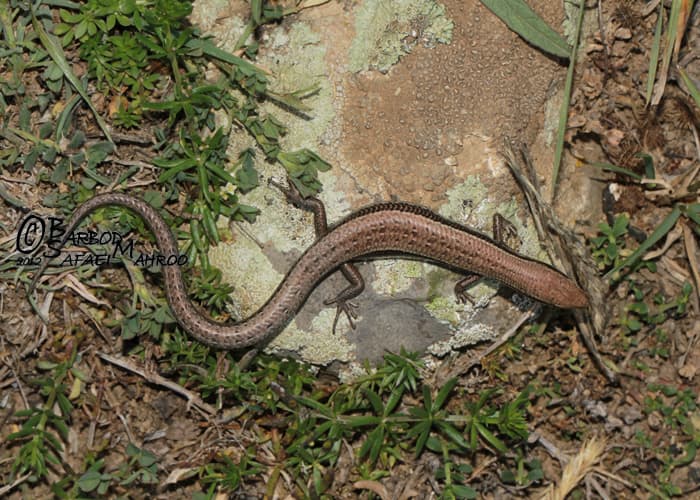
Ablepharus bivittatus
The twin-striped skink (Ablepharus bivittatus) is a species of skink found in mountainous regions of Armenia, Azerbaijan, Turkmenistan, northwestern Iran, and Turkey. It is distinguished by its habitat in high elevations, typically between 2,300 and 3,300 meters.

Anamalay gecko
The Anamalay gecko is a species of gecko native to the South Indian hills of Palni, Anamalai, and Tirunelveli. This species belongs to the genus Dravidogecko, which was re-established in 2019 based on molecular phylogenetic studies indicating a distinct evolutionary origin from other Hemidactylus species. Its natural habitat is within the mountainous regions of its distribution.

Deccan banded gecko
The Deccan banded gecko (Cyrtodactylus albofasciatus) is a species of gecko found exclusively in the Western Ghats of India. It was previously considered a synonym of another species but was re-established as distinct in 2004. Information regarding its specific physical characteristics, diet, and behavior is limited in available records.