
Cnemaspis kandiana
Oviparous (egg-laying), inferred from typical gecko reproduction.
The Kandyan day gecko, scientifically known as Cnemaspis kandiana, is a diurnal gecko species native to Sri Lanka. It is characterized by its elongated head, slender body and limbs, and small, keeled scales interspersed with spine-like tubercles. This small lizard inhabits mountainous regions, often found in rocky areas.
Key Facts
- ›Native to the mountains of Kandy, Sri Lanka.
- ›Has an elongated head with an obtusely pointed snout.
- ›Body and limbs are slender, with hind limbs reaching the axilla or shoulder.
- ›Covered in small, keeled granules and scattered, small, keeled tubercles.
- ›Males possess preanal and femoral pores.
- ›Brown coloration above, variegated with darker and lighter markings, often forming transverse patterns.

Kandyan Day Gecko, Kandyan Rock Gecko
Sri Lanka
- Head Is Rather Elongated With An Obtusely Pointed Snout, Longer Than the Distance Between the Eye and the Ear Opening.
- Forehead Is Not Concave; Ear Opening Is Small and Oval.
- Body and Limbs Are Rather Slender; Hind Limbs Reach the Axilla Or Shoulder.
- Digits Are Slender With Enlarged Plates Beneath.
- Snout Covered With Suboval Keeled Granules; Rest of Head Minutely Granulate.
- Rostral Scale Is Twice As Broad As Deep, With Median Emargination and Cleft Above.
- Nostrils Pierced Between the Rostral and Three Or Four Nasals.
- Seven Or Eight Upper and As Many Lower Labials.
- Mental Scale Is Large and Triangular With A Truncated Posterior Angle.
- Numerous Small Chin-Shields Pass Gradually Into Feebly Keeled Gular Granules.
- Upper Body Surface Covered With Small, More Or Less Distinctly Keeled Granules, Intermixed With Irregularly Scattered, Small, Keeled Tubercles.
- Flanks Have Small, Widely Separated, Spine-Like Tubercles.
- Scales On the Limbs Are Keeled.
- Ventral Scales Are Cycloid and Imbricated; Those Under the Neck Are Keeled, Others Smooth .
- Males Have Three Or Four Preanal Pores and Three To Five Femoral Pores On Each Side.
- Tail Is Cylindrical, Tapering, With Very Small Keeled Scales and Annuli of Spine-Like Tubercles Above, and Larger Scales Beneath, Lacking Transversely Dilated Median Plates.
- Coloration Is Brown Above, Variegated With Darker and Lighter Shades, Often Forming Transverse Markings On the Back and Tail; A Light Vertebral Band May Occur.
- Spine-Like Tubercles On the Flanks Are White.
- Lower Surfaces Are Light Brown Or Dirty White; Throat Sometimes Blackish.
- Snout To Vent Length Is 1.4 Inches .
- Tail Length Is 1.5 Inches .
Insects, Other Small Invertebrates
- Diurnal Activity Patterns.
- Likely Territorial Or Solitary, Typical of Many Small Geckos.
About Cnemaspis kandiana
Cnemaspis kandiana: The Kandyan Day Gecko
The Kandyan day gecko, scientifically classified as Cnemaspis kandiana, is a species of diurnal lizard found exclusively in Sri Lanka. Its common names, "Kandyan day gecko" and "Kandyan rock gecko," highlight its geographical origin and its active period during daylight hours. This small reptile is recognized for its distinct physical characteristics and its habitat in the mountainous regions of Kandy.
Description and Appearance
Cnemaspis kandiana possesses an elongated head with a somewhat pointed snout, which is longer than the distance from its eye to its ear opening. The body and limbs are notably slender, with the hind limbs extending to the axilla or shoulder. The gecko's skin is covered in small, keeled granules, interspersed with scattered, smaller keeled tubercles, particularly on the upper surfaces. The flanks are adorned with small, widely separated tubercles that have a spine-like appearance, and these are white in coloration. Scales on the limbs are also keeled. The ventral scales are cycloid and imbricated, with those beneath the neck being keeled while others are smooth. Males of the species can be identified by the presence of three to four preanal pores and three to five femoral pores on each side. The tail is cylindrical, tapering to a point, and covered with small keeled scales and annuli of spine-like tubercles above.
In terms of coloration, Cnemaspis kandiana is typically brown on its upper side, featuring variegations of darker and lighter shades. These markings often form transverse patterns across the back and tail, and occasionally a light vertebral band is present. The underside of the gecko is usually light brown or dirty white, with the throat sometimes appearing blackish.
Size and Habitat
This species is relatively small. Adult individuals measure approximately 1.4 inches (36 mm) from snout to vent, with a tail length of about 1.5 inches (38 mm). The Kandyan day gecko is found in the mountainous areas of Kandy, Sri Lanka, suggesting a preference for rocky environments within these elevated terrains.
Behavior and Diet
As a diurnal species, Cnemaspis kandiana is active during the day. While specific social structures are not detailed, it is likely that, like many small geckos, individuals may exhibit territorial behavior or be largely solitary outside of mating periods. Its diet is presumed to consist of insects and other small invertebrates, typical for geckos of its size. No information is provided regarding its lifespan or reproductive specifics such as clutch size or incubation periods in the available documentation.
Source: Wikipedia ↗
Frequently Asked Questions
What is the scientific name for the Kandyan day gecko?
The scientific name for the Kandyan day gecko is Cnemaspis kandiana. This binomial nomenclature is used to classify the species within the scientific community.
Where is the Kandyan day gecko found?
Cnemaspis kandiana is found in Sri Lanka, specifically in the mountainous regions of Kandy. Its type locality is documented as the mountains of Kandy.
What are the physical characteristics of Cnemaspis kandiana?
This gecko has an elongated head, a pointed snout, and slender body and limbs. Its body is covered in small, keeled granules and scattered, spine-like tubercles, with keeled scales on its limbs. The tail is cylindrical and tapers to a point.
What is the coloration of the Kandyan day gecko?
The upper surfaces of Cnemaspis kandiana are typically brown, with variegations of darker and lighter shades that often form transverse markings on the back and tail. The spine-like tubercles on its flanks are white, and its underside is light brown or dirty white.
Does the Kandyan day gecko have any distinguishing features in males?
Yes, male Kandyan day geckos have distinct pores. They possess three to four preanal pores and three to five femoral pores on each side of their body.
What is the size of Cnemaspis kandiana?
The Kandyan day gecko is a small species. It measures approximately 1.4 inches (36 mm) from snout to vent, with a tail length of about 1.5 inches (38 mm).
Related Lizards

Blainville's horned lizard
Blainville's horned lizard, also known as the San Diego horned lizard, is a flat-bodied lizard native to Southern California and northern Baja California, Mexico. Characterized by its distinctive spiky horns on its head and body, it typically inhabits sandy areas with low vegetation near ant hills. This species plays a crucial role in its ecosystem, primarily feeding on ants, and exhibits a unique defense mechanism of squirting blood from its eyes.

Crotaphytus collaris
The common collared lizard (Crotaphytus collaris) is a North American species known for its distinctive black bands around the neck and shoulders. Males are particularly colorful with blue-green bodies and yellow markings, while females are more muted. These lizards inhabit dry, open regions of the southwestern United States and northern Mexico, preferring rocky desert landscapes and grasslands.
Elgaria coerulia
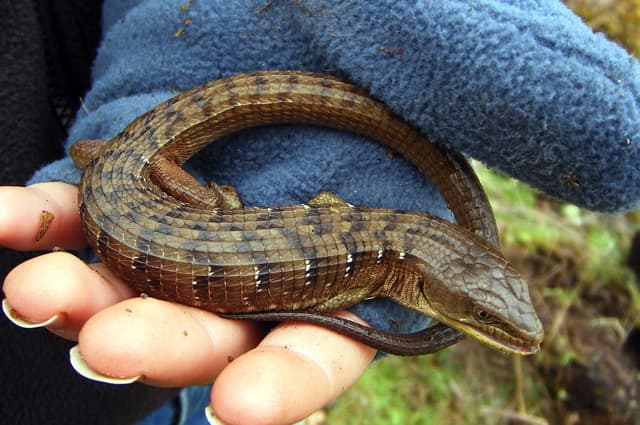
The northern alligator lizard (Elgaria coerulea) is a medium-sized, slender lizard found along the North American west coast. It is characterized by a distinct skin fold on each side and keeled scales dorsally, with smooth ventral scales. This species inhabits a variety of forested environments and can be found from sea level up to high elevations.