
Elgaria coerulia
Viviparous (live-bearing)
The northern alligator lizard (Elgaria coerulea) is a medium-sized, slender lizard found along the North American west coast. It is characterized by a distinct skin fold on each side and keeled scales dorsally, with smooth ventral scales. This species inhabits a variety of forested environments and can be found from sea level up to high elevations.
Key Facts
- ›Adults typically reach a snout-to-vent length of about 10 cm (3.9 in) and a total length of around 27.5 cm (10.8 in).
- ›They possess a distinctive lateral skin fold separating keeled dorsal scales from smooth ventral scales.
- ›The diet includes insects like crickets, slugs, beetles, spiders, and moths, with a capacity to consume small vertebrates.
- ›Northern alligator lizards are viviparous, giving birth to live young.
- ›The species undergoes brumation during winter, seeking shelter under rocks, logs, or in burrows.
- ›Subspecies include E. C. coerulea, E. C. palmeri, E. C. principis, and E. C. shastensis.
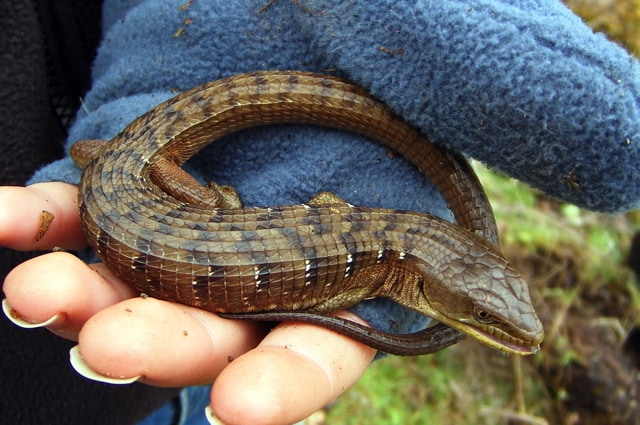
Northern Alligator Lizard
Pacific Coast of North America, Rocky Mountains, Southern British Columbia, Washington, Northern Idaho, Western Montana, Oregon, Central California
- Medium-Sized, Slender Lizard.
- Adults Reach A Snout-To-Vent Length of About 10 cm .
- Total Length Is Roughly 27.5 cm .
- Distinct Skin Fold On Each Side.
- Keeled Scales On the Back.
- Smooth Ventral Scales.
- Coloration Varies But Can Be Brown and White, Or Greenish Yellow and Brown.
- Dorsally Brownish With Dark Blotches That May Form Bands.
- Throat and Mouth Area of Some Young Individuals Can Be Yellow.
- Belly Is Light Gray.
- Eyes Are Dark.
Crickets, Slugs, Beetles, Spiders, Moths, Small Lizards, Small Baby Mice
- Undergo Brumation During Winter.
- Hide Under Rocks, Logs, Or In Burrows During Brumation.
- Males Grasp Females By the Head During Courtship and Mating, Sometimes For Many Hours.
About Elgaria coerulia
Northern Alligator Lizard
The northern alligator lizard, scientifically known as Elgaria coerulea, is a medium-sized, slender reptile native to the western coast of North America. Its range extends along the Pacific Coast and into the Rocky Mountains, from southern British Columbia south through California. This species is recognized by its distinct lateral skin fold that separates keeled scales on its back from smooth scales on its underside. Coloration varies but often includes shades of brown, white, or greenish-yellow.
Habitat and Distribution
Elgaria coerulea is found in a variety of habitats, including forested areas and montane chaparral, from sea level up to elevations of approximately 3,350 meters (10,990 feet). The species is distributed across several western U.S. states and Canadian provinces, with four recognized subspecies occupying distinct geographic ranges. The subspecies E. c. principis, the Northwestern alligator lizard, is notably widespread.
Diet and Behavior
The diet of the northern alligator lizard is varied, consisting of insects such as crickets, slugs, beetles, spiders, and moths. They are opportunistic feeders and have been known to consume small lizards and even baby mice. During the colder months, these lizards enter a state of brumation, seeking refuge under rocks, logs, or in burrows to conserve energy and body heat. Courtship involves the male grasping the female's head, a behavior that can last for many hours.
Source: Wikipedia ↗
Frequently Asked Questions
What is the scientific name for the northern alligator lizard?
The scientific name for the northern alligator lizard is Elgaria coerulea. It was formerly classified under the scientific name Gerrhonotus coeruleus.
What is the typical size of an adult northern alligator lizard?
Adult northern alligator lizards are medium-sized, with a snout-to-vent length (SVL) of approximately 10 cm (3.9 inches). Their total length, including the tail, can reach about 27.5 cm (10.8 inches).
What do northern alligator lizards eat?
Their diet consists primarily of invertebrates such as crickets, slugs, beetles, spiders, and moths. They are also known to prey on larger items, including small lizards and even baby mice when the opportunity arises.
How do northern alligator lizards reproduce?
Northern alligator lizards are viviparous, meaning they give birth to live young. A clutch can range from 4 to 5 offspring, with up to 15 young born between June and September.
Where are northern alligator lizards found?
These lizards are distributed along the Pacific Coast and in the Rocky Mountains, ranging from southern British Columbia in Canada down through California in the United States. They inhabit various forested environments and montane chaparral.
What are the different subspecies of the northern alligator lizard?
Four subspecies are recognized: Elgaria coerulea coerulea (San Francisco alligator lizard), E. c. palmeri (Sierra alligator lizard), E. c. principis (Northwestern alligator lizard), and E. c. shastensis (Shasta alligator lizard).
What is brumation and why do northern alligator lizards do it?
Brumation is a state of dormancy similar to hibernation, which northern alligator lizards undergo as winter temperatures drop. This process helps them conserve energy by reducing caloric needs and retaining body heat.
Related Lizards

Northern alligator lizard
The northern alligator lizard (Elgaria coerulea) is a medium-sized, slender lizard found along the North American west coast. It is characterized by a distinct skin fold along its sides, separating keeled dorsal scales from smooth ventral scales. This lizard inhabits a variety of forested areas and montane chaparral, and its diet consists of insects, slugs, and small vertebrates.

Chalcides sexlineatus
The Gran Canaria skink (Chalcides sexlineatus) is a species of skink endemic to the island of Gran Canaria in the Canary Islands. This lizard is characterized by its flattened body, wide head, and distinctive striping patterns, with variations between subspecies. It inhabits a wide range of environments across the island.

Gran Canaria skink
The Gran Canaria skink (Chalcides sexlineatus) is a species of skink endemic to the Canary Island of Gran Canaria. This lizard is characterized by its flattened body, wide head, and strong legs, with distinct striping patterns and coloration that vary between its subspecies and geographic locations on the island. It inhabits a wide range of environments, from coastal areas to higher altitudes, and primarily feeds on invertebrates.