
Colorado checkered whiptail
The Colorado checkered whiptail (Aspidoscelis neotesselatus) is a species of teiid lizard native to Colorado, USA. It is a triploid species, meaning it has three sets of chromosomes, and reproduces through parthenogenesis.
Key Facts
- ›Native to Colorado, United States.
- ›Scientific name: Aspidoscelis neotesselatus.
- ›A triploid species, possessing three sets of chromosomes.
- ›Reproduces asexually through parthenogenesis.
- ›Belongs to the Teiidae family of lizards.

Triploid Checkered Whiptail
Colorado, United States
About Colorado checkered whiptail
The Colorado Checkered Whiptail
The Colorado checkered whiptail, scientifically known as Aspidoscelis neotesselatus, is a unique species of lizard found exclusively in the state of Colorado, United States. This species is distinguished by its triploid genetic makeup, possessing three sets of chromosomes, which is a significant deviation from the typical diploid chromosome number found in most animals.
Reproduction and Genetics
A remarkable characteristic of the Colorado checkered whiptail is its method of reproduction, which is entirely parthenogenetic. This means that females are capable of producing offspring without the need for fertilization by a male. This asexual reproductive strategy is directly linked to its triploid nature, allowing for the continuation of the species through clonal reproduction.
Source: Wikipedia ↗
Frequently Asked Questions
What is a Colorado checkered whiptail?
The Colorado checkered whiptail is a species of teiid lizard found exclusively in Colorado, United States. It is notable for being a triploid species and reproducing through parthenogenesis.
What does 'triploid' mean for this lizard?
Being triploid means the Colorado checkered whiptail has three sets of chromosomes, unlike most diploid organisms which have two. This genetic makeup is characteristic of the species.
How does the Colorado checkered whiptail reproduce?
This species reproduces through parthenogenesis, a form of asexual reproduction. This means that females can produce offspring without fertilization from a male.
Where can I find the Colorado checkered whiptail?
The natural geographic distribution of the Colorado checkered whiptail is limited to the state of Colorado in the United States. They are not found naturally outside of this region.
Related Lizards

Aspidoscelis laredoensis
The Laredo striped whiptail (Aspidoscelis laredoensis) is a lizard species native to southern Texas and northern Mexico. It is known for its dark green or brown coloration, distinguished by seven yellow or white stripes extending from head to tail, and a white underside. This species is parthenogenic, meaning females reproduce without fertilization, and it is a fast-moving, diurnal insectivore.
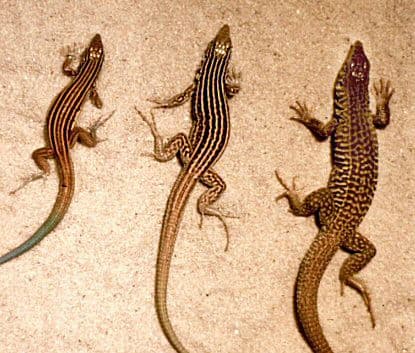
Aspidoscelis neomexicana
The New Mexico whiptail (Aspidoscelis neomexicana) is a unique, all-female lizard species native to the southwestern United States and northern Mexico, notable for its parthenogenetic reproduction. Characterized by its slender body, seven pale yellow stripes, and a blue or blue-green throat, this diurnal lizard inhabits a variety of semi-arid environments.

Aspidoscelis uniparens
The desert grassland whiptail lizard (Aspidoscelis uniparens) is an all-female reptile native to North America, known for its unique parthenogenetic reproduction. These slender lizards are characterized by six yellowish lines running the length of their olive or brown bodies, which fade to a blue or gray tail. They inhabit desert grasslands and low valleys in Arizona, New Mexico, and northern Mexico.