
Common dotted garden skink
Riopa punctata·Scincidae
The common dotted garden skink, scientifically known as Riopa punctata, is a species of skink found across South and Southeast Asia. Young individuals are notable for their bright red tails, which transition to spots and then lines on the body as they mature. This skink inhabits various hilly regions within its broad geographic range.
Key Facts
- ›Distinguished by a red tail in juveniles, which develops spots and lines in adults.
- ›Found in Bangladesh, India, Nepal, Pakistan, Vietnam, and Sri Lanka.
- ›Inhabits primarily hilly regions within its distribution.
- ›Scales are smooth and subequal, with each typically bearing a dark basal spot.
- ›The adpressed limbs fail to meet by nearly twice the length of the fore-limb.

Common Dotted Garden Skink, Common Snake Skink, Punctate Supple Skink, Spotted Supple Skink
Bangladesh, India, Nepal, Pakistan, Vietnam, Sri Lanka
- Young Skinks Have A Distinctive Red Tail, Lost In Adults.
- Adults Develop Small Spots On the Body, Which Coalesce Into Continuous Lines.
- Spots Are Present On the Head and Extend To the Snout.
- Snout Is Obtuse.
- Lower Eyelid Has An Undivided Semi-Transparent Disc.
- Supranasals Are Entire and In Contact Behind the Rostral.
- Frontal Scale Is Longer Than the Frontoparietals and Interparietal Combined.
- A Pair of Nuchal Scales Is Usually Present.
- An Enlarged Temporal Scale Borders the Outer Margin of the Parietal.
- Ear-Opening Is About Half the Size of the Eye-Opening, With One Or Two Small Lobules Anteriorly.
- Seven Supralabial Scales, the Fifth Below the Middle of the Eye.
- Body Covered With Smooth, Subequal Scales, Typically 20 Or 24 Around the Body .
- 62 To 76 Scales Down the Middle of the Back.
- Marginal Preanal Scales Are Slightly Enlarged.
- Adpressed Limbs Fail To Meet By Nearly Twice the Length of the Fore-Limb.
- Digits Are Long, With the Fourth Toe Distinctly Longer Than the Third.
- 11 To 14 Keeled Lamellae Under the Fourth Toe.
- Tail Is Thick At the Base and Slightly Longer Than the Head and Body.
- Dorsal and Lateral Coloration Is Brown.
- Each Scale Has A Dark Basal Spot.
- In Young, Spots Are Joined Into 4 Or 6 Longitudinal Lines Down the Back.
- A Yellowish Dorsolateral Streak Begins On the Canthus Rostralis, Strongly Marked In the Young.
- Lower Surfaces Are Yellowish-White and Uniform, Or Each Scale Has A Black Central Dot.
- Tail Is Reddish In the Young.
About Common dotted garden skink
What is the Common Dotted Garden Skink?
The common dotted garden skink, scientifically identified as Riopa punctata, is a species of skink native to a wide range across South and Southeast Asia. It is known by several other common names, including the common snake skink, punctate supple skink, and spotted supple skink. This reptile is primarily found in hilly regions within countries such as Bangladesh, India, Nepal, Pakistan, Vietnam, and Sri Lanka.
Physical Characteristics
A distinctive feature of young common dotted garden skinks is their bright red tail, a characteristic that fades as they reach adulthood. In mature individuals, this coloration is replaced by small spots distributed across the body, which gradually merge to form continuous lines. These spots can also be observed on the head and extend forward to the snout. The scales of this skink are smooth and subequal, with each scale typically marked by a dark basal spot. As the animal ages, these spots contribute to the formation of longitudinal lines along the back. The adpressed limbs of the common dotted garden skink are notably short, failing to meet by a significant margin.
Taxonomy and Distribution
The species was first described by Carl Linnaeus in 1758. Historically, its nomenclature has been stabilized through the selection of a lectotype in 2003 to clearly distinguish the Asian species, now Riopa punctata, from an African species previously identified by the same name. The common dotted garden skink's distribution spans a considerable geographical area, with notable populations found in the Yelagiris, Nilgiris, Shevaroy Hills, and various other hilly districts across its range.
Source: Wikipedia ↗
Frequently Asked Questions
What are the different common names for Riopa punctata?
Riopa punctata is known by several common names, including the common dotted garden skink, common snake skink, punctate supple skink, and spotted supple skink. These names reflect its appearance and general characteristics.
What is the most striking physical characteristic of young common dotted garden skinks?
Young common dotted garden skinks possess a distinctive bright red tail. This vibrant coloration is a key identifying feature of juveniles.
How does the appearance of adult common dotted garden skinks differ from juveniles?
As the common dotted garden skink matures, the bright red tail is lost. It is replaced by small spots that gradually coalesce to form continuous lines along the body and head.
Where is the common dotted garden skink geographically distributed?
This species is found in a wide range across Asia, including Bangladesh, India, Nepal, Pakistan, Vietnam, and Sri Lanka. They are often located in hilly areas within these countries.
What are the scale characteristics of the common dotted garden skink?
The body of the common dotted garden skink is covered with smooth, subequal scales. Each scale generally features a dark basal spot, contributing to its spotted or lined appearance as it ages.
How are the limbs of the common dotted garden skink positioned when pressed against the body?
A notable characteristic is that when the limbs of the common dotted garden skink are adpressed (pressed tightly against the body), they fail to meet. The gap between them is approximately twice the length of the fore-limb.
Related Lizards

Common snake skink
The Common snake skink, also known as Riopa punctata, is a skink species found across South and Southeast Asia. Young individuals are distinguished by a bright red tail, which fades in adults and is replaced by spots that can form lines along the body. This species inhabits various hilly regions within its geographic range.
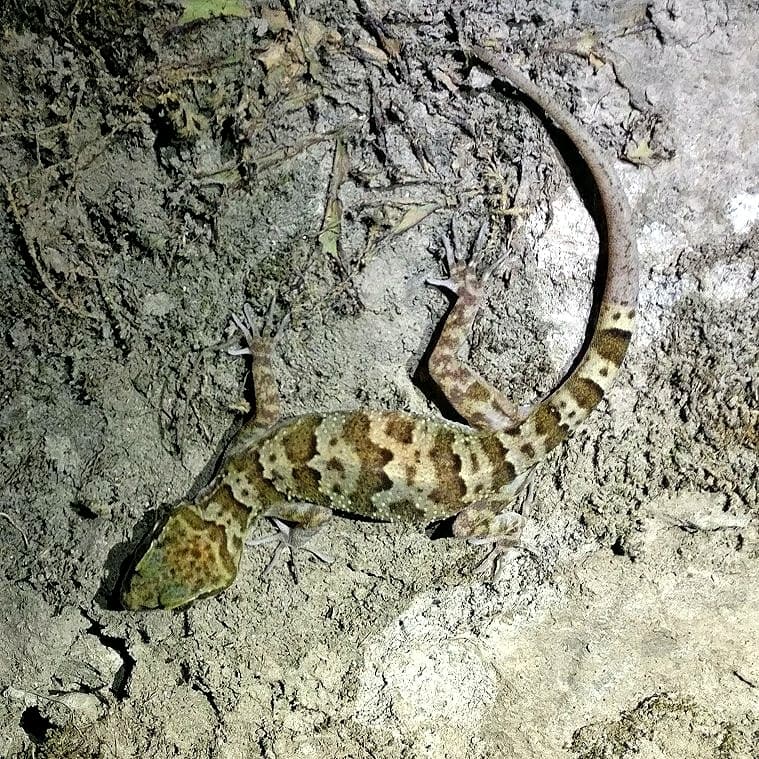
Cyrtopodion fasciolatus
The banded bent-toed gecko, scientifically known as Cyrtodactylus fasciolatus, is a gecko species native to north-western India. It is characterized by its distinctive banding patterns and is found in the hilly regions of the Western Himalayas.

Eutropis nagarjuni
Eutropis nagarjuni, also known as Sharma's mabuya, is a skink species endemic to India. It is characterized by specific scale arrangements, a dark brown or black coloration with longitudinal white stripes, and a distinct oval ear opening. This species inhabits hilly regions along the Krishna River in Andhra Pradesh.