
Eutropis nagarjuni
Eutropis nagarjuni, also known as Sharma's mabuya, is a skink species endemic to India. It is characterized by specific scale arrangements, a dark brown or black coloration with longitudinal white stripes, and a distinct oval ear opening. This species inhabits hilly regions along the Krishna River in Andhra Pradesh.
Key Facts
- ›Distinguished from Eutropis beddomei by several key morphological differences in scale arrangement and ear opening.
- ›Typically displays a dark brown or black body with three longitudinal white stripes on the back.
- ›Some specimens exhibit an orangish-red stripe on the neck, potentially indicating a sex-specific trait.
- ›The type specimen was rediscovered in the collections of the Zoological Survey of India in 2007.
- ›Has been documented in Nalgonda and Mahbubnagar districts of Andhra Pradesh, India.

Sharma's Mabuya
India
- Dark Brown Or Black Coloration With White Longitudinal Stripes On the Back, Including A Middle Vertebral Stripe.
- Head Scales Have Brown Centers and Light Brown Margins.
- Legs Are Dark Brown Dorsally, With Hind Limbs Sculpted With White On the Upper Side.
- Underside Is White.
- Some Individuals May Display An Orangish-Red Stripe On Either Side of the Neck.
- Supranasals Are Separated By the Frontonasal.
- Prefrontals Are Separate.
- Possesses Three Pairs of Nuchals.
- Has A Post Nasal.
- Dorsal Scales Exhibit 5-7 Keels.
- 16-22 Lamellae Are Present Beneath the Fourth Toe.
- Features An Oval Ear Opening That Is Twice the Size of the Lateral Scales.
About Eutropis nagarjuni
Eutropis nagarjuni, commonly known as Sharma's mabuya, is a species of skink found in India. It was first described by Sharma in 1969, with specimens collected from the hills south of Vijaypuri on the right bank of the Krishna River in Andhra Pradesh. The species is distinguished from similar skinks, such as Eutropis beddomei, by several specific morphological characteristics.
Description and Identification
Key features that differentiate Eutropis nagarjuni include the arrangement of its scales. It possesses supranasals that are separated by the frontonasal, and its prefrontals are also separate. Unlike some related species, it has three pairs of nuchals and a post nasal. The dorsal scales of Eutropis nagarjuni typically have between 5 and 7 keels, and it has 16 to 22 lamellae beneath its fourth toe. Its ear opening is notably oval and twice the size of the surrounding lateral scales. The coloration is generally dark brown or black, marked by three longitudinal white stripes on the back, with the central vertebral stripe being the most prominent. These stripes may fade on the tail. The head scales often display brown centers and lighter brown margins. The upper surfaces of the legs are dark brown, and the hind limbs are sculpted with white on their upper parts, while the underside is white. Some individuals have been observed with an orangish-red stripe on either side of the neck, which may be a sex-specific characteristic.
Distribution and Rediscovery
Eutropis nagarjuni has been recorded in additional locations within the Nalgonda and Mahbubnagar districts of Andhra Pradesh. A significant event in the species' history was the rediscovery of its type specimen in 2007. The original syntypes were found within the collections of the Zoological Survey of India, confirming the species' continued existence and aiding in its taxonomic understanding.
Source: Wikipedia ↗
Frequently Asked Questions
What are the distinguishing features of Eutropis nagarjuni?
Eutropis nagarjuni can be identified by its supranasals being separated by the frontonasal, separate prefrontals, three pairs of nuchals, the presence of a post nasal, dorsal scales with 5-7 keels, and 16-22 lamellae beneath the fourth toe. It also has an oval ear opening that is twice the size of the lateral scales.
What is the typical coloration of Eutropis nagarjuni?
The species is typically dark brown or black with white longitudinal stripes, including a prominent middle vertebral stripe. These stripes may become less distinct on the tail. The head scales have brown centers and light brown margins.
Where was Eutropis nagarjuni first described?
Eutropis nagarjuni was first described from the hills south of Vijaypuri on the right bank of the Krishna River in Andhra Pradesh, India.
Has the type specimen of Eutropis nagarjuni been located?
Yes, the type specimen of Eutropis nagarjuni, which was previously considered missing, was rediscovered in the collections of the Zoological Survey of India in 2007.
What other locations have been reported for Eutropis nagarjuni?
Besides its type locality, Eutropis nagarjuni has been found in a few additional areas within the Nalgonda and Mahbubnagar districts of Andhra Pradesh, India.
Related Lizards
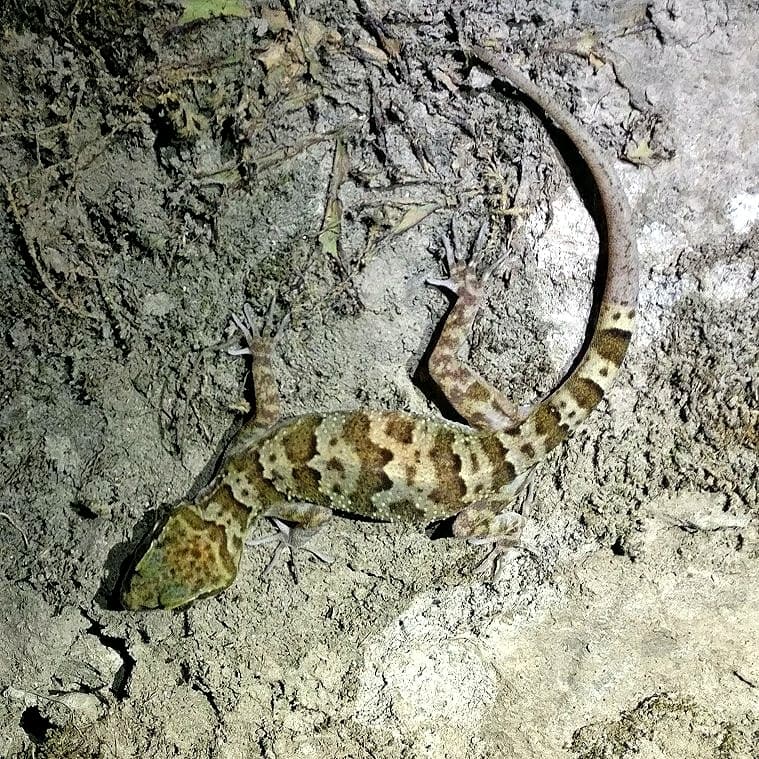
Cyrtopodion fasciolatus
The banded bent-toed gecko, scientifically known as Cyrtodactylus fasciolatus, is a gecko species native to north-western India. It is characterized by its distinctive banding patterns and is found in the hilly regions of the Western Himalayas.

Hemiphyllodactylus aurantiacus
The Southern Ghats slender gecko (Hemiphyllodactylus aurantiacus) is a small gecko species endemic to the hills of southern India. It is characterized by its elongated body, short limbs, and minute granular scales, with distinctive undulating dark-brown lines along its head and back. This species inhabits rocky areas and is typically found under stones.

Common dotted garden skink
The common dotted garden skink, scientifically known as Riopa punctata, is a species of skink found across South and Southeast Asia. Young individuals are notable for their bright red tails, which transition to spots and then lines on the body as they mature. This skink inhabits various hilly regions within its broad geographic range.