
Crotaphytus bicinctores
The Great Basin collared lizard (Crotaphytus bicinctores), also known as the desert collared lizard or Mojave black-collared lizard, is a species endemic to the Western United States. It is characterized by its less vibrant coloration compared to the common collared lizard, with males exhibiting brown to orange hues and females being darker. This species inhabits rocky arid desert regions, favoring desert scrub and wash environments.
Key Facts
- ›Endemic to the Western United States, including California, Nevada, Oregon, Idaho, Utah, and Arizona.
- ›Inhabits rocky desert regions, desert scrub, and desert wash habitats.
- ›Diet consists primarily of arthropods, but also includes small vertebrates and occasionally plant matter.
- ›Males have broader heads and more pronounced orange crossbands than females.
- ›Distinguished by two black bands on its neck.
- ›Adults typically measure 6.4 to 11.4 cm (2.5 to 4.5 inches) in snout-to-vent length.

Great Basin Collared Lizard, Desert Collared Lizard, Mojave Black-Collared Lizard
United States
Arid Deserts, Desert Scrub, Desert Wash, Rocky Regions
- Similar In Shape and Size To Crotaphytus Collaris, But With Less Vibrant Colors.
- Males Range From Brown To Orange With Some Red Or Pink On the Belly.
- Females Are Generally Black Or Dark Brown.
- Possesses Elongated Scales Near the Claws.
- Tail Is More Triangular In Shape Compared To the Round Tail of C. Collaris.
- Features A Broad Head and Large Hind Legs.
- Characterized By A Pair of Black Bands On the Neck.
- Males Have Broader Heads Than Females and More Pronounced Orange Crossbands On the Body.
- Adult Snout-To-Vent Length Ranges From 6.4 To 11.4 cm .
- Has A Thick Tail That Is Often Twice As Long As the Body.
Arthropods, Small Vertebrates, Plant Matter
Uses Powerful Jaws To Capture Prey.
About Crotaphytus bicinctores
The Great Basin Collared Lizard
The Great Basin collared lizard, scientifically known as Crotaphytus bicinctores, is a reptile native to the arid landscapes of the Western United States. This species is also commonly referred to as the desert collared lizard or the Mojave black-collared lizard, reflecting its habitat and distinctive markings.
Description and Habitat
Physically, Crotaphytus bicinctores is similar in form and size to its relative, the common collared lizard (Crotaphytus collaris), but it is distinguished by its less flamboyant coloration. Males typically display hues ranging from brown to orange, often with touches of red or pink on their bellies, while females tend to be darker, appearing black or dark brown. A key characteristic is the presence of two prominent black bands encircling the neck, giving the species its name. The lizard possesses elongated scales near its claws and a tail that is more triangular in shape, contrasting with the rounder tail of C. collaris. Adults generally measure between 6.4 and 11.4 cm (2.5 to 4.5 inches) in snout-to-vent length, and they have a robust tail that can be up to twice the length of their body. Males are notable for having broader heads and more pronounced orange crossbands along their bodies compared to females.
Crotaphytus bicinctores is endemic to the Western United States, with its range encompassing California, most of Nevada, southeastern Oregon, southern Idaho, and the western parts of Utah and Arizona. Its preferred habitat consists of rocky desert environments, and it is particularly common in desert scrub and desert wash areas. The species is widely distributed across major desert regions, including the Mojave, Sonoran, and southeastern Great Basin deserts.
Diet and Behavior
The diet of the Great Basin collared lizard is primarily composed of arthropods. However, these lizards are opportunistic predators and will use their powerful jaws to capture and consume small vertebrates, such as other lizards, snakes, and rodents. Occasionally, they have also been observed to ingest plant matter.
Taxonomy
The Great Basin collared lizard belongs to the family Crotaphytidae. Its scientific classification highlights its distinctiveness within the broader group of lizards.
Source: Wikipedia ↗
Frequently Asked Questions
What is the scientific name for the Great Basin collared lizard?
The scientific name for the Great Basin collared lizard is Crotaphytus bicinctores. This binomial nomenclature is used to classify the species within the scientific community.
Where is the Great Basin collared lizard found?
This species is endemic to the Western United States. Its geographic range includes California, most of Nevada, southeastern Oregon, southern Idaho, and parts of western Utah and Arizona.
What kind of habitat does the Great Basin collared lizard prefer?
The Great Basin collared lizard is typically found in rocky regions of arid deserts. It is most commonly observed in desert scrub and desert wash habitats.
What does the Great Basin collared lizard eat?
Its diet primarily consists of arthropods. However, it is also known to consume small vertebrates such as lizards, snakes, and rodents, and will occasionally eat plant matter.
How does the Great Basin collared lizard differ from the common collared lizard?
While similar in shape and size to the common collared lizard (Crotaphytus collaris), the Great Basin collared lizard lacks its bright, extravagant colors. Males are brown to orange, and females are more black or dark brown, whereas C. collaris is more vibrantly colored.
What are the physical characteristics of the Great Basin collared lizard?
It has elongated scales near the claws and a more triangular tail shape compared to C. collaris. Adults have a broad head, large hind legs, and two distinctive black bands on the neck. Males possess broader heads and more pronounced orange crossbands than females.
Related Lizards

Crotaphytus reticulatus
Crotaphytus reticulatus, also known as the reticulate collared lizard, is a moderately sized reptile native to semiarid, rocky regions of the Tamaulipan mezquital. It is characterized by a tan to brown body with distinctive reticulations and black pigmentation, and a faint collar. Unlike most of its genus, it is less restricted to purely rocky habitats and is protected from collection in the United States.
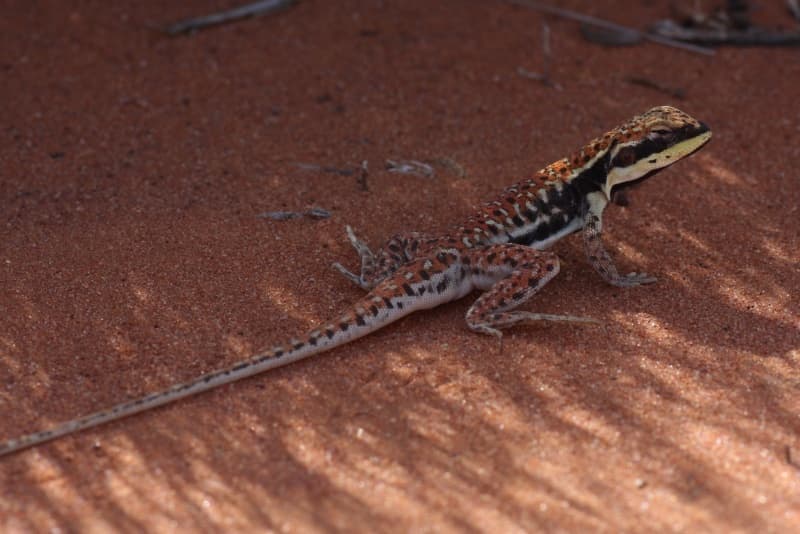
Ctenophorus isolepis
The Central Military Dragon (Ctenophorus isolepis) is an agamid lizard found in the arid regions of central and western Australia. Adults typically measure between 21 and 26.5 cm in total length and exhibit yellowish to reddish-brown coloration with darker blotches. They inhabit sand-ridge deserts and loamy flats, often seeking refuge in spinifex.

Gerrhosaurus major
The Sudan plated lizard, also known as the western plated lizard or great plated lizard, is a medium-sized, diurnal African reptile recognized for its heavily armored appearance. Found in eastern and central Africa, it inhabits rocky, semi-open areas within various savannah and woodland environments. Primarily insectivorous, it also supplements its diet with fruits, vegetation, and small vertebrates.