
Ctenophorus isolepis
The Central Military Dragon (Ctenophorus isolepis) is an agamid lizard found in the arid regions of central and western Australia. Adults typically measure between 21 and 26.5 cm in total length and exhibit yellowish to reddish-brown coloration with darker blotches. They inhabit sand-ridge deserts and loamy flats, often seeking refuge in spinifex.
Key Facts
- ›Occurs in arid central and western Australia.
- ›Adults reach a total length of 21–26.5 cm.
- ›Coloration ranges from yellowish to reddish-brown with blotches.
- ›Inhabits sand-ridge deserts and loamy flats with spinifex.
- ›Lives entirely above ground and avoids exposed areas.
- ›Prefers foraging in bare ground areas between low vegetation.
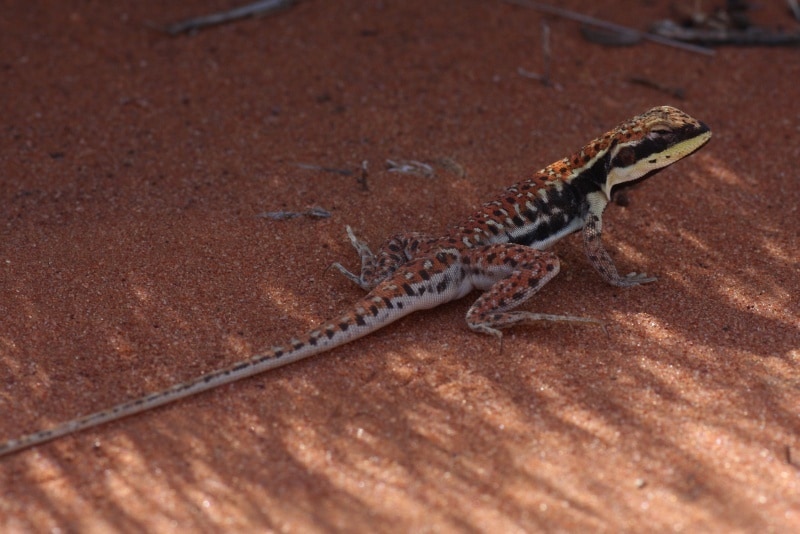
Central Military Dragon, Military Dragon, Military Sand Dragon
Western Australia, Northern Territory, South Australia, Queensland
Arid Deserts, Sand-Ridge Deserts, Loamy Flats, Areas With Spinifex
- Adults Range In Color From Yellowish To Reddish-Brown.
- Possess Blotches and Flecks Ranging From Pale To Dark.
- Adult Total Length Is 21–26.5 cm .
- Hide In Spinifex If Alarmed.
- Live Entirely Above Ground.
- Avoid Elevated and Exposed Areas.
- Prefer To Forage In Areas of Bare Ground Between Low Vegetation.
About Ctenophorus isolepis
Central Military Dragon
The Central Military Dragon, scientifically known as Ctenophorus isolepis, is a species of agamid lizard native to Australia. This reptile is commonly referred to as the military dragon or military sand dragon, reflecting its distinctive appearance and habitat.
Description and Habitat
Adult Central Military Dragons exhibit a coloration that varies from yellowish to reddish-brown, often adorned with blotches and flecks of darker or paler hues. Their total length, including the tail, typically ranges from 21 to 26.5 centimeters (approximately 8.3 to 10.4 inches). These lizards are inhabitants of the arid regions of central and western Australia, favoring environments such as sand-ridge deserts and loamy flats. They are frequently found in areas with spinifex ground cover, which they utilize for concealment when alarmed.
Behavior and Distribution
Central Military Dragons are exclusively ground-dwelling and tend to avoid elevated or exposed locations. Instead, they prefer to forage in open, bare ground situated between patches of low vegetation. Their geographic distribution spans across outback Western Australia, extending into the southern half of the Northern Territory and north-western South Australia, as well as reaching into south-western Queensland. Previously, C. rubens was considered a subspecies of the Central Military Dragon, but this classification has since been revised.
Source: Wikipedia ↗
Frequently Asked Questions
What is the common name for Ctenophorus isolepis?
Ctenophorus isolepis is commonly known as the Central Military Dragon. It is also referred to as the military dragon or military sand dragon.
Where does the Central Military Dragon live?
This species is found in the arid parts of central and western Australia. Its distribution includes outback Western Australia, the southern half of the Northern Territory, north-western South Australia, and south-western Queensland.
What is the typical size of an adult Central Military Dragon?
Adults of this species have a total length, including their tail, ranging from 21 to 26.5 centimeters (8.3 to 10.4 inches).
What does the Central Military Dragon look like?
Adults are typically yellowish to reddish-brown in color, marked with blotches and flecks that vary from pale to dark. They possess a total length of up to 26.5 cm.
What is the habitat of the Central Military Dragon?
They inhabit sand-ridge deserts and loamy flats, usually in areas with spinifex ground cover. They live entirely above ground, preferring to forage in bare ground between low vegetation.
Related Lizards

Crotaphytus bicinctores
The Great Basin collared lizard (Crotaphytus bicinctores), also known as the desert collared lizard or Mojave black-collared lizard, is a species endemic to the Western United States. It is characterized by its less vibrant coloration compared to the common collared lizard, with males exhibiting brown to orange hues and females being darker. This species inhabits rocky arid desert regions, favoring desert scrub and wash environments.
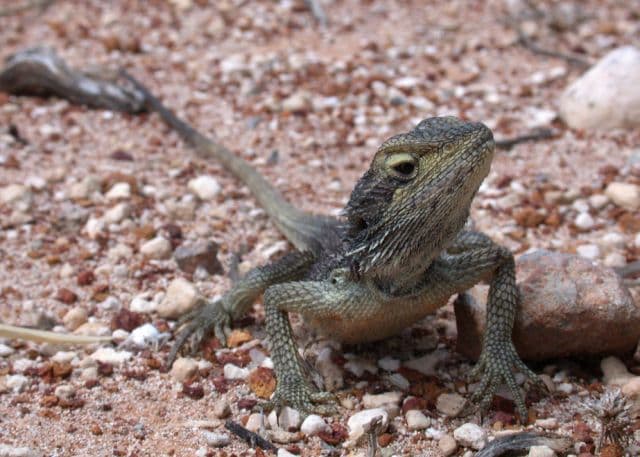
Abrolhos bearded dragon
The Abrolhos bearded dragon (Pogona minor minima) is a small agamid lizard endemic to the islands of the Houtman Abrolhos archipelago off the coast of Western Australia. It is characterized by its smaller size compared to related bearded dragons and inhabits sandy or limestone outcrop environments.

Algerian sand racer
The Algerian sand racer, scientifically known as Psammodromus algirus, is a lizard species found in southwestern Europe and northwestern Africa. It typically inhabits dense bushy vegetation and can be found at high elevations, though it is more common at lower altitudes. This species is characterized by its metallic brownish dorsal coloration with conspicuous white or yellowish stripes.