
Ctenophorus caudicinctus
The Ctenophorus caudicinctus, commonly known as the ring-tailed dragon, is a vibrantly colored agamid lizard native to the rocky ranges and outcrops of Australia, particularly the Pilbara region of Western Australia. These lizards are recognized for their distinctive banding around the tail, a line of spines curving beneath the eyes, and pronounced sexual dimorphism, with males displaying brighter colors. They are diurnal insectivores adapted to arid environments, utilizing unique scale structures for water absorption and thermoregulation.
Key Facts
- ›Native to rocky ranges and outcrops in Australia, most commonly found in Western Australia's Pilbara region.
- ›Possesses a distinctive banded tail, a line of spines below the eyes, and exhibits sexual dimorphism with males being more brightly colored.
- ›Primarily insectivorous, feeding on arthropods, termites, and ants, with occasional consumption of vegetative material.
- ›Adapts to arid environments through specialized scale hinges for water absorption and thermoregulatory behaviors like color change.
- ›Most predators include snakes such as dugites and pythons.
- ›Considered of Least Concern by the Nature Conservation Act 1992 in Queensland.

Ring-Tailed Dragon, Ring-Tailed Bicycle-Dragon
Australia
Rocky Ranges, Outcrops, Arid Areas, Low Vegetation
- Length of 25–35 cm.
- Distinctive Banding Around the Tail.
- White To Yellow Underbelly.
- A Line of Spines Curves Beneath the Eyes.
- Short Crest of Nuchal Spines That Varies In Colour.
- Coloration Ranges From Pale Beige To Dark Orange, With Some Subspecies Exhibiting Brighter Colors Like Green and Red, Though Brown and Dark Red Are Common For Camouflage.
- Males Display Brighter Colors Than Females, With Yellow Markings On Flanks and A Dark Chest Patch During Mating Season.
- Larger Heads In Males For Dominance.
- Flattened Body and A Longer, Narrower Snout Adapted For Fitting Through Spaces and Catching Prey.
Arthropods, Termites, Ants, Vegetative Material
- Diurnal
- Highly Territorial
- Ambush Predators
- Utilizes Thermoregulation Behaviors, Moving Higher In Elevation Throughout the Day and Returning To the Ground.
- Can Change Skin Color To Absorb Or Lose Heat.
- Employs Motion-Based Signaling For Communication, Influenced By Surroundings.
- Can Remain Motionless To Blend Into Surroundings For Predator Avoidance.
- Possesses High-Speed Locomotion For Retreat To Rocks.
- Exhibits Both Bipedalism and Quadrupedalism For Retreat.
- Uses Tail For Balance During Bipedal Movement.
Snakes, Dugites, Pythons
Extreme Weather Conditions, Periods of Limited Rainfall, Excessive Heat
About Ctenophorus caudicinctus
Ctenophorus caudicinctus: The Ring-Tailed Dragon
The Ctenophorus caudicinctus, commonly known as the ring-tailed dragon, is a striking species of agamid lizard found across the rocky landscapes and outcrops of Australia. Its most prominent feature is the distinctive banding around its tail, which gives it its common name. These lizards are well-adapted to arid environments and are particularly prevalent in the Pilbara region of Western Australia, inhabiting areas with low vegetation and rocky terrain.
Description and Adaptations
Ring-tailed dragons typically measure between 25 to 35 centimeters in length. They are recognized for their bright coloration, which can range from pale beige to dark orange, with a white to yellow underbelly. A notable characteristic is the line of spines curving beneath their eyes. Sexual dimorphism is evident, with males exhibiting more vibrant colors, including yellow flank markings and a dark chest patch during the mating season, to attract females. Their bodies are somewhat flattened, allowing them to navigate narrow spaces, and they possess a longer, narrower snout adapted for hunting prey. Specialized scale hinges on their bodies play a crucial role in water management, facilitating absorption from the environment.
Behavior and Ecology
Ctenophorus caudicinctus is a diurnal species, meaning it is active during the day. Thermoregulation is a key aspect of its daily behavior; the lizards begin their day on the ground and gradually move to higher elevations, returning to the ground as the day cools. They possess the ability to alter their skin color to manage heat absorption and loss, a vital adaptation for survival in extreme temperatures. The ring-tailed dragon is primarily an insectivore, preying on arthropods, termites, and ants, though it occasionally consumes vegetative material. They are ambush predators, often waiting in sheltered rocks or burrows for prey. Despite their abundance, snakes such as dugites and pythons are among their main predators.
Reproduction and Conservation
Reproduction in Ctenophorus caudicinctus is influenced by environmental conditions, particularly rainfall and food availability, with breeding often occurring in spring. The species is oviparous, laying eggs. While the exact number of offspring is not precisely detailed, it is noted that the number of hatched individuals is less than the number of eggs laid. The ring-tailed dragon is considered to be of Least Concern, with no significant conservation issues identified due to its high abundance and widespread distribution.
Source: Wikipedia ↗
Frequently Asked Questions
What is the common name for Ctenophorus caudicinctus?
Ctenophorus caudicinctus is commonly known as the ring-tailed dragon or ring-tailed bicycle-dragon. These names reflect its distinctive tail banding and its bipedal locomotion.
Where does the ring-tailed dragon live?
The ring-tailed dragon is native to Australia and is most commonly found in the rocky ranges and outcrops of Western Australia, particularly in the Pilbara region and its offshore islands. They also inhabit areas in the MacDonnell, James, and Musgrave Ranges.
What does the ring-tailed dragon eat?
As a diurnal and saxicolous lizard species, the ring-tailed dragon is primarily insectivorous. Its diet consists mainly of arthropods, termites, and ants. Occasionally, they will supplement their diet with some vegetative material.
How does Ctenophorus caudicinctus manage water in its arid habitat?
Ctenophorus caudicinctus has specialized scale hinges that overlap, creating an enclosed space between scales. These flexible hinges allow water to flow over the scales and be absorbed into the deeper layers of the body through capillary action and hinge joint channels, promoting cutaneous water transport.
Are ring-tailed dragons territorial?
Yes, Ctenophorus caudicinctus is described as highly territorial. They use motion-based signaling and motor patterns to communicate and differentiate themselves from other species within their habitat, which is important as many other lizard species share their environment.
What are the main predators of the ring-tailed dragon?
Despite their abundance, the ring-tailed dragon has a few main predators, which include snakes such as dugites and pythons. Their bright coloration during mating season can also make them more vulnerable to predation.
How do male and female ring-tailed dragons differ?
There is significant sexual dimorphism in Ctenophorus caudicinctus. Males display brighter colors than females to attract mates, often developing yellow markings on their flanks and a dark chest patch during the mating season. Males also tend to have larger heads, which aids in asserting dominance.
What is the conservation status of Ctenophorus caudicinctus?
Ctenophorus caudicinctus is considered to be of Least Concern. The species is highly abundant and has no significant conservation concerns, being assessed as such under the Nature Conservation Act 1992.
Related Lizards

Hemidactylus reticulatus
The reticulate leaf-toed gecko (Hemidactylus reticulatus) is a nocturnal, insectivorous species found in the rocky regions of South India. During the day, it seeks shelter under stones, emerging at night to forage for insects. Its distinctive coloration features a network of darker lines on a brown background, with many of its tubercles appearing whitish.
Reticulate leaf-toed gecko
The reticulate leaf-toed gecko is a terrestrial, nocturnal gecko species native to the rocky regions of South India. It is characterized by its short, convex head, short limbs, and distinctive keeled tubercles interspersed with granules on its body. This insectivorous lizard seeks shelter under stones during the day and emerges at night to hunt.
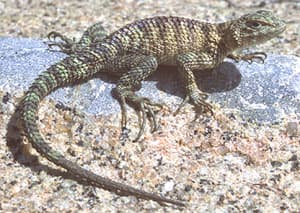
Sceloporus orcutti
The granite spiny lizard (Sceloporus orcutti) is a species native to the southwestern United States and northwestern Mexico. It is characterized by strongly keeled and pointed dorsal scales, and distinct colorations between males, females, and juveniles. This lizard is typically found on rocky hillsides and outcrops.