
Sceloporus orcutti
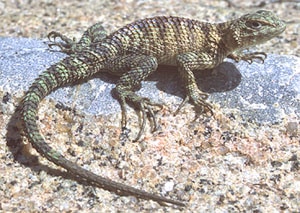
The granite spiny lizard (Sceloporus orcutti) is a species native to the southwestern United States and northwestern Mexico. It is characterized by strongly keeled and pointed dorsal scales, and distinct colorations between males, females, and juveniles. This lizard is typically found on rocky hillsides and outcrops.
Key Facts
- ›Native to southern California and Baja California.
- ›Possesses strongly keeled and pointed dorsal scales.
- ›Males have yellow-green and blue-centered scales, while females and juveniles display yellow-tan transverse bands.
- ›Males exhibit blue ventral patches on the chest and throat.
- ›Reproduction is oviparous (egg-laying).
- ›Associated with rocky hillsides and outcrops.
La Espinosa Del Granito
Extreme Southern California, United States, Baja California, Mexico
- Snout-To-Vent Length Typically 7.6–10.8 cm .
- Maximum Recorded Total Length Is 28.9 cm .
- Dorsal Scales Are Strongly Keeled and Pointed On Body and Tail.
- Males Have Yellow-Green and Blue-Centered Scales On the Body.
- Females and Juveniles Have Distinct Yellow-Tan Transverse Bands On the Body and Tail.
- Males Have Deep-Blue Ventral Patches On Chest and Throat.
- Males Possess Femoral Pores.
Can Be Observed Perched Atop Boulders., Primarily Associated With Rocky Environments.
About Sceloporus orcutti
Granite Spiny Lizard (Sceloporus orcutti)
The granite spiny lizard, scientifically known as Sceloporus orcutti, is a distinct species of lizard found in the arid landscapes of the southwestern United States and northwestern Mexico. Its common name derives from its preferred habitat and its spiny appearance, while in Mexican Spanish it is referred to as 'la espinosa del granito'. This species is a member of the Phrynosomatidae family and is recognized for its unique physical attributes and its association with rocky terrains.
Description and Habitat
Sceloporus orcutti typically measures between 7.6 to 10.8 centimeters in snout-to-vent length, with its total length, including the tail, reaching up to 28.9 centimeters. A defining characteristic of this lizard is its dorsal scales, which are strongly keeled and pointed across both the body and tail, giving it a textured appearance. Coloration varies significantly with age and sex. Adult males display scales with yellow-green and blue centers, complemented by deep blue patches on their chest and throat. In contrast, females and juveniles exhibit more subdued yellow-tan transverse bands along their body and tail. The species is strongly tied to its environment, being primarily observed perched on boulders within rocky hillsides and outcrops, where it can be seen from considerable distances.
Behavior and Reproduction
The granite spiny lizard is diurnal, actively foraging and basking during the day. Its behavior is closely linked to its rocky habitat, utilizing these features for thermoregulation and predator avoidance. Reproduction in Sceloporus orcutti is oviparous, meaning the females lay eggs. While detailed information on its diet, lifespan, and specific predators or threats is not extensively documented in all sources, its ecological niche within the desert and scrubland ecosystems of its native range is well-established.
Source: Wikipedia ↗
Frequently Asked Questions
What is the scientific name for the granite spiny lizard?
The scientific name for the granite spiny lizard is Sceloporus orcutti. This binomial nomenclature is used to classify the species within the scientific community.
Where is the granite spiny lizard found?
The granite spiny lizard is naturally found in extreme southern California in the United States and in Baja California in Mexico. Its distribution is primarily in arid and semi-arid regions of these areas.
What are the distinguishing physical characteristics of the granite spiny lizard?
This lizard typically has a snout-to-vent length of 7.6–10.8 cm. Its dorsal scales are strongly keeled and pointed. Males are identifiable by yellow-green and blue-centered scales on their body and blue ventral patches, while females and juveniles show yellow-tan transverse bands.
What is the habitat of Sceloporus orcutti?
Sceloporus orcutti is primarily associated with rocky hillsides and outcrops. They can often be observed perched on boulders within these environments.
How does the granite spiny lizard reproduce?
The granite spiny lizard is oviparous, meaning it reproduces by laying eggs. This is a common reproductive strategy among many reptile species.
Related Lizards
Gerrhonotus infernalis
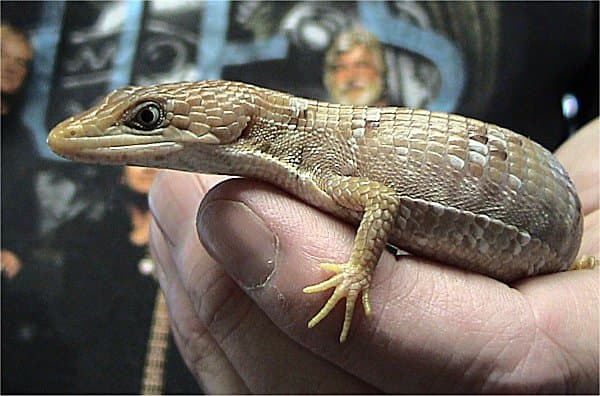
The Texas alligator lizard (Gerrhonotus infernalis) is a large, heavily armored lizard found in rocky hillsides of central Texas and northern Mexico. Characterized by its flat, wedge-shaped head, stiff, plate-like scales, and a tail that can detach to evade predators, this diurnal species typically exhibits a yellow-brown coloration with darker checker patterns that change with age. While not aggressive, it will bite if handled and is often mistakenly believed to be venomous.

Ctenophorus caudicinctus
The Ctenophorus caudicinctus, commonly known as the ring-tailed dragon, is a vibrantly colored agamid lizard native to the rocky ranges and outcrops of Australia, particularly the Pilbara region of Western Australia. These lizards are recognized for their distinctive banding around the tail, a line of spines curving beneath the eyes, and pronounced sexual dimorphism, with males displaying brighter colors. They are diurnal insectivores adapted to arid environments, utilizing unique scale structures for water absorption and thermoregulation.

Hemidactylus reticulatus
The reticulate leaf-toed gecko (Hemidactylus reticulatus) is a nocturnal, insectivorous species found in the rocky regions of South India. During the day, it seeks shelter under stones, emerging at night to forage for insects. Its distinctive coloration features a network of darker lines on a brown background, with many of its tubercles appearing whitish.