
Ctenotus inornatus
The bar-shouldered ctenotus (Ctenotus inornatus) is an Australian skink species known for its intricate color patterns, often a complex blend of stripes and spots. It inhabits arid and desert regions across Australia, particularly favoring spinifex grass habitats. A key distinguishing feature is the arrangement of its supraciliary scales, with the first three being noticeably larger than the rest.
Key Facts
- ›Found across Northern Territory, Queensland, Victoria, New South Wales, Western Australia, and South Australia.
- ›Adults typically range from 85 to 110 millimeters in snout-vent length.
- ›Prefers habitats dominated by spinifex grass, foraging within or along its edges.
- ›Diet consists mainly of termites, ants, locusts, beetles, other insects, and some vegetation.
- ›Reproduction occurs during the Australian spring and early summer (October to February), with clutches typically containing up to six eggs.
- ›Distinguished from other Ctenotus species by the absence of a white subocular stripe and the extent of dorsal pattern elements onto the head and neck.
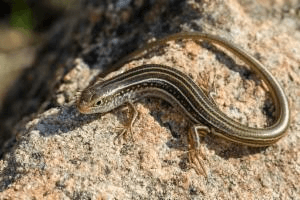
Bar-Shouldered Ctenotus
Australia, Northern Territory, Queensland, Victoria, New South Wales, Western Australia, South Australia
- Large-Bodied Skink Species.
- Adult Snout-Vent Length Typically Ranges From 85 To 110 Millimeters.
- Intricate Color Patterns, Often A Complex Blend of Stripes and Spots.
- Toes Are Not Significantly Compressed Or Are Only Slightly So.
- Subdigital Lamellae Possess A Relatively Broad, Flat Callus.
- Features Supraciliary Scales, With the First Three Being Notably Larger Than the Remainder.
- Absence of A White Subocular Stripe.
- Dorsal Color Pattern Elements May Extend Anteriorly Onto the Head and Neck Region, With Variation Observed.
- Intraspecific Variation In Color Patterns Exists; Even As Dorsal Patterns Reduce, Lateral Elements Often Remain Distinct.
Isoptera, Formicidae, Locustidae, Coleoptera, Various Insects, Parts of Vegetation
- Navigates Within Or Along the Edges of Dense Spinifex Grass Tussocks.
- Exhibits Specific Foraging Behaviors.
- Displays Geographic Variation In Color Patterns.
- Can Be Confused With Other Ctenotus Species In Sympatric Regions Due To Pattern Variations.
About Ctenotus inornatus
Ctenotus inornatus: The Bar-Shouldered Ctenotus
The bar-shouldered ctenotus, scientifically known as Ctenotus inornatus, is a species of skink native to Australia. This lizard is recognized for its distinctive appearance, characterized by intricate color patterns that often present as a complex mix of stripes and spots across its body. It is a member of the large and diverse Ctenotus genus, one of Australia's most species-rich vertebrate clades.
Habitat and Distribution
Ctenotus inornatus is found across a broad geographical range within Australia, inhabiting the Northern Territory, Queensland, Victoria, New South Wales, Western Australia, and South Australia. Its preferred habitat is the arid and desert ecosystems, where it shows a particular affinity for areas dominated by spinifex grass. These lizards are often observed foraging within or along the edges of dense spinifex tussocks, utilizing the dense vegetation for cover and hunting opportunities.
Physical Description and Identification
Adult bar-shouldered ctenotus typically measure between 85 to 110 millimeters in snout-vent length. Their physical features include toes that are not significantly compressed, and subdigital lamellae with a broad, flat callus, which may aid in locomotion. A key characteristic for identification is the arrangement of their supraciliary scales, where the first three are notably larger than the subsequent ones. Distinctive traits that help differentiate C. inornatus from other species in its genus include the absence of a white subocular stripe and the specific extent to which its dorsal color patterns extend onto the head and neck. However, intraspecific variation in color patterns is common, with some individuals exhibiting reduced patterns while retaining distinct lateral markings.
Diet and Reproduction
The diet of the bar-shouldered ctenotus is varied, primarily consisting of termites, but also including ants, locusts, beetles, and other insects. They are also known to consume parts of vegetation, demonstrating their adaptability to available resources in their environment. Reproduction is timed to coincide with the Australian spring and early summer, typically from October to February. Females lay clutches of up to six eggs, and there is evidence suggesting that individual females may produce multiple clutches within a single reproductive season.
Source: Wikipedia ↗
Frequently Asked Questions
What are the key physical characteristics of the bar-shouldered ctenotus?
The bar-shouldered ctenotus is a large-bodied skink with intricate color patterns, typically a complex blend of stripes and spots. Its toes are not significantly compressed, and it possesses a broad, flat callus on its subdigital lamellae. A notable feature is the arrangement of its supraciliary scales, with the first three being larger than the others.
Where is the bar-shouldered ctenotus found?
This species is distributed across a wide range of Australia, including the Northern Territory, Queensland, Victoria, New South Wales, Western Australia, and South Australia. It is particularly adapted to arid and desert ecosystems within these regions.
What is the preferred habitat of the bar-shouldered ctenotus?
The bar-shouldered ctenotus shows a strong preference for habitats dominated by spinifex grass (triodea). They are often found foraging within or along the edges of dense spinifex tussocks, which likely provide both cover and hunting advantages.
What does the bar-shouldered ctenotus eat?
The diet of the bar-shouldered ctenotus is diverse, with a primary focus on termites. They also consume ants, locusts, beetles, various other insects, and occasionally parts of vegetation, demonstrating adaptability to available resources.
When does the bar-shouldered ctenotus reproduce, and how many eggs do they lay?
Reproduction for this species is timed to the Australian spring and early summer, from October to February. Females typically produce clutches of up to six eggs, with potential for multiple clutches within a single season.
How can the bar-shouldered ctenotus be distinguished from similar species?
Key distinguishing features of the bar-shouldered ctenotus include the absence of a white subocular stripe and the extent of its dorsal color pattern onto the head and neck. In the southeastern parts of its range, it can be differentiated from Ctenotus spaldingi by its unpatterned face and neck, and lack of striping on the labials.
Related Lizards

Diplodactylus intermedius
The Diplodactylus intermedius, commonly known as the eastern or southern spiny-tailed gecko, is a medium-sized lizard endemic to semi-arid regions of Australia. It is characterized by distinctive orange-brown spines along its back and tail, which can exude a foul-smelling fluid as a defense mechanism. This nocturnal and terrestrial gecko inhabits mallee shrubland, woodland, and grassland environments.

Qinghai toadhead agama
The Qinghai toadhead agama (Phrynocephalus vlangalii) is a viviparous lizard endemic to the Tibetan Plateau in China. It inhabits high-altitude burrows, typically between 2,000 and 4,600 meters, adapting to arid and semi-arid environments. This species is known for its territorial defense displays, including tail curling and belly patch exposure, and exhibits sexual dimorphism in head and tail lengths, as well as tail-tip coloration.

Tiliqua multifasciata
The Centralian blue-tongued skink (Tiliqua multifasciata) is a robust lizard found in arid and semi-arid regions of Australia. It is characterized by its pale brown to grey coloration, marked by distinctive orange-brown bands and a black stripe around the eye. This terrestrial, diurnal species has a varied diet and gives birth to live young.