
Cuban pale-necked galliwasp
The Cuban pale-necked galliwasp (Diploglossus delasagra) is a small lizard species endemic to Cuba, characterized by its short legs and distinct coloration. It inhabits forests, orchards, and plantations, laying eggs as its primary method of reproduction.
Key Facts
- ›Endemic to Cuba.
- ›Adults typically reach a snout-to-vent length of about 12 cm.
- ›Possesses short legs, with brown dorsal coloration, dark brown to black sides, and a yellowish cream underside.
- ›Prefers forest habitats but is also found in orchards and plantations.
- ›Reproduces by laying eggs (oviparous).
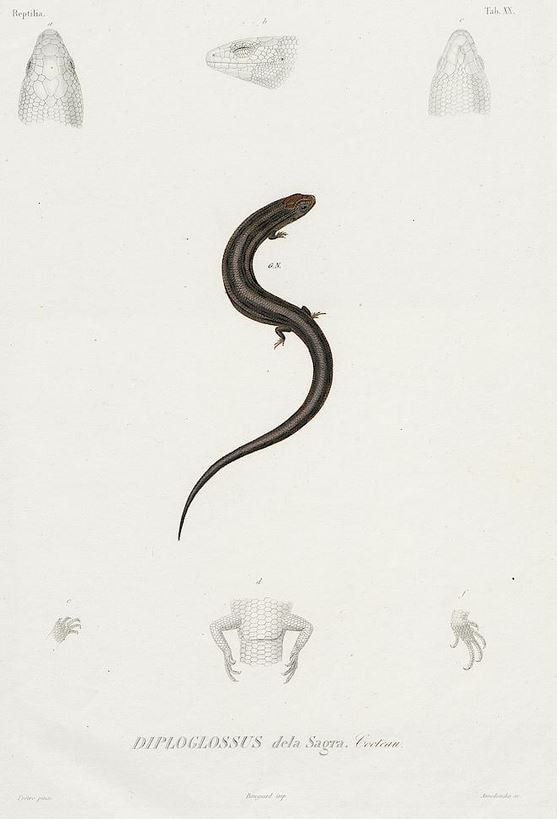
Cuban Galliwasp, La Culebrita De Cuatro Patas
Cuba
Forest, Orchard, Plantation
Small For the Genus Diploglossus., Adult Snout-To-Vent Length of About 12 cm ., Short-Legged Species., Dorsally Brown., Laterally Dark Brown To Black., Ventrally Yellowish Cream.
About Cuban pale-necked galliwasp
The Cuban Pale-Necked Galliwasp
The Cuban pale-necked galliwasp, scientifically known as Diploglossus delasagra, is a lizard species indigenous to the island of Cuba. It is also referred to by common names such as the Cuban galliwasp and, in Cuban Spanish, 'la culebrita de cuatro patas,' meaning 'the little four-legged snake.' This species belongs to the Diploglossidae family.
Habitat and Distribution
Diploglossus delasagra is endemic to Cuba. Its preferred natural environment is forest ecosystems. However, the species has also adapted to and can be found in cultivated areas, including orchards and plantations, indicating a degree of flexibility in its habitat selection.
Physical Characteristics
This galliwasp is considered small within its genus, Diploglossus. Adult individuals typically measure around 12 centimeters (4.7 inches) in snout-to-vent length. It is characterized by its short legs. The dorsal side of the body is brown, transitioning to a dark brown or black coloration along the lateral sides. The ventral surface, or belly, is a yellowish cream color.
Reproduction
The reproductive strategy of the Cuban pale-necked galliwasp is oviparous, meaning the females lay eggs. Further details regarding specific reproductive behaviors or clutch sizes are not extensively documented in available records.
Taxonomy and Etymology
The specific epithet, delasagra, honors the Spanish botanist Ramón de la Sagra. The species is classified under the family Diploglossidae.
Source: Wikipedia ↗
Frequently Asked Questions
What is the scientific name for the Cuban pale-necked galliwasp?
The scientific name for the Cuban pale-necked galliwasp is Diploglossus delasagra.
Where is the Cuban pale-necked galliwasp found?
This species is endemic to Cuba. Its natural habitat includes forests, but it can also be found in agricultural areas like orchards and plantations.
What are the physical characteristics of the Cuban pale-necked galliwasp?
Adults are small, with a snout-to-vent length of approximately 12 cm. They have short legs, a brown back, dark brown to black sides, and a yellowish cream belly.
How does the Cuban pale-necked galliwasp reproduce?
The Cuban pale-necked galliwasp is oviparous, meaning it reproduces by laying eggs.
What are the common names for Diploglossus delasagra?
Besides the Cuban pale-necked galliwasp, it is also known as the Cuban galliwasp and, in Cuban Spanish, as 'la culebrita de cuatro patas,' which translates to 'the little four-legged snake'.
Related Lizards

Painted-lipped lizard
The painted-lipped lizard (Calotes ceylonensis), also known as the Ceylon bloodsucker, is a colorful, arboreal agamid native to Sri Lanka. It inhabits monsoon forests, plantations, and home gardens, characterized by a distinctive bright red or reddish-orange stripe on its upper lip that can turn white when agitated. This diurnal lizard feeds on insects and other arthropods.

Aaron Bauer's house gecko
Aaron Bauer's house gecko is a species of lizard found in the Western Ghats of Maharashtra, India. It is notable for its relatively large size within its genus, reaching up to 13 cm in snout-to-vent length. This species prefers rocky outcrops within forested areas as its natural habitat.

Adolfus jacksoni
Adolfus jacksoni, also known as Jackson's forest lizard, is a species of lizard belonging to the Lacertidae family, native to East Africa. It prefers forest habitats at significant altitudes and exhibits diurnal and semi-arboreal behaviors. This oviparous species lays clutches of three to five eggs, and communal nesting sites have been observed.