
Painted-lipped lizard
The painted-lipped lizard (Calotes ceylonensis), also known as the Ceylon bloodsucker, is a colorful, arboreal agamid native to Sri Lanka. It inhabits monsoon forests, plantations, and home gardens, characterized by a distinctive bright red or reddish-orange stripe on its upper lip that can turn white when agitated. This diurnal lizard feeds on insects and other arthropods.
Key Facts
- ›Native to Sri Lanka, specifically in dry and intermediate monsoon forest zones.
- ›Features a prominent red or orange stripe on its upper lip, which can turn white when stressed.
- ›Active during the day and lives primarily on tree trunks.
- ›Diet consists of insects and other arthropods.
- ›Lays clutches of 5-10 eggs.

Ceylon Bloodsucker, Thol Visithuru Katussa
Sri Lanka
Monsoon Forest, Plantation, Home Garden, Dry Zone, Intermediate Zone
- Colorful, Arboreal Agamid.
- Head Length Is 1.5 Times Its Width.
- Body Is Laterally Compressed.
- Tail Is Long and Slender, Approximately Twice the Head-Body Length.
- Cheeks Are Swollen.
- Two Separated Spines Above the Tympanum.
- Nuchal Crest Formed By Low Spines.
- Midbody Scale Rows Number 54–60.
- Dorsum Is Brown With Indistinct Crossbands.
- Head and Anterior Body Are Blackish-Brown.
- Distinctive Bright Red Or Reddish-Orange Stripe On the Upper Lip Extending To the Back of the Head.
- This Lip Stripe Turns Bright White When the Lizard Is Threatened Or Agitated.
- Dorso-Nuchal Crest Also Turns Bright White When Agitated.
- Throat of Adult Males Is Black.
- Tail Is Brown With Dark Crossbands.
- Venter Is Pale Brown With Darker Crossbands.
Insects, Other Arthropods
Diurnal, Arboreal, Observed On Tree Trunks, Lip Color Changes When Threatened Or Agitated
About Painted-lipped lizard
The Painted-lipped Lizard
The painted-lipped lizard, known scientifically as Calotes ceylonensis and also by the common name Ceylon bloodsucker, is a vibrantly colored lizard endemic to Sri Lanka. This species belongs to the Agamidae family and is one of four Calotes species native to the island. Its striking appearance is marked by a distinctive bright red or reddish-orange stripe along its upper lip, a feature that can dramatically shift to a stark white when the lizard feels threatened or agitated.
Habitat and Distribution
This arboreal species is primarily found in the dry and intermediate zones of Sri Lanka. Its preferred habitats include monsoon forests, agricultural plantations, and even home gardens. Documented sightings and collections have occurred in various locations across the country, such as Mankulam, Nilgala, Minneriya National Park, and Sigiriya, generally at elevations up to approximately 400 meters.
Physical Characteristics and Behavior
The painted-lipped lizard possesses a laterally compressed body and a long, slender tail that is often twice the length of its head and body. Its head is notably wider than it is long, and its cheeks are described as swollen. Two small spines are visible above the tympanum, and a low nuchal crest adds to its unique morphology. The lizard's coloration is typically brown with indistinct crossbands, though its head and the front of its body can be blackish-brown. When agitated, not only does its lip stripe turn white, but its dorso-nuchal crest also becomes bright white. Adult males can be distinguished by their black throats. The painted-lipped lizard is diurnal, meaning it is active during daylight hours, and is often observed perched on tree trunks.
Diet and Reproduction
The diet of the painted-lipped lizard consists mainly of insects and other arthropods, which it likely hunts within its arboreal environment. Reproduction involves the laying of eggs; females typically produce clutches ranging from 5 to 10 eggs, each measuring around 14.5 mm by 16.5 mm.
Source: Wikipedia ↗
Frequently Asked Questions
What is the painted-lipped lizard?
The painted-lipped lizard, scientifically known as Calotes ceylonensis, is a species of lizard belonging to the Agamidae family. It is one of four Calotes species found exclusively in Sri Lanka and is also referred to as the Ceylon bloodsucker.
Where does the painted-lipped lizard live?
This lizard is confined to monsoon forests, plantations, and home gardens within the dry and intermediate zones of Sri Lanka. Recorded locations include Mankulam, Elahera, Nilgala, and Minneriya National Park, typically below 400 meters elevation.
What does the painted-lipped lizard look like?
It is a colorful, arboreal agamid with a laterally compressed body and a long, slender tail. A notable feature is a bright red or reddish-orange stripe on its upper lip, which can change to bright white when the lizard is threatened. Adult males have a black throat.
What does the painted-lipped lizard eat?
The diet of the painted-lipped lizard primarily comprises insects and other arthropods. They forage for their food within their arboreal habitat.
How does the painted-lipped lizard reproduce?
Reproduction involves the laying of eggs. Females typically produce clutches of 5 to 10 eggs, which measure approximately 14.5 mm by 16.5 mm each.
What is the behavior of the painted-lipped lizard?
The painted-lipped lizard is diurnal, meaning it is active during the day. It is often observed on tree trunks, where it spends its active hours.
Related Lizards

Sri Lanka golden gecko
The Sri Lanka golden gecko, scientifically known as Calodactylodes illingworthorum, is a large, rock-dwelling gecko endemic to the dry zone of Sri Lanka. Characterized by its yellow-ochre dorsum with dark brown spots and a bright yellow or orange throat, this species inhabits granitic caves within monsoon forests and savannahs. It is known to be oviparous and feeds on a variety of large insects and arthropods.
Cuban pale-necked galliwasp
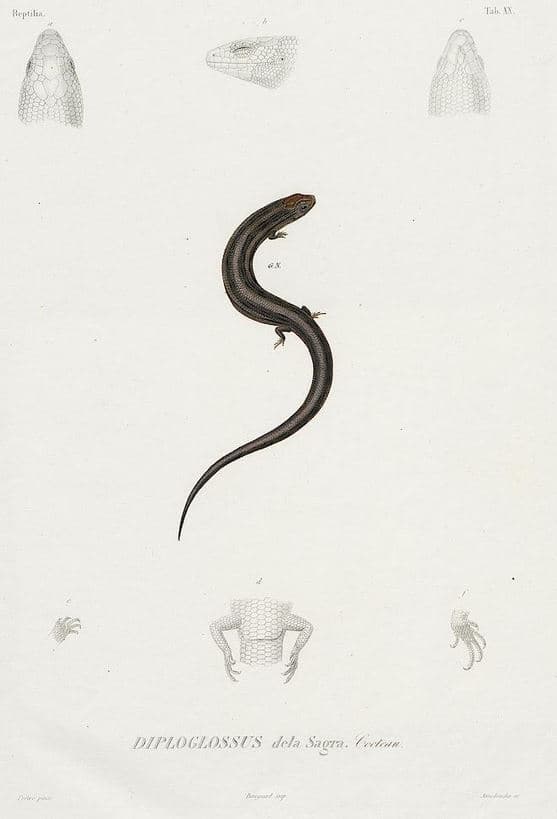
The Cuban pale-necked galliwasp (Diploglossus delasagra) is a small lizard species endemic to Cuba, characterized by its short legs and distinct coloration. It inhabits forests, orchards, and plantations, laying eggs as its primary method of reproduction.

Termite hill gecko
The Termite hill gecko, scientifically known as *Hemidactylus lankae*, is a ground-dwelling gecko species found exclusively in the dry zones of Sri Lanka. Characterized by its distinctive dark-light banding and saddle-like patches, it inhabits open forests and shrublands, sheltering in rock crevices and rodent burrows during the day. Its diet consists mainly of termites, supplemented by various insects and spiders.