
Cyrtodactylus pulchellus
The Malayan forest gecko, scientifically known as Cyrtodactylus pulchellus, is a species of gecko native to Southeast Asia. It is characterized by its depressed, oviform head, elongated body and limbs, and distinct coloration featuring broad chestnut-brown cross bands with light edges. This gecko inhabits forest environments across several Southeast Asian countries.
Key Facts
- ›Also known as the banded bent-toed gecko.
- ›Found in Southeast Asia, including NE India, Burma, Singapore, Thailand, and the Malay Peninsula.
- ›Possesses a granular head with small tubercles and enlarged granules on the snout.
- ›Distinguished by its light brown coloration with chestnut-brown, light-edged cross bands.
- ›Males have a specialized pubic region with preanal and femoral pores.
- ›Tail is cylindrical and tapering, with small scales and keeled tubercles.
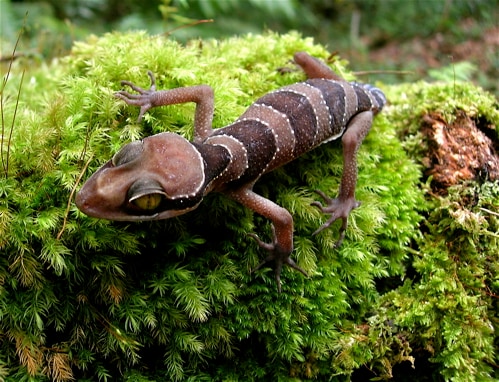
Malayan Forest Gecko, Banded Bent-Toed Gecko
Ne India, Burma, Singapore, Thailand, Malay Peninsula, Penang, Pulau Langkawi, Perak
- Head Is Large, Much Depressed, and Oviform.
- Snout Is Longer Than the Orbit.
- Ear Opening Is Suboval, Vertical, and Slightly Oblique.
- Body and Limbs Are Rather Elongate.
- Digits Are Strong, Depressed At the Base, and Compressed Further Up.
- Head Is Granular With Small Round Tubercles On Occipital and Temporal Regions, and Enlarged Granules On the Snout.
- Rostral Scale Is Subquadrangular.
- Males Have A Longitudinal Groove On the Pubic Region With Preanal Pores and A Series of Femoral Pores.
- Tail Is Cylindrical, Tapering, With Small Flat Scales and Annuli of Feebly Keeled Tubercles.
- Coloration Is Light Brown Above With Broad Chestnut-Brown, Light-Edged Cross Bands.
- Tail Has Chestnut-Brown Complete Annuli.
- Lower Surfaces Are Dirty White.
- Snout To Vent Length Is Approximately 4 Inches .
- Tail Length Is Approximately 5 Inches .
About Cyrtodactylus pulchellus
Malayan Forest Gecko (Cyrtodactylus pulchellus)
The Malayan forest gecko, scientifically classified as Cyrtodactylus pulchellus, is a species of gecko found throughout Southeast Asia. It is also commonly known as the banded bent-toed gecko, a name that hints at its distinctive appearance and morphology.
Description and Physical Characteristics
Cyrtodactylus pulchellus possesses a notable physical structure. Its head is large, depressed, and oviform (egg-shaped), with a snout that extends beyond the diameter of its eye. The skin of the head is granular, featuring small round tubercles on the occipital and temporal regions, while the snout has enlarged granules, except in specific concave areas. The body and limbs are described as rather elongate, and the digits are strong, showing a depressed base and compressed remaining portion, equipped with well-developed transverse plates beneath.
A key characteristic of this gecko is its coloration. It is typically light brown above, adorned with broad, chestnut-brown cross bands that are edged with a lighter hue. These bands are narrower than the spaces between them. The anterior band is horseshoe-shaped, running from eye to eye over the nape, followed by a crescent-shaped band on the scapular region, and three more on the body. The tail is adorned with complete chestnut-brown annuli. The ventral surfaces are generally a dirty white.
Males exhibit specific sexual dimorphism, featuring a longitudinal groove on the pubic region containing two parallel series of preanal pores. This is complemented by a long series of femoral pores, with a total of 18 to 20 pores on each side, forming a right angle. The tail is cylindrical and tapers, covered above with small flat scales and annuli of feebly keeled tubercles, while the underside features large transverse plates.
Distribution and Habitat
The Malayan forest gecko has a broad distribution across Southeast Asia. Its natural range includes Northeast India (Bengal), Burma, Singapore, Thailand (specifically in provinces like Phatthalung, Trang, Nakhon Si Thammarat, and Satun), and the Malay Peninsula. It is also found on islands such as Penang and Pulau Langkawi. Historically, Cyrtodactylus abrae from Australia was considered a synonym, but this is no longer the prevailing view. The species typically inhabits forest environments.
Size
Measurements indicate that the snout-to-vent length of Cyrtodactylus pulchellus can reach approximately 4 inches (about 10 cm), with the tail measuring around 5 inches (about 12.7 cm) in length, resulting in a total length of about 9 inches (approximately 22.7 cm).
Source: Wikipedia ↗
Frequently Asked Questions
What are the common names for Cyrtodactylus pulchellus?
Cyrtodactylus pulchellus is commonly referred to as the Malayan forest gecko. It is also known by the name banded bent-toed gecko.
Where is the Malayan forest gecko found?
This species is distributed across Southeast Asia. Its range includes parts of Northeast India (Bengal), Burma, Singapore, Thailand, and the Malay Peninsula, as well as islands like Penang and Pulau Langkawi.
What does Cyrtodactylus pulchellus look like?
It has a large, flattened, egg-shaped head and an elongated body and limbs. Its coloration is typically light brown with prominent chestnut-brown cross bands that have light edges. The tail is cylindrical and tapers to a point.
What are the distinctive physical features of this gecko?
Key features include a head that is longer than the orbit (eye diameter), a granular skin texture with small tubercles, and a distinctive pattern of cross bands. Males possess a specialized pubic region with preanal and femoral pores.
Are there any other scientific names associated with this species?
Historically, Cyrtodactylus abrae, found in Australia, was considered a synonym of Cyrtodactylus pulchellus, but this is no longer the accepted classification.
Related Lizards

Brookesia dentata
The toothed leaf chameleon, *Brookesia dentata*, is a species of chameleon native to northwestern Madagascar. Known for its small size and leaf-like camouflage, it inhabits forests and areas affected by human activity. This species is currently classified as endangered due to habitat decline.

Burmese false bloodsucker
The Burmese false bloodsucker, scientifically known as Pseudocalotes microlepis, is a species of agamid lizard native to Southeast Asia and southern China. It is characterized by its small scales and is found in forested environments within its geographic range.

Furcifer nicosiai
Furcifer nicosiai is a large chameleon species endemic to western Madagascar, specifically found within the Tsingy de Bemaraha National Park. Distinguished by its high parietal crest and lack of snout appendages, it shares similarities with Furcifer verrucosus but can be identified by its smaller size and different color patterns. It is currently classified as an endangered species due to habitat loss and degradation.