
Diplodactylus rankini
The Exmouth spiny-tailed gecko, scientifically known as *Strophurus rankini*, is a lizard species endemic to the Exmouth Gulf region of coastal Western Australia. It is characterized by its pale gray dorsal coloration, darker snout and lips, and grayish-white underside. This gecko is oviparous and inhabits shrubland in the supralittoral zone.
Key Facts
- ›Endemic to the Exmouth Gulf region of Western Australia, including Bernier Island.
- ›Possesses a pale gray dorsal coloration with darker shading on the snout and lips.
- ›Adults can reach a snout-to-vent length of up to 6.3 cm.
- ›Its tail is approximately two-thirds the length of its snout-to-vent length.
- ›Inhabits shrubland within the supralittoral zone.
- ›Reproduction is oviparous, meaning it lays eggs.

Rankin's Spiny-Tailed Gecko
Western Australia, Exmouth Gulf Region, Bernier Island
- Snout-To-Vent Length Up To 6.3 cm .
- Tail Length Is About Two-Thirds the Svl.
- Dorsally Pale Gray, Darker On the Snout and Lips.
- Ventrally Grayish-White.
About Diplodactylus rankini
Exmouth Spiny-tailed Gecko (Strophurus rankini)
The Exmouth spiny-tailed gecko, scientifically known as Strophurus rankini and also referred to as Rankin's spiny-tailed gecko, is a species of lizard belonging to the family Diplodactylidae. This species is exclusively found in the Exmouth Gulf region of coastal Western Australia, with its natural range extending to Bernier Island.
Habitat and Description
Strophurus rankini primarily inhabits shrubland environments, specifically within the supralittoral zone, which is the area above the high tide line. Physically, these geckos are of moderate size, with adults potentially reaching a snout-to-vent length (SVL) of up to 6.3 centimeters (2.5 inches). Their tail is proportionally significant, measuring approximately two-thirds of their SVL. The coloration of the Exmouth spiny-tailed gecko is distinct: its dorsal side is a pale gray, becoming darker on the snout and lips, while its ventral side is a grayish-white.
Reproduction
In terms of reproduction, Strophurus rankini is oviparous, meaning it reproduces by laying eggs. Further details regarding their breeding habits, such as clutch size or incubation periods, are not extensively documented in available records.
Source: Wikipedia ↗
Frequently Asked Questions
What is the scientific name of the Exmouth spiny-tailed gecko?
The scientific name of the Exmouth spiny-tailed gecko is *Strophurus rankini*. This binomial nomenclature identifies it within the scientific classification of species.
Where is the Exmouth spiny-tailed gecko found?
This species is endemic to the Exmouth Gulf region of coastal Western Australia. Its natural range also includes Bernier Island.
What is the typical habitat of *Strophurus rankini*?
*Strophurus rankini* is found in shrubland environments. Specifically, it inhabits the supralittoral zone, which is the area above the high tide mark.
What are the physical characteristics of the Exmouth spiny-tailed gecko?
The Exmouth spiny-tailed gecko has a pale gray coloration on its back, with the snout and lips appearing darker. Its underside is grayish-white. Adults may reach a snout-to-vent length of up to 6.3 cm, with a tail about two-thirds of that length.
How does the Exmouth spiny-tailed gecko reproduce?
The Exmouth spiny-tailed gecko is oviparous. This means that the species reproduces by laying eggs.
Related Lizards

Pygomeles braconnieri
Pygomeles braconnieri, also known as Braconnier's short skink, is a lizard species endemic to Madagascar. This unique reptile is characterized by its lack of front legs and very small, styliform hind legs, as well as the absence of visible ear openings. It inhabits sandy soils in supralittoral zones and forests.
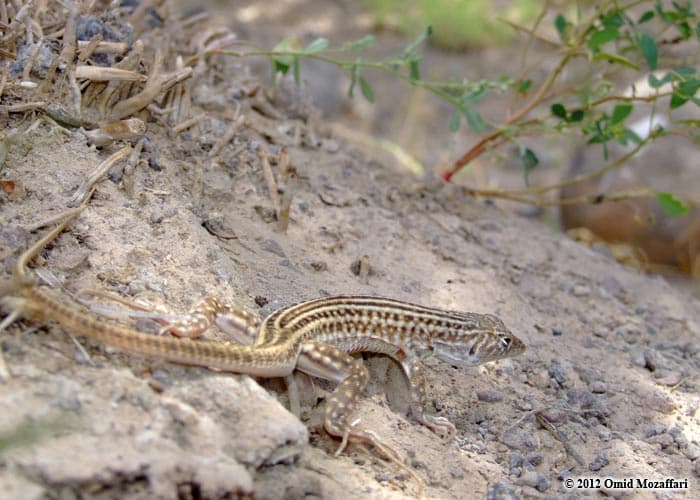
Acanthodactylus cantoris
The Indian fringe-fingered lizard (Acanthodactylus cantoris) is a terrestrial species endemic to Asia, primarily found in sandy desert and shrubland habitats. It is characterized by its acutely pointed snout, keeled dorsal scales, and strong digital denticulations. This oviparous lizard burrows in the sand for protection and its young have distinctive white longitudinal lines on a blackish background.

Agama anchietae
Agama anchietae, commonly known as Anchieta's agama or the western rock agama, is a species of lizard native to southern Africa. It is characterized by its cryptic coloration, a wider head and longer tail in males due to sexual dimorphism, and a diet primarily consisting of insects, particularly ants. This species inhabits diverse environments including deserts, shrublands, and grasslands, and it reproduces by laying eggs.