
Agama anchietae
Agama anchietae, commonly known as Anchieta's agama or the western rock agama, is a species of lizard native to southern Africa. It is characterized by its cryptic coloration, a wider head and longer tail in males due to sexual dimorphism, and a diet primarily consisting of insects, particularly ants. This species inhabits diverse environments including deserts, shrublands, and grasslands, and it reproduces by laying eggs.
Key Facts
- ›Native to southern Africa, found in Angola, Botswana, Congo, Namibia, and South Africa.
- ›Inhabits desert, shrubland, and grassland environments.
- ›Primarily insectivorous, with a diet consisting mainly of ants.
- ›Exhibits sexual dimorphism; males have broader heads and longer tails than females.
- ›Known for its cryptic coloration, which is associated with a more solitary lifestyle compared to other Agama species.
- ›Reproduction is oviparous, meaning they lay eggs.

Anchieta's Agama, Western Rock Agama
Angola, Botswana, Congo, Namibia, South Africa
- Exhibits Sexual Dimorphism, With Males Having A Wider Head and Longer Tail Than Females.
- Possesses Cryptic Coloration, Making It Less Brightly Colored Than Some Other Agama Species.
- the Specific Coloration Is Associated With A Relatively Solitary Lifestyle.
Insects, Ants
Relatively Solitary Lifestyle.
About Agama anchietae
Agama anchietae, commonly known as Anchieta's agama or the western rock agama, is a species of lizard belonging to the family Agamidae. This species is native to the southern African region.
Etymology
The specific name, anchietae, honors Portuguese naturalist José Alberto de Oliveira Anchieta, who was an explorer of Africa. This naming convention highlights the historical exploration and scientific study of the continent's fauna.
Geographic Range and Habitat
Agama anchietae is distributed across several southern African countries, including Angola, Botswana, Congo, Namibia, and South Africa. It demonstrates adaptability to a variety of habitats, being found in desert environments, shrublands, and grasslands. This broad habitat preference allows it to thrive in diverse ecological niches within its range.
Diet and Description
The diet of Agama anchietae primarily consists of insects, with a particular emphasis on ants. Physically, the species exhibits sexual dimorphism. Males are distinguished by a wider head and a longer tail compared to females. In terms of coloration, Agama anchietae is noted for being one of the more cryptically colored members within the genus Agama. This subdued coloring is contrasted with the more vibrant hues of social species like Agama planiceps, and it is associated with the western rock agama's relatively solitary lifestyle.
Reproduction
Agama anchietae reproduces by laying eggs, a method known as being oviparous. This is a common reproductive strategy among many lizard species, ensuring the continuation of the species through egg development outside the mother's body.
Source: Wikipedia ↗
Frequently Asked Questions
What is Agama anchietae commonly called?
Agama anchietae is commonly referred to as Anchieta's agama or the western rock agama. These names reflect its association with naturalist José Alberto de Oliveira Anchieta and its typical habitat.
Where can Agama anchietae be found?
This lizard species is native to southern Africa and has been documented in Angola, Botswana, Congo, Namibia, and South Africa. Its geographic range covers a significant portion of this region.
What kind of habitats does Anchieta's agama prefer?
Agama anchietae is adaptable and can be found in a variety of environments. These include desert regions, shrublands, and grasslands, indicating a tolerance for arid to semi-arid conditions.
What does Anchieta's agama eat?
The diet of Agama anchietae is primarily insectivorous. It subsists mainly on insects, with ants being a particularly important part of its food intake.
Are there physical differences between male and female Agama anchietae?
Yes, Agama anchietae exhibits sexual dimorphism. Males typically possess a wider head and a longer tail when compared to females of the same species.
How does Agama anchietae reproduce?
Agama anchietae is oviparous, which means that reproduction occurs through the laying of eggs. This is a common reproductive strategy among many reptile species.
Is Agama anchietae brightly colored?
Compared to some other members of the Agama genus, Agama anchietae is considered to have more cryptic coloration. This subdued coloring is thought to be related to its relatively solitary lifestyle.
Related Lizards
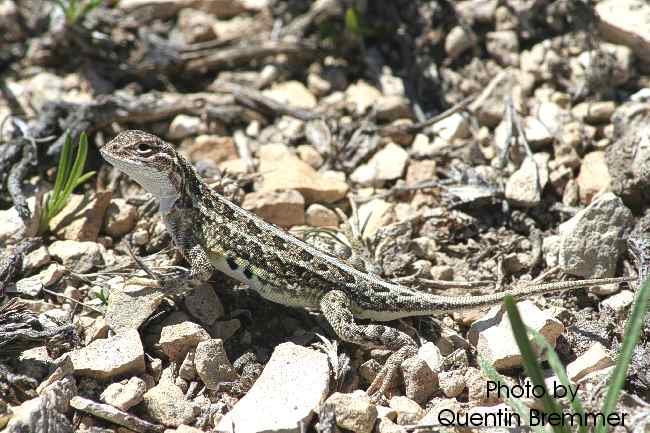
Lesser earless lizard
The lesser earless lizard (Holbrookia maculata) is a small reptile native to the southwestern and central United States and northern Mexico. Adults typically reach a total length of 4 to 5 inches, characterized by smooth, granular dorsal scales and the absence of external ear openings. This species primarily inhabits shrubland, grassland, and desert environments.

Mesalina olivieri
Mesalina olivieri, also known as Olivier's sand lizard, is a species of sand-dwelling lizard native to North Africa and the Middle East. Primarily inhabiting desert, grassland, and shrubland environments, this terrestrial and diurnal species feeds mainly on ants and other small arthropods. It reproduces by laying two to four eggs per clutch, with sexually mature females laying at least two clutches annually.
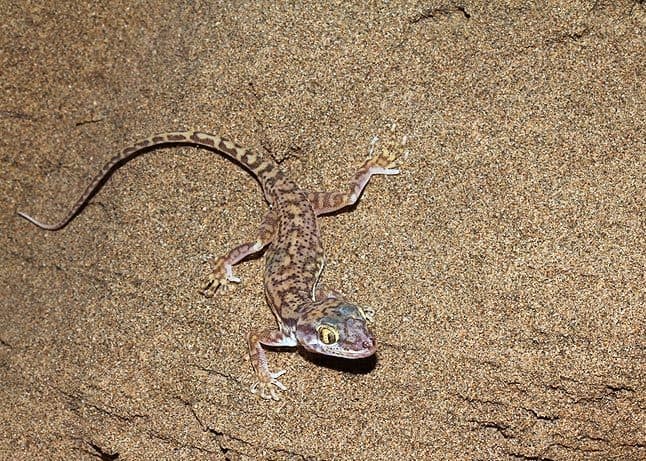
Crossobamon eversmanni
Crossobamon eversmanni, commonly known as the comb-toed gecko, is a species of Asian gecko found in desert, grassland, and shrubland habitats across Iran, Pakistan, and Central Asia. This terrestrial and nocturnal lizard is characterized by its burrowing behavior and oviparous reproduction, with females laying one to two eggs per clutch.