
Dutta's Mahendragiri gecko
Dutta's Mahendragiri gecko is a large-bodied, tuberculate gecko species native to Andhra Pradesh, India. Distinctive features include its scalation of small granules interspersed with prominent, pointed tubercles, and specific counts of subdigital lamellae and labial scales. These geckos are characterized by their robust build and a unique arrangement of tubercles on their body and tail.
Key Facts
- ›Found in Andhra Pradesh, India.
- ›Possesses a large body size with a snout-to-vent length of at least 105 mm.
- ›Dorsal scalation features small granules and large, pointed, trihedral tubercles in regular rows.
- ›Males have 20-23 femoral pores separated by poreless scales.
- ›Exhibits 6-8 strongly pointed and keeled enlarged tubercles on the original tail.

Dutta's Mahendragiri Gecko
India
- Large-Bodied Gecko.
- Tuberculate Scalation.
- Snout To Vent Length Up To At Least 105 mm.
- Dorsal Scalation of Small Granules Intermixed With Large, Pointed, Trihedral Tubercles.
- Tubercles Form 16–17 Fairly Regularly Arranged Longitudinal Rows At Midbody.
- 9–11 Subdigital Lamellae Below the First Digit.
- 11–13 Subdigital Lamellae Below the Fourth Digit.
- 6–8 Strongly Pointed and Keeled Enlarged Tubercles On the Original Tail.
- 20–23 Femoral Pores Separated By 4 Poreless Scales In Males.
- 11–13 Supralabials.
- 9–11 Infralabials.
About Dutta's Mahendragiri gecko
Dutta's Mahendragiri gecko, scientifically known as Hemidactylus sushilduttai, is a species of gecko distinguished by its large body and prominent tuberculate scales. This reptile is native to the Indian state of Andhra Pradesh, where its presence has been documented.
Anatomy and Description
This species exhibits a robust physical form, with a snout-to-vent length reaching at least 105 millimeters. Its most striking characteristic is its dorsal scalation, which consists of a mosaic of small granules interspersed with larger, pointed, trihedral tubercles. These tubercles are often arranged in 16 to 17 fairly regular longitudinal rows along the midbody. Further anatomical details include the number of subdigital lamellae on its digits, with 9 to 11 found below the first digit and 11 to 13 below the fourth. Males of the species possess 20 to 23 femoral pores, separated by four poreless scales. The gecko also has 11 to 13 supralabial scales and 9 to 11 infralabial scales.
Tail Morphology
The tail of Dutta's Mahendragiri gecko is also notable for its ornamentation. It features 6 to 8 strongly pointed and keeled enlarged tubercles, contributing to the species' overall tuberculate appearance. The exact function of these specialized tubercles on the tail is not detailed in available records.
Discovery and Taxonomy
The species is named in honor of Sushil Dutta, and its classification places it within the genus Hemidactylus, a group known for its diversity of geckos. While its specific habitat preferences and ecological role are areas for further study, its discovery highlights the ongoing exploration of India's herpetological biodiversity.
Source: Wikipedia ↗
Frequently Asked Questions
What is the scientific name of Dutta's Mahendragiri gecko?
The scientific name for Dutta's Mahendragiri gecko is Hemidactylus sushilduttai. This binomial nomenclature identifies it as a distinct species within the Hemidactylus genus.
Where is Dutta's Mahendragiri gecko found?
This gecko species is found in the region of Andhra Pradesh, India. Its distribution is specifically documented within this Indian state.
What are the distinctive physical characteristics of Dutta's Mahendragiri gecko?
Dutta's Mahendragiri gecko is recognized by its large body and tuberculate scales. Its dorsal surface is covered in small granules mixed with large, pointed, trihedral tubercles arranged in longitudinal rows. It also has specific numbers of subdigital lamellae and labial scales.
How large can Dutta's Mahendragiri gecko grow?
Dutta's Mahendragiri gecko can reach a snout-to-vent length of at least 105 mm. This indicates it is a relatively large-bodied gecko species.
Are there any notable features on the tail of this gecko?
Yes, the original tail of Dutta's Mahendragiri gecko is adorned with 6 to 8 strongly pointed and keeled enlarged tubercles. These tubercles contribute to its distinctive tuberculate appearance.
Related Lizards
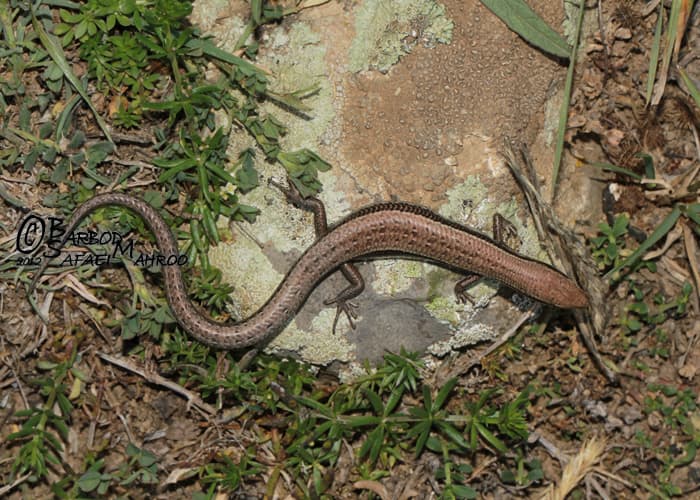
Ablepharus bivittatus
The twin-striped skink (Ablepharus bivittatus) is a species of skink found in mountainous regions of Armenia, Azerbaijan, Turkmenistan, northwestern Iran, and Turkey. It is distinguished by its habitat in high elevations, typically between 2,300 and 3,300 meters.
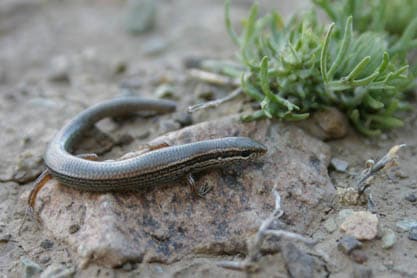
Ablepharus pannonicus
The Asian snake-eyed skink (Ablepharus pannonicus) is a species of skink native to a wide range across Asia and parts of the Middle East. It is characterized by its snake-like appearance and is found in diverse arid and semi-arid environments.

Adam's dravidogecko
Adam's dravidogecko (Dravidogecko douglasadamsi) is a species of gecko native to India. Little is documented about its specific characteristics, habitat, or behaviors, making it a relatively understudied species.