
Egernia napoleonis
The southwestern crevice-skink (Egernia napoleonis) is a large skink species endemic to Western Australia. Characterized by its robust, flattened body and keeled dorsal scales, it displays olive-brown coloration with darker spots and a pale flank zone, while its underside ranges from salmon pink to orangish brown. This species inhabits forests, shrublands, and rocky outcrops, exhibiting both arboreal and rock-dwelling behaviors.
Key Facts
- ›Endemic to southwestern Western Australia and islands of the Recherche Archipelago.
- ›Adults typically have a snout-to-vent length of around 13.5 cm.
- ›Features keeled dorsal scales with two to four sharp keels per scale.
- ›Inhabits forests, shrublands, and rocky outcrops.
- ›Both arboreal and saxicolous, sheltering under bark and in rock crevices.
- ›Reproduction method is ovoviviparous.
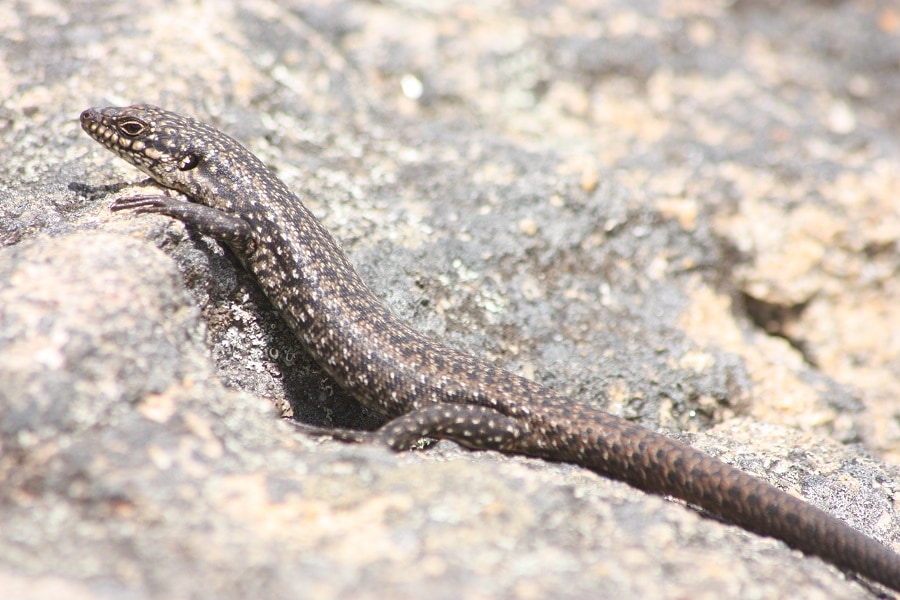
South-Western Crevice Skink, Napoleon Skink
Western Australia, Recherche Archipelago
- Adults Usually Have A Snout-To-Vent Length of About 13.5 cm.
- Body Is Robust and Relatively Flattened.
- Dorsal Scales Are Keeled, With Two To Four Sharp Keels Per Scale.
- Dorsal Coloration Is Olive Brown With Small Darker Spots In Three Longitudinal Series.
- Broad Pale Zone On the Flanks.
- Ventral Coloration Is Salmon Pink To Orangish Brown.
Arboreal, Saxicolous, Shelters Under Bark, Shelters In Rock Crevices
About Egernia napoleonis
Egernia napoleonis: The Southwestern Crevice-Skink
The southwestern crevice-skink, scientifically classified as Egernia napoleonis and also commonly referred to as the south-western crevice skink or Napoleon skink, is a notable species of large skink found exclusively in the Australian state of Western Australia. Its specific name, "napoleonis," is derived from "Terre Napoléon," an historical designation for parts of southern Australia.
Physical Characteristics and Habitat
Adult individuals of Egernia napoleonis typically measure around 13.5 centimeters in snout-to-vent length. The lizard possesses a robust and somewhat flattened body. Its dorsal scales are distinctly keeled, each bearing two to four sharp keels. The coloration of the upper body is generally olive brown, often adorned with small, darker spots that tend to form three longitudinal rows. A prominent feature is a broad pale band running along the flanks. The underside of the skink ranges in color from salmon pink to orangish brown.
This species is primarily found in the southwestern region of Western Australia, including the islands that comprise the Recherche Archipelago. Its preferred natural environments include forests, shrublands, and rocky outcrops, where it can effectively find shelter and sustenance.
Behavior and Reproduction
Egernia napoleonis exhibits adaptability in its lifestyle, being both arboreal, meaning it lives in trees, and saxicolous, meaning it dwells among rocks. It seeks refuge by sheltering beneath loose bark and within the crevices of rocks. The species is ovoviviparous, a reproductive strategy where eggs develop and hatch internally within the mother, leading to the birth of live young.
Source: Wikipedia ↗
Frequently Asked Questions
What is the southwestern crevice-skink?
The southwestern crevice-skink, scientifically known as Egernia napoleonis, is a species of large skink belonging to the subfamily Egerniinae. It is native to the Australian state of Western Australia, including its southwestern regions and offshore islands.
What does the southwestern crevice-skink look like?
Adults typically reach a snout-to-vent length of about 13.5 cm. They possess a robust, flattened body with olive-brown coloration dorsally, marked by small, dark spots arranged in longitudinal series. Their flanks have a broad pale zone, and their undersides are salmon pink to orangish brown. The dorsal scales are notably keeled, with each scale bearing two to four sharp keels.
Where is the Egernia napoleonis found?
This species is geographically distributed across southwestern Western Australia. Its range includes the mainland areas of this region as well as the islands of the Recherche Archipelago.
What kind of habitats does the southwestern crevice-skink prefer?
Egernia napoleonis thrives in a variety of natural environments. Its preferred habitats include forests, shrublands, and rocky outcrops, where it can find suitable shelter and foraging grounds.
How does the southwestern crevice-skink behave?
This skink exhibits a dual lifestyle, being both arboreal (tree-dwelling) and saxicolous (rock-dwelling). It seeks refuge and shelter under loose bark and within the crevices of rocks.
What is the reproductive method of Egernia napoleonis?
The southwestern crevice-skink reproduces via ovoviviparity. This means that the eggs develop and hatch internally within the mother, and she gives birth to live young.
Related Lizards

Cordylus melanotus
The Cordylus melanotus, commonly known as the common crag lizard or Highveld crag lizard, is a species of ovoviviparous lizard found across Eswatini, Lesotho, and South Africa. It inhabits rocky outcrops, hills, and mountains, tolerating temperatures as low as -5°C. This species is characterized by its adaptability to various mountainous regions within southern Africa.

Diplodactylus conspicillatus
The variable fat-tailed gecko (Diplodactylus conspicillatus) is a small to medium-sized lizard endemic to arid and semi-arid regions of Australia. Characterized by its stout body, short limbs, and a broad, flat tail, it typically displays a fawn to reddish-brown coloration with a reticulated pattern and pale speckles. This nocturnal insectivore primarily feeds on termites and is known for its unique burrow-plugging behavior, though much of its ecology remains under-researched.

Egernia stokesii
Egernia stokesii, also known as the Gidgee skink or spiny-tailed skink, is a gregarious lizard species native to Australia. It is distinguished by its spiny tail and complex social structures, forming stable, long-term aggregations. This diurnal species inhabits semi-arid environments and exhibits an omnivorous diet. While the species as a whole is listed as Least Concern, one subspecies is considered endangered.