
Egernia stokesii
Egernia stokesii, also known as the Gidgee skink or spiny-tailed skink, is a gregarious lizard species native to Australia. It is distinguished by its spiny tail and complex social structures, forming stable, long-term aggregations. This diurnal species inhabits semi-arid environments and exhibits an omnivorous diet. While the species as a whole is listed as Least Concern, one subspecies is considered endangered.
Key Facts
- ›Forms stable, long-term social aggregations of up to 17 closely related individuals.
- ›Possesses a flattened, spiny tail that is shorter than its body and cannot be autotomized.
- ›Is omnivorous, consuming arthropods and plant material such as seeds.
- ›Is viviparous, giving birth to between 1 and 8 young per litter.
- ›Found in semi-arid environments across New South Wales, Northern Territory, Queensland, South Australia, and Western Australia.
- ›The species has a lifespan of 10 to 25 years and reaches sexual maturity between five and six years of age.

Gidgee Skink, Spiny-Tailed Skink, Stokes's Skink, Stokes's Egernia
Australia, New South Wales, Northern Territory, Queensland, South Australia, Western Australia
- Coloration Ranges From Olive To Reddish Brown Dorsally, With Lighter Ventral Scales From White To Yellow.
- Often Displays Scatterings of Lighter Colored Dorsal Scales.
- Dorsal Scales Are Keeled From the Back of the Neck To the Tail.
- Prominent Spiny Tail Scales.
- Tail Is Flattened, Not Cylindrical, and Shorter Than the Head and Body, Approximately 35% of Snout-To-Vent Length.
- Snout-To-Vent Length of Mature Adults Is Between 155 and 190mm.
- Arthropods
- Plant Material
- Juveniles Consume A Higher Proportion of Insects.
- Adults Consume A Proportionally Higher Percentage of Plants, Especially During Mid To Late Summer.
- Gregarious, Forming Stable, Long-Term Social Aggregations of Up To 17 Related Individuals.
- Diurnal.
- Philopatric, With Juveniles Staying Within the Natal Group Until Maturity.
- Exhibit Complex Social Organization Aiding In Predator Detection and Thermoregulation.
- Bask In Close Contact With Group Members.
- Shelter In Rock Crevices, Under Logs, Or In Tree Hollows.
- Defensive Behaviors Include Remaining Close To Refuges and Utilizing Their Spiny Tail.
Mammals, Reptiles, Birds of Prey
Habitat Fragmentation, Agricultural Activities, Mining, Altered Fire Regimes, Land Clearing, Grazing, Cropping
About Egernia stokesii
Egernia stokesii: The Gidgee Skink
Egernia stokesii, commonly known as the Gidgee skink or spiny-tailed skink, is a remarkable lizard species native to Australia, belonging to the Scincidae family. This diurnal species is notable for its gregarious nature and complex social structures, a trait uncommon among reptiles of the Squamata order. They form stable, long-term social aggregations, often consisting of closely related individuals, which are believed to enhance predator detection and thermoregulation.
Description and Ecology
The spiny-tailed skink exhibits a color range from olive to reddish-brown, with lighter ventral scales and scattered lighter dorsal scales. A defining characteristic is its spiny tail, which is flattened and shorter than its body, and cannot be autotomized. Mature adults typically measure between 15.5 and 19.0 cm in snout-to-vent length. Egernia stokesii reaches sexual maturity slowly, between five and six years of age, and has a lifespan of 10 to 25 years. They are omnivorous, feeding on arthropods like beetles and grasshoppers, alongside plant material such as seeds from native and introduced flora. Juvenile diets lean more towards insects, while adults consume a higher proportion of plants, especially in late summer.
Habitat and Social Behavior
Egernia stokesii inhabits semi-arid environments across Australia, including New South Wales, the Northern Territory, Queensland, South Australia, and Western Australia. They are saxicolous, preferring rocky outcrops, or can be found in grassland, woodland, and shrubland habitats. Rather than burrowing, they shelter in rock crevices, under logs, or in tree hollows. Social aggregations are a key feature, typically comprising a breeding pair, offspring of various ages, and other related individuals. These groups maintain defined home ranges with shared refuge crevices and communal scat piles, demonstrating an ability to distinguish group members through olfactory cues.
Reproduction and Conservation
This species is viviparous, giving birth to live young. Litters range from 1 to 8 offspring. They are known for their monogamous relationships, with a preference for mates with dissimilar genotypes. Newborn skinks measure between 6.5 and 9.5 cm in snout-to-vent length. While the species as a whole is classified as Least Concern by the IUCN, its populations are fragmented and decreasing due to habitat degradation from activities like agriculture and mining. Notably, the subspecies E. stokesii badia (Western spiny-tailed skink) is listed as endangered due to threats such as land clearing and grazing.
Etymology
The specific name, stokesii, honors Royal Navy Admiral John Lort Stokes. The subspecific name, zellingi, is in honor of British biological collector Charles Weldon De Burgh Birch, Count Zelling.
Source: Wikipedia ↗
Frequently Asked Questions
What are the common names for Egernia stokesii?
Egernia stokesii is commonly known as the Gidgee skink, spiny-tailed skink, Stokes's skink, and Stokes's egernia.
What is the typical lifespan of an Egernia stokesii?
The typical lifespan for Egernia stokesii ranges between 10 and 25 years. They are slow to reach sexual maturity, generally between five and six years of age.
What is the diet of the spiny-tailed skink?
The spiny-tailed skink is omnivorous. Its diet includes arthropods such as beetles and grasshoppers, as well as plant material like seeds from native and introduced flora.
Where is Egernia stokesii found?
Egernia stokesii is endemic to Australia and is found in New South Wales, the Northern Territory, Queensland, South Australia, and Western Australia. They inhabit semi-arid environments.
What are the unique social behaviors of Egernia stokesii?
This species exhibits complex social organization, forming stable aggregations of closely related individuals. These groups, which can include breeding pairs and offspring, help with predator detection and thermoregulation.
What is the conservation status of Egernia stokesii?
The species Egernia stokesii is listed as Least Concern by the IUCN. However, one of its subspecies, E. stokesii badia, is listed as endangered.
How does Egernia stokesii reproduce?
Egernia stokesii are viviparous, meaning they give birth to live young. Litters typically consist of 1 to 8 offspring, and they tend to be highly monogamous with evidence of mate selection.
Related Lizards

Sceloporus grammicus
Sceloporus grammicus, also known as the mesquite lizard or graphic spiny lizard, is a flat-bodied species found in Mexico and the southern United States. Adults typically measure between 10 and 17.5 cm in total length and display a mottled olive or gray dorsum with dark crossbars. This viviparous lizard gives birth to litters ranging from 2 to 12 offspring.

Ctenophorus fordi
The Mallee dragon (Ctenophorus fordi) is a small lizard native to the arid regions of southern Australia, characterized by its reddish-orange coloration and pale, black-bordered stripes. It inhabits shrubland and hummock grass environments, particularly in Mallee woodlands and spinifex areas, often near vegetated sand dunes. This species is primarily an ant specialist, employing a sit-and-wait strategy to ambush its prey.
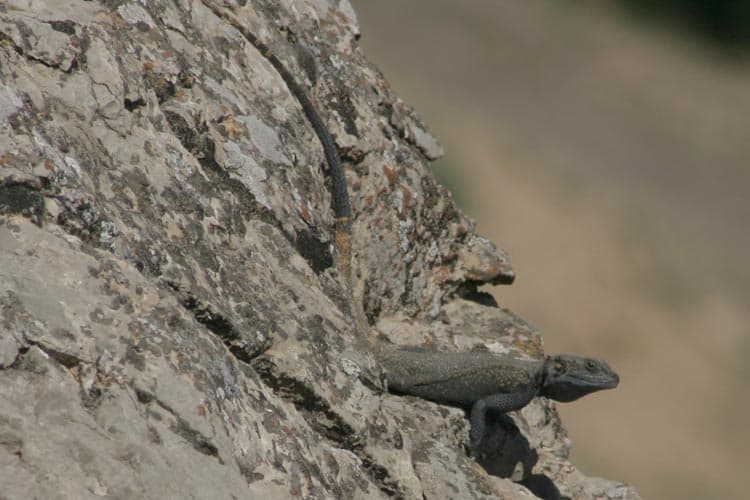
Laudakia nupta
Laudakia nupta, commonly known as the large-scaled rock agama, is a species of lizard native to western Asia, specifically found in Iraq, Iran, Afghanistan, and Pakistan. This species is characterized by its large size, heavy head, and vertebral enlarged scales along its back. It primarily inhabits rocky areas with crevices and man-made structures, and its diet consists mainly of plants, though one subspecies is known to be omnivorous.