
Erhard's wall lizard
Erhard's wall lizard, also known as the Aegean wall lizard, is a species of lizard endemic to Southeast Europe, primarily found in the Balkan peninsula and Aegean islands. It is characterized by its variable coloration, typically grey or brown with stripes, and a belly that can range from white to red or even blue in some island populations. This species inhabits dry, rocky areas with low bushes, demonstrating excellent climbing abilities and utilizing camouflage for predator avoidance.
Key Facts
- ›Endemic to Southeast Europe, including the Balkan peninsula and Aegean islands.
- ›Snout-to-vent length averages about 7 cm, with a tail twice that length.
- ›Coloration is highly variable, ranging from grey, brown, and green, often with stripes.
- ›Inhabits dry, rocky areas with dense, low bushes and is an excellent climber.
- ›Feeds primarily on arthropods, especially insects.
- ›Mates in spring, lays eggs in early summer, and young hatch in September.

Aegean Wall Lizard
Albania, North Macedonia, Serbia, Bulgaria, Greece, Aegean Islands
Dry Rocky Areas, Areas With Dense Low Bushes, Open Plant-Covered Dunes
- Snout-To-Vent Length Approximately 7 cm .
- Tail Is Twice the Snout-To-Vent Length.
- Head Is Rather Wide.
- Skin Is Smooth.
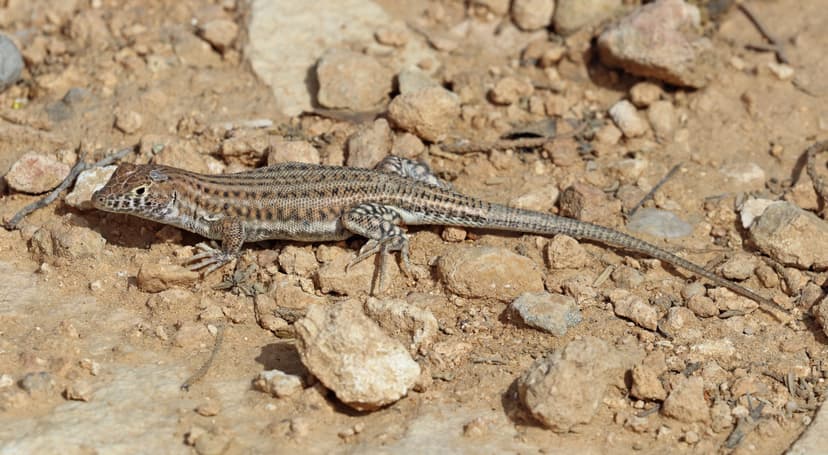
- Coloration Is Highly Variable: Typically Grey Or Brown, Sometimes Green.
- Females Often Striped, With Two White Stripes Bordering Two Dark Or Spotty Lines On the Edges of the Back.
- A Dark Line May Be Present In the Middle of the Back.
- Some Males Have Net-Like Patterning.
- Belly and Throat Typically White, Yellow, Orange, Or Red.
- In Aegean Islands, Belly Can Also Be Green, Blue, Or Grey.
- Belly Is Never Spotty, But Blue Spots May Appear On Hind Legs.
Arthropods, Insects
- Chooses Backgrounds Matching Its Color For Camouflage.
- Excellent Climber.
Avian Predators
About Erhard's wall lizard
Erhard's wall lizard, scientifically identified as Podarcis erhardii and also commonly known as the Aegean wall lizard, is a species of lizard native to Southeast Europe. This reptile is a member of the Lacertidae family and is primarily found inhabiting the Balkan peninsula and the numerous islands of the Aegean Sea.
Description and Habitat
The physical characteristics of Erhard's wall lizard are quite variable, adding to its diverse populations across its range. Adults typically measure around 7 centimeters (2.8 inches) from snout to vent, with a tail that is roughly twice this length. The head is described as rather wide, and the skin is smooth. Coloration ranges significantly, with common base colors including grey, brown, and occasionally green. Females often display distinct striping patterns, particularly along the edges of their backs. Males can exhibit intricate, net-like patterns. The underside, including the belly and throat, commonly presents in shades of white, yellow, orange, or red, though populations on the Aegean Islands may feature green, blue, or grey bellies, sometimes with blue spots on the hind legs.
Erhard's wall lizard thrives in dry, rocky environments characterized by dense, low-growing bushes. They are highly agile climbers, adept at navigating their rugged terrain. In the Aegean archipelago, these lizards also inhabit more open spaces, such as vegetated dunes, showcasing their adaptability to different microhabitats within their broader geographic distribution.
Diet and Reproduction
The diet of Erhard's wall lizard primarily consists of arthropods, with a strong preference for insects. They actively hunt these small invertebrates within their preferred habitats.
Reproductively, the species engages in mating during the spring season. Egg-laying typically occurs at the commencement of summer. The young hatchlings emerge in September, measuring approximately 3 centimeters (1.2 inches) in length, ready to begin their lives in the varied landscapes of Southeast Europe.
Source: Wikipedia ↗
Frequently Asked Questions
What is Erhard's wall lizard?
Erhard's wall lizard, scientifically known as Podarcis erhardii, is a species of lizard found in Southeast Europe. It is part of the Lacertidae family and is also commonly referred to as the Aegean wall lizard.
Where does Erhard's wall lizard live?
This lizard species is endemic to Southeast Europe, with its geographic range covering the Balkan peninsula and the Aegean islands. On the mainland, it is found in countries like Albania, North Macedonia, Serbia, and Bulgaria, extending into Greece.
What does Erhard's wall lizard look like?
Erhard's wall lizard has a snout-to-vent length of approximately 7 cm, with a tail that is twice its body length. Its coloration varies significantly, but it is typically grey or brown, sometimes with green hues, and often features stripes. The belly and throat can be white, yellow, orange, or red, and in the Aegean Islands, may even be green or blue.
What is the habitat of Erhard's wall lizard?
Erhard's wall lizard prefers dry or rocky environments that are interspersed with dense, low bushes. They are very adept at climbing and can also be found in open, plant-covered areas like dunes, particularly in the Aegean archipelago.
What does Erhard's wall lizard eat?
The diet of Erhard's wall lizard consists mainly of arthropods, with a particular emphasis on insects. They forage for these small invertebrates in their natural habitat.
When does Erhard's wall lizard reproduce?
Reproduction for Erhard's wall lizard occurs in the spring, with egg-laying taking place at the beginning of summer. The young lizards typically hatch in September, measuring around 3 cm at birth.
How does Erhard's wall lizard avoid predators?
Erhard's wall lizard employs camouflage as a defense mechanism against predators, especially avian ones. They actively choose backgrounds that match their own coloration to blend in effectively within their natural surroundings.
Related Lizards

Ablepharus
Ablepharus, commonly known as snake-eyed skinks, are small lizards distinguished by fused eyelids that prevent blinking, similar to snakes. They inhabit dry fields, hills, and rocky areas, often concealed within leaf litter. These skinks possess shiny, bronze scales and a characteristic dark stripe along their sides, feeding primarily on small insects and mollusks.

Acanthocercus atricollis
The black-necked agama, Acanthocercus atricollis, is a species of tree agama found across East, Central, and southern Africa. These lizards are known for forming structured colonies and are often found in high densities near human settlements due to reduced predator presence. They are primarily insectivorous ambush predators.
Acanthodactylus boskianus
Bosc's fringe-toed lizard (Acanthodactylus boskianus) is a medium-sized lizard found across North Africa and Western Asia. It is characterized by its olive-grey dorsal surface with dark stripes and distinctive long, fringed digits on its feet. This fast-moving lizard inhabits diverse environments, from coastal plains to oases, and is a common diurnal species within its extensive range.