
Eutropis rugifera
Eutropis rugifera, also known as the Nicobar Island skink or rough-scaled sun skink, is a species of skink found across southeastern Asia. This lizard is characterized by strongly keeled scales and a dark olive-brown coloration dorsally, fading to greenish-white on its underside. It inhabits a range of environments from islands to peninsular regions.
Key Facts
- ›Possesses strongly quinquecarinate dorsal, nuchal, and lateral scales.
- ›Found in the Nicobar Islands, Malay Peninsula, Sunda Islands, and Mindanao.
- ›Adults range from 2 to 5 inches in snout-to-vent length.
- ›The tail is approximately 1.6 times the length of the head and body.
- ›Coloration is typically dark olive-brown above and greenish-white below.
- ›Subdigital lamellae are smooth, and scales on the upper tibia are bicarinate.

Nicobar Island Skink, Rough-Scaled Sun Skink
Nicobar Islands, Malay Peninsula, Sunda Islands, Borneo, Mindanao
Island Environments, Peninsular Regions
- Snout Short and Obtuse.
- Lower Eyelid Is Scaly.
- Dorsal, Nuchal, and Lateral Scales Are Very Strongly Quinquecarinate.
- 26 Scales Around the Body, With 8 Or 10 Being Smooth.
- Hind Limb Reaches the Elbow of the Adpressed Fore Limb.
- Subdigital Lamellae Are Smooth.
- Scales On the Upper Surface of the Tibia Are Bicarinate.
- Tail Length Is Approximately 1.6 Times the Length of the Head and Body.
- Coloration Is Dark Olive-Brown Above and Greenish-White Inferiorly.
About Eutropis rugifera
Eutropis rugifera: The Rough-Scaled Sun Skink
Eutropis rugifera, commonly known as the Nicobar Island skink or the rough-scaled sun skink, is a species of skink native to southeastern Asia. Its distinctive features include strongly keeled scales and a coloration pattern that transitions from dark olive-brown on its back to a greenish-white on its underside.
Description and Distribution
This skink is characterized by a short, obtuse snout and scaly lower eyelids. The scales along its back, neck, and sides are notably keeled, with five prominent ridges (quinquecarinate). Approximately 26 scales encircle its body, of which 8 to 10 are smooth. The hind limb extends to the elbow of the forelimb when pressed against the body. Its tail is substantial, measuring about 1.6 times the length of its head and body combined. Eutropis rugifera has been documented across a wide range, including the Nicobar Islands in India, the Malay Peninsula (encompassing parts of Thailand, Malaysia, and Singapore), the Sunda Islands of Indonesia, and the island of Mindanao in the Philippines.
Physical Attributes
The adult Eutropis rugifera typically measures between 2 to 5 inches from snout to vent, with its tail reaching around 4.5 inches. The scales on the upper surface of its tibia are bicarinate, and the lamellae beneath its toes are smooth. This combination of scale characteristics contributes to its rough-scaled common name and potentially aids in its locomotion within its natural environment.
Source: Wikipedia ↗
Frequently Asked Questions
What are the common names for Eutropis rugifera?
Eutropis rugifera is commonly known as the Nicobar Island skink or the rough-scaled sun skink. These names often reflect its geographic origin or its distinctive scale texture.
Where is Eutropis rugifera distributed geographically?
This skink species is found in southeastern Asia, with confirmed populations in the Nicobar Islands (India), the Malay Peninsula (including southern Thailand, Peninsular Malaysia, and Singapore), the Sunda Islands (Indonesia), and Mindanao in the Philippines.
What are the key physical characteristics of Eutropis rugifera?
Eutropis rugifera has a short, obtuse snout and scaly lower eyelids. Its dorsal, nuchal, and lateral scales are very strongly keeled, and it has 26 scales around the body, with 8 to 10 being smooth. The coloration is dark olive-brown above and greenish-white inferiorly.
What is the size of Eutropis rugifera?
The snout-to-vent length of Eutropis rugifera typically ranges from 2 to 5 inches. Its tail is notably longer, approximately 1.6 times the combined length of its head and body, with a tail length of around 4.5 inches.
What kind of scales does Eutropis rugifera have?
A distinguishing feature of Eutropis rugifera is its scales. The dorsal, nuchal, and lateral scales are strongly quinquecarinate, meaning they have five keels. Scales on the upper surface of the tibia are bicarinate, and the subdigital lamellae are smooth.
Related Lizards
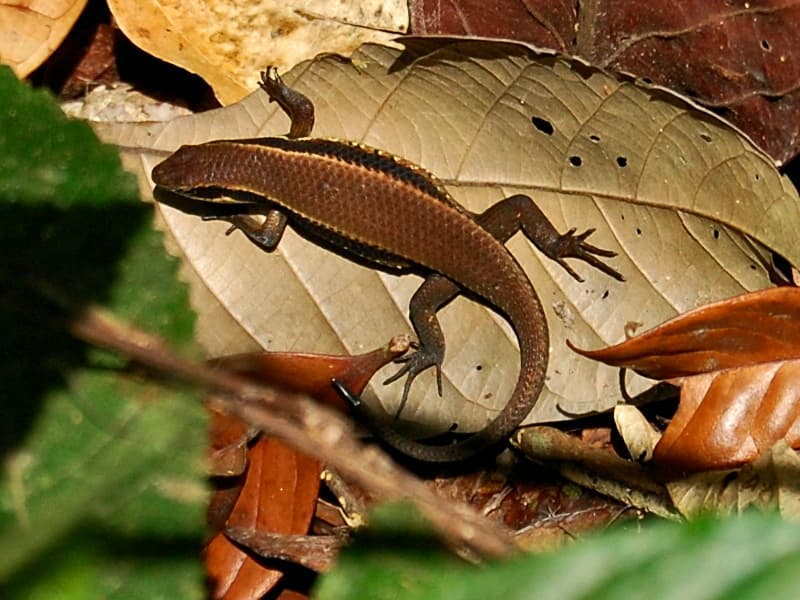
Rough mabuya
The Rough mabuya (Eutropis rudis) is a species of skink native to Maritime Southeast Asia and the Nicobar Islands. This lizard is characterized by its rough scales and is found in various island environments across its extensive range.
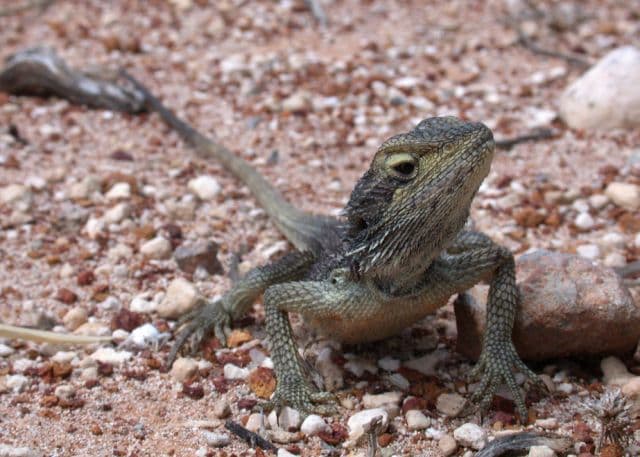
Abrolhos bearded dragon
The Abrolhos bearded dragon (Pogona minor minima) is a small agamid lizard endemic to the islands of the Houtman Abrolhos archipelago off the coast of Western Australia. It is characterized by its smaller size compared to related bearded dragons and inhabits sandy or limestone outcrop environments.

Algerian sand racer
The Algerian sand racer, scientifically known as Psammodromus algirus, is a lizard species found in southwestern Europe and northwestern Africa. It typically inhabits dense bushy vegetation and can be found at high elevations, though it is more common at lower altitudes. This species is characterized by its metallic brownish dorsal coloration with conspicuous white or yellowish stripes.