
Abrolhos bearded dragon
The Abrolhos bearded dragon (Pogona minor minima) is a small agamid lizard endemic to the islands of the Houtman Abrolhos archipelago off the coast of Western Australia. It is characterized by its smaller size compared to related bearded dragons and inhabits sandy or limestone outcrop environments.
Key Facts
- ›Found exclusively on islands within the Houtman Abrolhos.
- ›Closely related to other bearded dragons in Western Australia.
- ›Reaches a maximum total length of 360 mm, with a snout-vent length of up to 115 mm.
- ›Inhabits sandy areas and limestone outcrops.
- ›Its distribution is limited to three islands in the Wallabi Group.
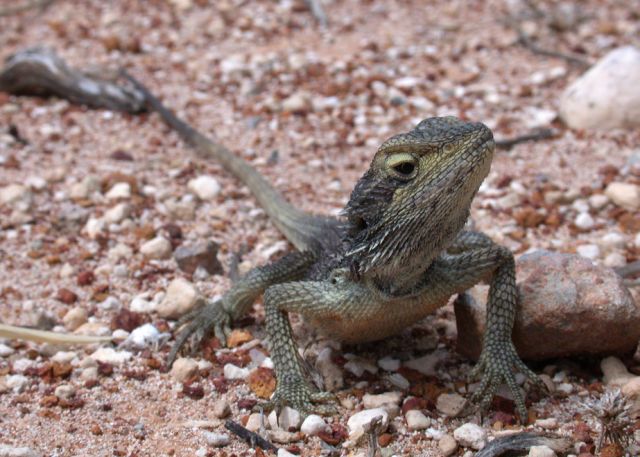
Abrolhos Dwarf Bearded Dragon
Houtman Abrolhos Islands, Western Australia
Smaller Size Compared To Related Subspecies., Maximum Total Length of 360 mm., Maximum Snout-Vent Length of 115 mm.
About Abrolhos bearded dragon
The Abrolhos bearded dragon, scientifically known as Pogona minor minima, is a distinct subspecies of agamid lizard found exclusively on the islands of the Houtman Abrolhos archipelago off the coast of Western Australia. This species is commonly named for its restricted island home. It shares a close kinship with other bearded dragon species prevalent in Western Australia, though it is notably smaller.
Habitat and Distribution
The natural range of the Abrolhos bearded dragon is confined to three islands within the Wallabi Group of the Houtman Abrolhos: North Island, East Wallabi Island, and West Wallabi Island. These islands are situated approximately 80 kilometers from the mainland. The preferred habitats for this lizard include sandy areas and outcrops of limestone, providing the specific environmental conditions it requires for survival.
Physical Characteristics
In terms of size, the Abrolhos bearded dragon is characterized by its smaller stature compared to its relatives. It typically measures no more than 360 millimeters in total length, with its snout-vent length reaching up to 115 millimeters. Specific details regarding coloration, scale patterns, or other unique anatomical features beyond its size are not extensively documented in available records.
Source: Wikipedia ↗
Frequently Asked Questions
Where is the Abrolhos bearded dragon found?
The Abrolhos bearded dragon is found only on islands within the Houtman Abrolhos archipelago. Specifically, its range is restricted to North Island, East Wallabi Island, and West Wallabi Island in the Wallabi Group.
What is the size of the Abrolhos bearded dragon?
This subspecies is smaller than its related counterparts. It measures no more than 360 mm in total length, with a snout-vent length of up to 115 mm.
What kind of habitat does the Abrolhos bearded dragon prefer?
The Abrolhos bearded dragon prefers sandy habitats and outcrops of limestone. These environments are typical of the islands where it resides.
Is the Abrolhos bearded dragon closely related to other species?
Yes, the Abrolhos bearded dragon is closely related to other bearded dragons found in Western Australia. It is considered a subspecies within this group.
Related Lizards

Furcifer nicosiai
Furcifer nicosiai is a large chameleon species endemic to western Madagascar, specifically found within the Tsingy de Bemaraha National Park. Distinguished by its high parietal crest and lack of snout appendages, it shares similarities with Furcifer verrucosus but can be identified by its smaller size and different color patterns. It is currently classified as an endangered species due to habitat loss and degradation.

Mosor rock lizard
The Mosor rock lizard (Dinarolacerta mosorensis) is a flattened lizard characterized by a long head and slender tail, typically reaching about 7 cm in snout-to-vent length. Its dorsal surface is brown, greyish-brown, or olive-brown with dark mottling, while its underparts are unspotted and yellow or orange in adults. This species inhabits high-rainfall limestone outcrops and karst regions above the treeline in southern Croatia, Bosnia and Herzegovina, and Montenegro.

Hemidactylus scabriceps
The scaly gecko (Hemidactylus scabriceps) is a nocturnal, terrestrial, and insectivorous lizard species native to South India and northern Sri Lanka. It is characterized by its short, stout body, convex forehead, blunt snout, and a cylindrical tail. The dorsal scales are imbricate and leaf-shaped, while the venter is creamy white, often with mottled patterns of black and yellow.