
Furcifer oustaleti
The Malagasy giant chameleon (Furcifer oustaleti), also known as Oustalet's chameleon, is the world's largest chameleon species by length, reaching up to 68.5 cm. It is native to Madagascar and found in a wide array of habitats, from forests to urban areas, and is known for its variable coloration and diet that includes invertebrates, small vertebrates, and fruit.
Key Facts
- ›Recognized as the world's largest chameleon species by total length.
- ›Native to Madagascar, found across the entire island in diverse habitats.
- ›Diet includes insects, small vertebrates like birds and reptiles, and notably, fruit.
- ›Possesses a distinctive dorsal crest of spines and a high casque on the head.
- ›Males are typically larger and more robust than females.
- ›Reproduction is oviparous, meaning they lay eggs.

Oustalet's Chameleon, Malagasy Giant Chameleon
- Madagascar
- Introduced Near Nairobi, Kenya
- Introduced In Miami-Dade County, United States
Dry Deciduous Forest, Humid Evergreen Forest, Montane Savanna, Degraded Forests, Agricultural Areas, Urban Settings, Forest Edges
- Maximum Total Length of 68.5 cm , Considered the World's Largest By This Measurement.
- Relatively Slender Build; Large Males Typically Weigh 400–500 g .
- Females Are Smaller, Reaching Up To About 40 cm Total Length.
- Head Features A High Casque With Several Crests.
- Dorsal Crest Consisting of 45 Or More Small Triangular Spines Runs Along the Spine.
- Coloration Is Variable: Males Are Usually Grey Or Brownish, Sometimes With Reddish Feet Or Underparts.
- Females Are Often More Colorful, With Base Colors Or Markings In Red, Yellow, and Green.
- Eyelids Can Sometimes Be Blue.
Invertebrates, Vertebrates, Fruit
- Prey Is Typically Acquired With A Long, Muscular Tongue.
- Fruit Is Usually Seized Directly With the Jaws.
- Known To Manipulate Fruit-Bearing Twigs With Zygodactyl Feet For Consumption, A Behavior Also Seen In Some Monitor Lizards and Chamaeleo Namaquensis.
About Furcifer oustaleti
Malagasy Giant Chameleon (Furcifer oustaleti)
The Malagasy giant chameleon, scientifically known as Furcifer oustaleti and commonly referred to as Oustalet's chameleon, holds the distinction of being the world's largest chameleon species based on total length. This impressive reptile is native to Madagascar, where it is found across the entire island, inhabiting an exceptionally wide variety of environments. Its adaptability allows it to thrive in diverse settings, ranging from dry deciduous forests and humid evergreen forests to montane savannas, agricultural lands, and even urban areas. While it can be found in degraded vegetation within villages, it is less common in the interior of primary forests, preferring forest edges.
Physical Characteristics and Diet
Furcifer oustaleti can reach a maximum total length of 68.5 cm (27 inches). Males are generally more robust, typically weighing between 400–500 g (14–18 oz), while females are considerably smaller, reaching up to approximately 40 cm (16 inches). The species is characterized by a high casque on its head and a prominent dorsal crest composed of numerous small, triangular spines running along its back. The coloration of the Malagasy giant chameleon is quite variable. Males are usually a shade of grey or brown, occasionally displaying reddish hues on their feet or underparts. Females, on the other hand, are often more colorful, exhibiting base colors or markings in red, yellow, and green, and sometimes possess blue eyelids.
The diet of Furcifer oustaleti is varied, encompassing invertebrates such as large insects, and small vertebrates like birds and reptiles. Uniquely among chameleons, this species is also known to consume fruit, regularly feeding on the fruits of plants like Grangeria porosa, Chassalia princei, and Malleastrum gracile. This fruit consumption is not solely for hydration, as it occurs even during the wet season. Prey is typically captured using their characteristic long, muscular tongue, while fruit is usually seized with their jaws. In remarkable instances, they have been observed using their zygodactyl feet to grasp fruit-bearing twigs and bring them closer for consumption, a level of forelimb food manipulation rarely documented in reptiles.
Reproduction and Taxonomy
Furcifer oustaleti is an oviparous species, meaning it reproduces by laying eggs. Its widespread distribution across both the arid and wettest regions of Madagascar has led to some observed geographic variation in color and size, prompting questions about whether it represents a single species or a complex of closely related species. The generic name, Furcifer, is derived from the Latin word for "forked," referring to the shape of the chameleon's feet. The specific epithet, oustaleti, honors the French biologist Jean-Frédéric Émile Oustalet.
Source: Wikipedia ↗
Frequently Asked Questions
What is the Malagasy giant chameleon?
The Malagasy giant chameleon (Furcifer oustaleti) is a large species of chameleon native to Madagascar. It is notable for being the world's largest chameleon by length and inhabits a wide range of environments across the island.
Where does Furcifer oustaleti live?
Furcifer oustaleti is found throughout Madagascar. Its habitat is very diverse, including dry deciduous forests, humid evergreen forests, savannas, degraded areas, agricultural land, and even urban settings. They tend to prefer forest edges over deep interiors.
What does the Malagasy giant chameleon eat?
This chameleon has a varied diet that includes invertebrates such as large insects, and some vertebrates like small birds and reptiles. Unusually for chameleons, it also consumes fruit from specific plant species.
How large can Furcifer oustaleti get?
Furcifer oustaleti is considered the world's largest chameleon by length, with males reaching up to 68.5 cm (27 inches) in total length. Females are typically smaller, growing to about 40 cm (16 inches).
What are the physical characteristics of Furcifer oustaleti?
Adult males are generally grey or brownish, sometimes with reddish feet. Females are more variable and can be more colorful, displaying red, yellow, and green markings, with blue eyelids sometimes observed. Both sexes have a high casque on their head and a prominent dorsal crest of spines.
How does Furcifer oustaleti reproduce?
Furcifer oustaleti reproduces by laying eggs, meaning it is an oviparous species.
Related Lizards

Oustalet's chameleon
Oustalet's chameleon (Furcifer oustaleti), also known as the Malagasy giant chameleon, is the world's largest chameleon species by length, reaching up to 68.5 cm. It is native to Madagascar and inhabits a wide array of environments, from dry forests to urban settings, though it is less common in primary forest interiors. Males are typically grey or brown, while females can be more colorful, displaying red, yellow, and green.
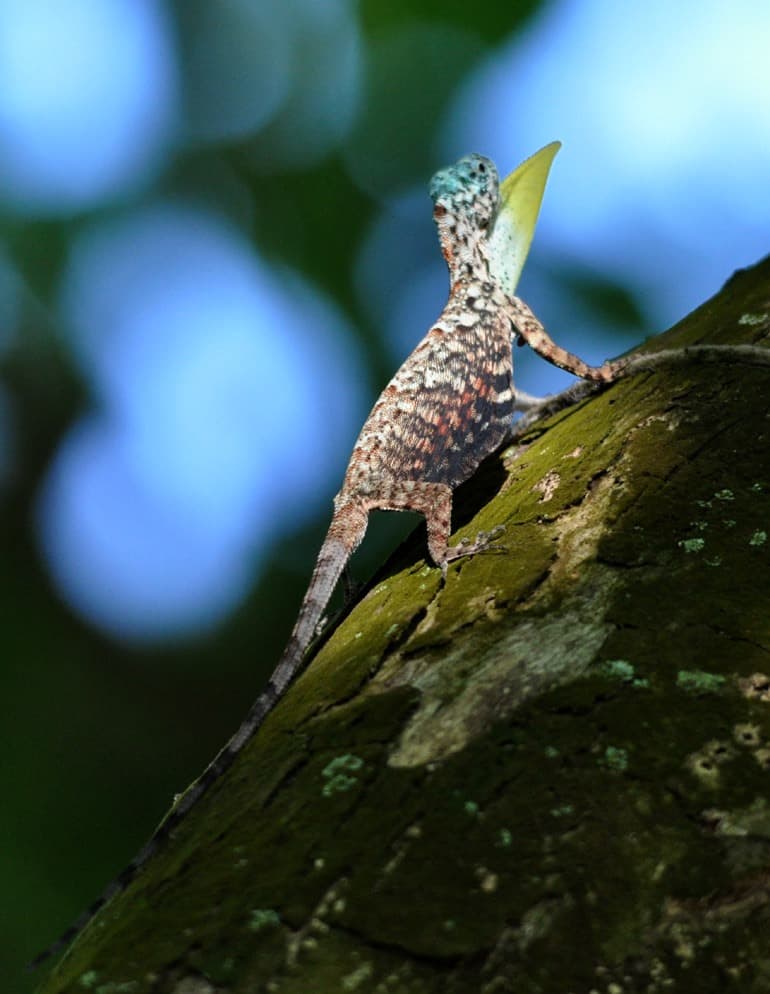
Draco sumatranus
Draco sumatranus, commonly known as the common gliding lizard, is a species of agamid lizard found in Southeast Asia. Its most distinctive feature is the presence of elongated ribs and skin flaps that allow it to glide between trees. These lizards are typically found in forests and urban environments and feed on small insects.

Phelsuma hielscheri
Phelsuma hielscheri is a species of day gecko endemic to Madagascar. This lizard is found in both natural and urban environments, often on screw palms. Males are typically larger than females, with a maximum recorded total length of 17 cm.