
Furcifer willsii
Furcifer willsii, commonly known as the canopy chameleon, is a species of lizard endemic to Madagascar. This arboreal species is characterized by its green and white coloration, sometimes with brown accents, and inhabits humid forests, often high in the canopy. While its population is believed to be declining, it is currently listed as Least Concern by the IUCN.
Key Facts
- ›Endemic to Madagascar, found in east-central and northeastern regions, with an isolated range in the north-central part.
- ›Arboreal species, typically found high in the canopy of humid forests.
- ›Green and white coloration, occasionally with brown on the back and head.
- ›Oviparous, meaning it reproduces by laying eggs.
- ›Threatened by agricultural clearance and logging.
- ›Previously exported in large numbers before trade was banned by CITES.

Canopy Chameleon, Wills's Chameleon
Madagascar
Humid Forests, Forest Canopy, Degraded Habitats
- Green and White In Color
- Sometimes With A Hint of Brown Along the Back and Head
Arboreal
Agricultural Clearance, Logging, Pet Trade
About Furcifer willsii
Furcifer willsii: The Canopy Chameleon
Furcifer willsii, commonly known as the canopy chameleon or Wills's chameleon, is a species of lizard belonging to the family Chamaeleonidae. This reptile is endemic to the island of Madagascar, with its natural range primarily encompassing the east-central and northeastern regions, as well as an isolated area in the north-central part of the island. The species was first described by Albert Günther in 1890, with its specific name, willsii, honoring English ornithologist Rev. James Wills, who served as a missionary in Madagascar.
Habitat and Distribution
The canopy chameleon is an arboreal species, meaning it lives in trees. It is typically found high in the canopy of humid forests, often at elevations between 600 and 1,300 meters (2,000 to 4,300 feet) above sea level. While its preferred habitat is native forests, it has shown an ability to adapt to degraded environments at the forest edges. Its estimated distribution covers an area of approximately 100,350 square kilometers.
Physical Characteristics and Reproduction
Furcifer willsii displays a distinctive coloration, generally appearing green and white. Some individuals may also exhibit a subtle hint of brown along their back and head. This species reproduces by laying eggs, classifying it as oviparous.
Conservation and Threats
The International Union for Conservation of Nature (IUCN) currently lists Furcifer willsii as Least Concern. While the population is believed to be declining, there is insufficient evidence to classify it as endangered or threatened. The primary threats to the canopy chameleon are habitat loss due to agricultural clearance and logging. Historically, large numbers of this species were exported from Madagascar for the pet trade, leading to international trade restrictions implemented by the CITES treaty.
Taxonomy
Originally described as Chamaeleon willsii, the species was later transferred to the genus Furcifer in 1986 by Charles Klaver and Wolfgang Böhme. It is most commonly referred to as the canopy chameleon.
Source: Wikipedia ↗
Frequently Asked Questions
What is the scientific name for the canopy chameleon?
The scientific name for the canopy chameleon is Furcifer willsii. It was initially described by Albert Günther in 1890 as Chamaeleon willsii before being transferred to the genus Furcifer.
Where is Furcifer willsii found?
Furcifer willsii is endemic to Madagascar, primarily in the east-central and northeastern parts of the island. There is also an isolated range in the north-central region.
What kind of habitat does the canopy chameleon prefer?
The canopy chameleon is an arboreal species that lives high in the canopy of humid forests. It seems capable of adapting to degraded habitats at the edges of native forests.
What does Furcifer willsii look like?
Furcifer willsii is typically green and white in color. Some individuals may also display a hint of brown along the back and head.
How does the canopy chameleon reproduce?
Furcifer willsii is oviparous, which means it reproduces by laying eggs.
What are the main threats to Furcifer willsii?
The primary threats to Furcifer willsii are agricultural clearance and logging, which lead to habitat destruction. Large numbers were also exported for trade before international bans were implemented.
What is the conservation status of Furcifer willsii?
The IUCN rates Furcifer willsii as Least Concern. Although its population is believed to be declining, there is not enough evidence to classify it as endangered or threatened.
Related Lizards

Trioceros oweni
Owen's chameleon (Trioceros oweni) is a species of lizard native to the forests of central Africa. Characterized by a prehensile tail and single clawed toes, males possess three smooth horns while females have loose skin on their hind legs. This generally arboreal species feeds on insects and arthropods, and is classified as Least Concern by the IUCN.
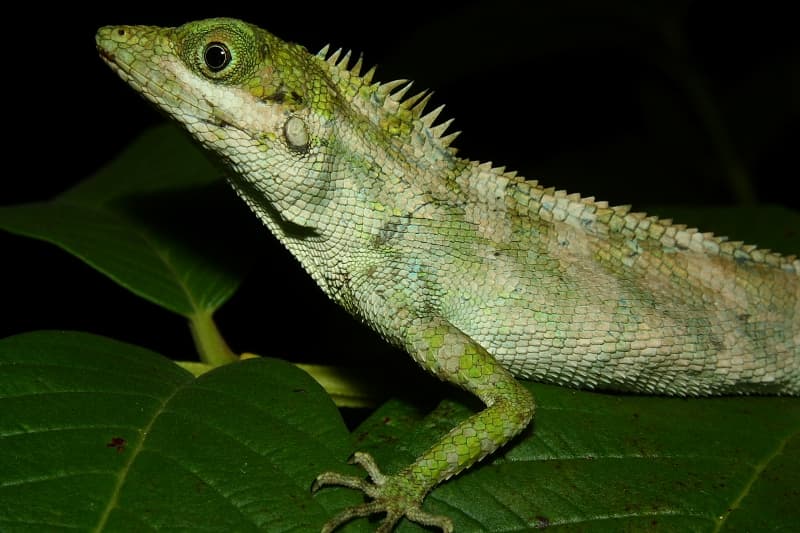
Andaman canopy agama
The Andaman canopy agama, also known as the green crestless forest lizard, is a species of agamid lizard native to the Andaman and Nicobar Islands of India. It is primarily an arboreal species, spending most of its life in the forest canopy and is rarely observed.
Green crestless forest lizard (Calotes andamanensis)
The Green crestless forest lizard (Pseudocalotes andamanensis) is a species of agamid lizard found in the Andaman and Nicobar Islands of India. It is characterized by its arboreal lifestyle, predominantly inhabiting the forest canopy, which makes it a rarely observed species. Historically, it was also known by various common names including the Andaman and Nicobar forest lizard.