
Gallotia auaritae
Critically Endangered (Possibly Extinct)·Unknown
The La Palma giant lizard (Gallotia auaritae) is a large wall lizard that was once widespread on the island of La Palma in the Canary Islands. Once believed to be extinct, recent unconfirmed sightings suggest it may still exist. Historically, it inhabited xerophytic vegetation and its size may have decreased over millennia.
Key Facts
- ›Endemic to the island of La Palma in the Canary Islands.
- ›Listed as critically endangered, with a possibility of extinction.
- ›Subfossil remains indicate it once occurred across the island up to 800 meters above sea level.
- ›Preferred habitat was xerophytic vegetation.
- ›Sightings in 2007 suggest it may not be extinct, though these are considered doubtful by many.
- ›Potential causes for its decline include human arrival, introduced cats, hunting, and habitat destruction.

La Palma Giant Lizard
La Palma, Canary Islands
Xerophytic Vegetation
- Large Wall Lizard.
- the Individual Sighted In 2007 Was Slightly More Than 30 cm Long.
- Fossil Evidence Suggests A Potential Decrease In Average Size Over Millennia.
Introduced Cats, Humans
Habitat Destruction For Agriculture, Introduced Cats, Consumption By Humans
About Gallotia auaritae
What is known about the La Palma giant lizard
The La Palma giant lizard, scientifically known as Gallotia auaritae, is a large wall lizard that is endemic to the island of La Palma in the Canary Islands. This species is currently classified as critically endangered, with a strong possibility that it may already be extinct. Historical evidence from subfossil remains indicates that the lizard was once distributed across the entire island, reaching elevations of up to 800 meters above sea level. Its preferred habitat is described as xerophytic vegetation, suggesting a preference for arid and dry environments.
History and Rediscovery Hopes
While the La Palma giant lizard was originally described from bones in 2001 and largely presumed extinct, recent events have introduced a glimmer of hope. Sightings and photographic evidence of a large lacertid were reported in 2007 in the northern part of the island. However, many experts remain skeptical, considering these sightings doubtful. Despite this uncertainty, new expeditions have been planned with the aim of discovering more individuals and potentially a breeding population.
Taxonomy and Physical Characteristics
Initially described as a subspecies of Simony's giant lizard (G. simonyi), the La Palma giant lizard was later elevated to full species status. There is a possibility that remains previously attributed to Gallotia goliath actually belong to G. auaritae. If confirmed, this would suggest that the average size of the species has diminished over the last few millennia, possibly due to hunting by humans targeting larger individuals. The single sighted individual in 2007 measured just over 30 centimeters (approximately 1 foot) in length and was estimated to be around four years old. Scientists have not had the opportunity to study living specimens, and the available fossil material does not allow for detailed phylogenetic analysis, though it is believed to be part of the simonyi clade, common to other large Gallotia species from the western Canary Islands.
Source: Wikipedia ↗
Frequently Asked Questions
Is the La Palma giant lizard definitely extinct?
The La Palma giant lizard is listed as critically endangered and is possibly extinct. While subfossil remains confirm its past existence, recent unconfirmed sightings in 2007 have raised hopes it might still survive, though these are viewed with skepticism by many scientists.
What kind of environment did the La Palma giant lizard live in?
Subfossil evidence suggests that the La Palma giant lizard primarily inhabited xerophytic vegetation. This indicates a preference for dry, arid environments, typically found at elevations up to 800 meters above sea level on the island.
What are the suspected reasons for the decline of the La Palma giant lizard?
The decline of the La Palma giant lizard is thought to have begun with the arrival of humans on the island around 2000 years ago. Introduced cats, consumption by the indigenous population, and habitat destruction for agriculture are considered the main contributing factors to its possible extinction.
Has the La Palma giant lizard ever been seen alive?
Although there was a sighting in 2007 of a large lacertid that could belong to this species, no living individuals have ever been captured or studied. Scientists have only had the chance to examine fossil and subfossil material.
How large was the La Palma giant lizard?
Remains suggest that the average size of the species may have decreased over millennia. The individual sighted in 2007 was slightly over 30 cm (about 1 foot) in length and was estimated to be about four years old.
Related Lizards
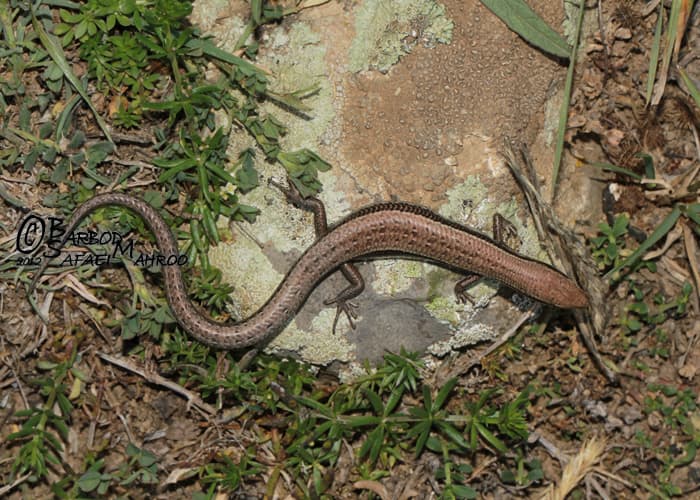
Ablepharus bivittatus
The twin-striped skink (Ablepharus bivittatus) is a species of skink found in mountainous regions of Armenia, Azerbaijan, Turkmenistan, northwestern Iran, and Turkey. It is distinguished by its habitat in high elevations, typically between 2,300 and 3,300 meters.
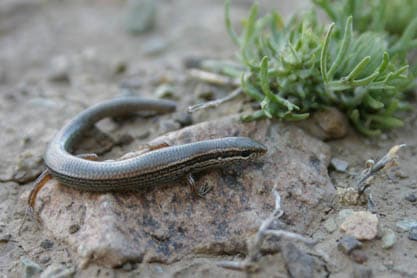
Ablepharus pannonicus
The Asian snake-eyed skink (Ablepharus pannonicus) is a species of skink native to a wide range across Asia and parts of the Middle East. It is characterized by its snake-like appearance and is found in diverse arid and semi-arid environments.

Adam's dravidogecko
Adam's dravidogecko (Dravidogecko douglasadamsi) is a species of gecko native to India. Little is documented about its specific characteristics, habitat, or behaviors, making it a relatively understudied species.