
Gehyra australis
Gehyra australis, commonly known as the Australian house gecko or northern dtella, is a species of gecko native to northern and eastern Australia, and also found in Indonesia. This arboreal lizard primarily inhabits woodlands, coastal, and riverine forests, but can also be found near human settlements. It is distinguished by its size and scale patterns, which can vary among closely related species within its complex.
Key Facts
- ›Native to northern and eastern Australia and widespread in Indonesia.
- ›Primarily an arboreal species, found in woodlands and forests.
- ›Can be found near human dwellings and gardens.
- ›Reproduces by laying eggs (oviparous).
- ›Distinguished from closely related species by pre-cloacal pore counts and chin scale patterns.
- ›Its range, sensu stricto, is limited to the western Top End region of the Northern Territory.

Australian House Gecko, Northern Dtella, Top-End Dtella
Australia, Indonesia
Woodlands, Coastal Forests, Riverine Forests, Near Human Dwellings, Gardens
- Arboreal Gecko.
- Adult Males of G. Australis Sensu Stricto Have 10–14 Pre-Cloacal Pores.
- Closely Related Species Can Differ In Details of Their Scale Patterns, Particularly On the Chin.
Insects, Other Invertebrates
Primarily Arboreal., Can Occur Near Human Dwellings.
About Gehyra australis
Gehyra australis: The Australian House Gecko
Gehyra australis, commonly known as the Australian house gecko or northern dtella, is a species of gecko native to the northern and eastern regions of Australia. This adaptable lizard has also extended its range to Indonesia, where it is found alongside other common gecko species. Its name, 'dtella,' is thought to be derived from the Aboriginal word 'dthala.'
Habitat and Lifestyle
This species is primarily arboreal, meaning it spends most of its life in trees. It favors habitats such as woodlands, coastal forests, and riverine forests. Despite its preference for natural environments, Gehyra australis is also known to inhabit areas close to human dwellings and gardens, demonstrating a degree of synanthropy. It reproduces by laying eggs (oviparous).
Systematics and Identification
Recent molecular genetic analyses have led to the reclassification of several lineages previously considered part of Gehyra australis. As a result, new species such as G. arnhemica, G. gemina, and G. lauta have been proposed, refining the specific range of G. australis sensu stricto to the western Top End of the Northern Territory. Members of the australis species complex are generally smaller than rock-dwelling geckos. Distinguishing between these closely related species often involves examining specific physical characteristics, such as the number of pre-cloacal pores in adult males and subtle differences in their chin scale patterns.
Source: Wikipedia ↗
Frequently Asked Questions
What are the common names for Gehyra australis?
Gehyra australis is known by several common names, including the Australian house gecko, northern dtella, and top-end dtella. These names reflect its geographic origin and its tendency to inhabit human structures.
Where is Gehyra australis found?
This gecko species is native to northern and eastern Australia. It has also established populations in Indonesia, where it is found alongside other common gecko species.
What kind of habitat does Gehyra australis prefer?
Gehyra australis is primarily an arboreal lizard, meaning it lives in trees. Its preferred habitats include woodlands, coastal forests, and riverine forests. It is also adaptable enough to be found near human homes and gardens.
How does Gehyra australis reproduce?
Gehyra australis is oviparous, which means it reproduces by laying eggs. The specific details of its nesting behavior or clutch size are not extensively detailed in available records.
Are there different species within the Gehyra australis complex?
Yes, molecular genetic analysis has led to the proposal of new species within what was previously considered the Gehyra australis species complex. These include G. arnhemica, G. gemina, and G. lauta, which differ in range and specific physical characteristics.
How can Gehyra australis be distinguished from similar species?
Distinguishing Gehyra australis from closely related species often involves examining specific physical traits. Details such as the number of pre-cloacal pores in adult males and subtle variations in chin scale patterns are key identifiers.
Related Lizards

Phelsuma klemmeri
The yellow-headed day gecko (Phelsuma klemmeri) is a small, diurnal lizard endemic to northwestern Madagascar. Its distinctive features include a turquoise-blue body, a yellow head, and a laterally flattened form. It primarily inhabits bamboo forests and is known to feed on insects and nectar.
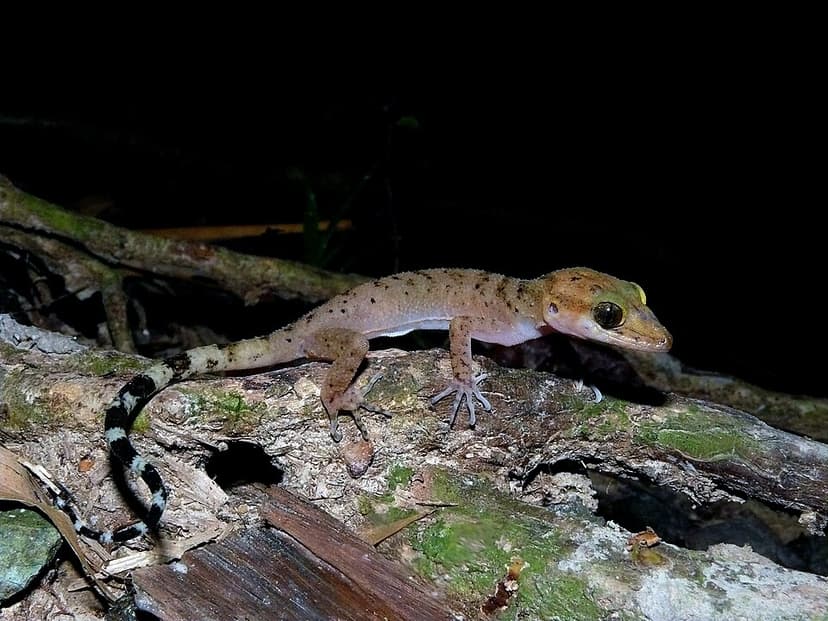
Andaman bent-toed gecko
The Andaman bent-toed gecko, also known as the red bow-fingered gecko, is a small to medium-sized gecko found in the Andaman Islands of India and the Coco Islands of Myanmar. It inhabits lowland and deciduous forests, often found near human dwellings, and is known for its reddish-brown to dark grey coloration marked with black bands or blotches, and a black and white banded tail. This species is oviparous, typically laying two eggs, and exhibits both terrestrial and arboreal behaviors.
Cyrtodactylus rubidus
Cyrtodactylus rubidus, also known as the Andaman bent-toed gecko or red bow-fingered gecko, is a small to medium-sized gecko native to the Andaman Islands of India and the Coco Islands of Myanmar. It inhabits lowland and deciduous forests, exhibiting both terrestrial and arboreal behavior, and is characterized by its black-banded yellowish-brown body and a distinctive black and white banded tail.