
Gila spotted whiptail
Parthenogenic (asexual)
The Sonoran spotted whiptail is a parthenogenic lizard species found in the southwestern United States and Mexico. It is characterized by its spotted pattern and is known to reproduce asexually. This species inhabits arid and semi-arid regions.
Key Facts
- ›Parthenogenic species, meaning it reproduces asexually.
- ›Found in Arizona and New Mexico (USA) and Mexico.
- ›Belongs to the teiid lizard family.
- ›Inhabits arid and semi-arid environments.

Sonoran Spotted Whiptail
Arizona, New Mexico, Mexico
Characterized By A Spotted Pattern.
About Gila spotted whiptail
The Sonoran Spotted Whiptail
The Sonoran spotted whiptail, scientifically known as Aspidoscelis sonorae, is a fascinating lizard species notable for its unique reproductive strategy. This species is found across arid and semi-arid regions of the southwestern United States, specifically in Arizona and New Mexico, as well as in parts of Mexico.
Key Characteristics
A distinguishing feature of the Sonoran spotted whiptail is its parthenogenic nature. This means that the females of the species can reproduce asexually, producing offspring without the need for fertilization by a male. This reproductive method sets it apart within the lizard kingdom and is a significant aspect of its biology.
Source: Wikipedia ↗
Frequently Asked Questions
What does parthenogenic mean for the Sonoran spotted whiptail?
Parthenogenic means that the Sonoran spotted whiptail reproduces asexually. This allows females to produce offspring without fertilization by a male.
Where is the Sonoran spotted whiptail found?
The natural geographic distribution of the Sonoran spotted whiptail includes the states of Arizona and New Mexico in the United States, as well as parts of Mexico.
What type of habitat does the Sonoran spotted whiptail prefer?
This lizard species is typically found in arid and semi-arid environments. These regions provide the necessary conditions for its survival and reproduction.
Related Lizards
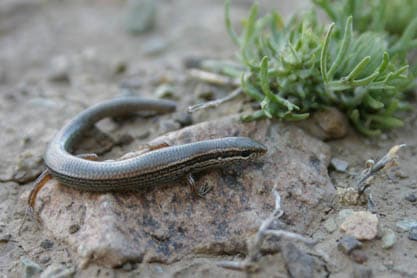
Ablepharus pannonicus
The Asian snake-eyed skink (Ablepharus pannonicus) is a species of skink native to a wide range across Asia and parts of the Middle East. It is characterized by its snake-like appearance and is found in diverse arid and semi-arid environments.

Acanthodactylus longipes
The long fringe-fingered lizard (Acanthodactylus longipes) is a species of lizard belonging to the Lacertidae family, native to northwestern Africa. It is characterized by its fringe-like scales on its toes, which aid in locomotion on sandy substrates. This oviparous species is found across a wide range of arid and semi-arid environments within the region.
Asian snake-eyed skink
The Asian snake-eyed skink (Ablepharus pannonicus) is a species of skink native to a wide range across Western and Central Asia, as well as parts of the Middle East. It is characterized by its small size and its distribution across various arid and semi-arid environments.