
Goniurosaurus hainanensis
Stable (as of 2019 assessment)
Goniurosaurus hainanensis, also known as the Chinese cave gecko, is a nocturnal gecko species native to Hainan Island, China. It is characterized by its large red eyes, gray body with black spots and yellow/orange bands, and a translucent white underside. This species is notable for its ability to climb rocky terrain using its clawed fingers, lacking adhesive toepads.
Key Facts
- ›Endemic to Hainan Island, China.
- ›Nocturnal species with large red eyes.
- ›Adults typically reach around 22 cm (8.5 inches) in length.
- ›Characterized by gray coloration with black spots and yellow/orange dorsal bands.
- ›Possesses five clawed fingers for climbing, but lacks adhesive toepads.
- ›The only Goniurosaurus species regularly available in the commercial pet trade.

Chinese Cave Gecko, Hainan Cave Gecko, Cave Gecko, Chinese Leopard Gecko
Hainan Island, China
Rock Formations, Forest Floors, Rainforest Cliffs
- Can Grow Over 23 cm Long, Often Averaging Around 22 cm .
- Large Red Eyes, Ranging From Maroon To Crimson.
- Possess Movable Eyelids.
- Typically Gray With Black Spots and Yellow Or Orange Bands In the Dorsal Area.
- Some Individuals Lose Coloring With Age, Becoming Nearly Solid Gray.
- Ventral Area Is Nearly White and Translucent.
- Five Clawed Fingers For Climbing.
- Lack Adhesive Toepads.
Insects
- Nocturnal Species.
- Found Dwelling On the Sides of Rock Formations and Forest Floors.
- Capable Climbers of Rocky Terrain and Rainforest Cliffs.
Exotic Pet Trade, Poaching
About Goniurosaurus hainanensis
Goniurosaurus hainanensis, commonly known as the Chinese cave gecko or Hainan Cave Gecko, is a nocturnal lizard species endemic to Hainan Island in China. This species is distinguished by its striking large red eyes, which can range from maroon to crimson, and movable eyelids. Adults typically measure around 22 centimeters (8.5 inches) in length, with some reaching over 23 centimeters (9 inches).
Physical Characteristics
The coloration of Goniurosaurus hainanensis is generally gray, adorned with black spots and distinctive yellow or orange bands across its dorsal area. Some individuals may lose this vibrant coloring as they age, becoming a more uniform gray. The underside, or ventral area, is nearly white and translucent. Unlike many other gecko species, Goniurosaurus hainanensis lacks adhesive toepads but possesses five clawed fingers, which enable it to effectively climb rocky terrain and steep rainforest cliffs.
Habitat and Behavior
These geckos are typically found dwelling on the sides of rock formations and on forest floors. Their nocturnal nature means they are most active during the night. While they are adept climbers, their primary habitats are terrestrial and rocky environments rather than exclusively arboreal ones.
Conservation and Pet Trade
Goniurosaurus hainanensis is the only species within the Goniurosaurus genus that is regularly available in the commercial pet trade. Since the 1990s, these lizards have been sought after, leading to concerns about poaching and the impact on wild populations. However, in recent years, the population has stabilized, and as of a 2019 assessment, the species was not classified as vulnerable or endangered. Captive-bred individuals have become the standard for pet owners, helping to mitigate some of the pressure on wild populations.
Source: Wikipedia ↗
Frequently Asked Questions
What is Goniurosaurus hainanensis commonly known as?
Goniurosaurus hainanensis is commonly known as the Chinese cave gecko, Hainan Cave Gecko, cave gecko, or the Chinese Leopard Gecko.
Where does the Chinese cave gecko live?
This species is endemic to Hainan Island, which is part of China.
What are the physical characteristics of Goniurosaurus hainanensis?
They have large red eyes, typically gray bodies with black spots and yellow or orange bands on their dorsal side, and a nearly white, translucent ventral area. They can grow up to 23 centimeters (9 inches) long.
How does Goniurosaurus hainanensis climb?
Goniurosaurus hainanensis has five clawed fingers that allow it to easily climb rocky terrain and rainforest cliffs. Unlike many other geckos, it does not have adhesive toepads.
What is the conservation status of the Chinese cave gecko?
As of a 2019 assessment, Goniurosaurus hainanensis has a stable population and is not classified as vulnerable or endangered. While the exotic pet trade has historically driven down numbers, the population has stabilized in recent years.
Is the Chinese cave gecko a popular pet?
Yes, Goniurosaurus hainanensis is the only Goniurosaurus species regularly available in the commercial pet trade. Captive-bred individuals are now the standard for potential owners.
Related Lizards
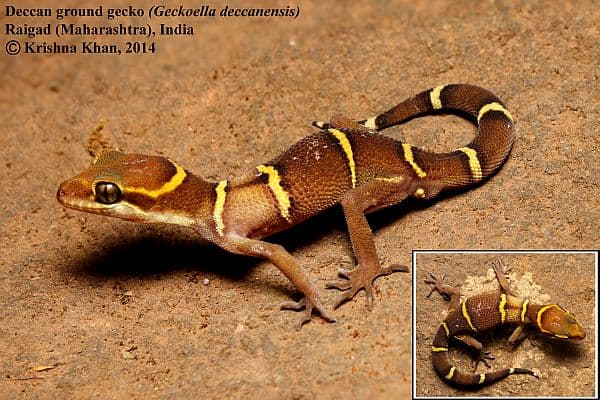
Cyrtodactylus deccanensis
The Cyrtodactylus deccanensis, also known as the Deccan ground gecko, is a species of gecko native to the northern Western Ghats of India, with a habitat that may extend into southern Gujarat. It is characterized by its moderately elongate, depressed body, long limbs, and head covered in convex granules. This nocturnal, insectivorous species lives on forest floors and is identifiable by its reddish-brown coloration marked with narrow, black-edged white crossbars.

Granite rock gecko
The Granite rock gecko, scientifically known as Hemidactylus graniticolus, is a reclusive gecko species native to India. It is characterized by its rock-dwelling nature, inhabiting granite formations. The species was first described from the hills near Harohalli village in Karnataka.

Northern curly-tailed lizard
The Northern curly-tailed lizard, scientifically known as Leiocephalus carinatus, is a robust and active reptile characterized by its keeled, pointed dorsal scales and a tail that is typically curled upward. Native to the Bahamas, Cayman Islands, and Cuba, it has also been introduced to Florida and Honduras. This primarily terrestrial lizard prefers sunny, rocky environments and exhibits unique defense mechanisms like playing dead and tail curling.