
Cyrtodactylus deccanensis
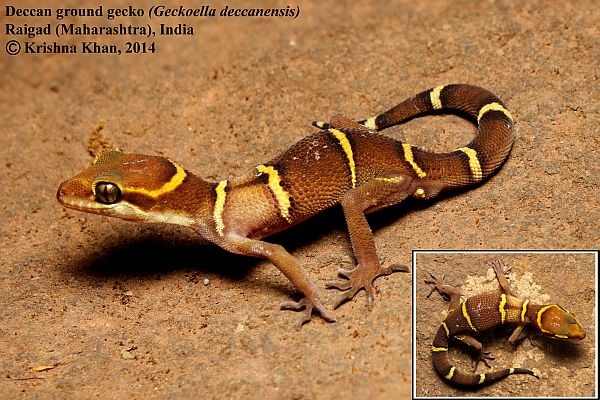
The Cyrtodactylus deccanensis, also known as the Deccan ground gecko, is a species of gecko native to the northern Western Ghats of India, with a habitat that may extend into southern Gujarat. It is characterized by its moderately elongate, depressed body, long limbs, and head covered in convex granules. This nocturnal, insectivorous species lives on forest floors and is identifiable by its reddish-brown coloration marked with narrow, black-edged white crossbars.
Key Facts
- ›Found in the northern Western Ghats of India and potentially southern Gujarat.
- ›Nocturnal species that inhabits forest floors.
- ›Insectivorous diet, feeding primarily on insects.
- ›Distinctive reddish-brown coloration with white, black-edged crossbars on body and tail.
- ›Males possess enlarged preanal and femoral scales but lack pores.
- ›Rarely encountered due to its nocturnal habits and forest dwelling.
Deccan Ground Gecko, GüNther's Indian Gecko, Banded Ground Gecko
Northern Western Ghats, India, Northern Maharashtra, India, Possibly Southern Gujarat, India
- Head Is Large, Oviform, With Snout Longer Than the Diameter of the Orbit.
- Forehead and Loreal Region Are Concave; Ear-Opening Is Suboval and Vertical.
- Body Is Moderately Elongate and Depressed.
- Limbs Are Rather Long; Digits Are Cylindrical At the Base and Compressed Distally.
- Head Is Covered With Convex Granules, Largest On the Snout and Temples.
- Body Covered Above With Large Juxtaposed Subequal Tubercles, Arranged In More Or Less Regular Transverse Series; Tubercles Are Flat Or Slightly Keeled.
- Abdominal Scales Are Round, Smooth, Sub-Imbricate, and Much Smaller Than Dorsal Scales.
- Males Have Enlarged Preanal and Femoral Scales, But No Pores.
- Tail Is Cylindrical, Tapering, and Covered With Uniform Smooth Scales Arranged In Rings.
- Coloration Is Reddish-Brown Above With Narrow White, Black-Edged Crossbars On the Body and Tail.
- Lower Surfaces Are Whitish.
Insectivorous, Insects
Nocturnal, Lives On Forest Floors
About Cyrtodactylus deccanensis
What is known
Cyrtodactylus deccanensis, commonly referred to as the Deccan ground gecko, is a species of gecko native to the northern Western Ghats of India. Its known range includes northern Maharashtra, with potential extensions into southern Gujarat. This species is characterized by its nocturnal habits and its habitat on forest floors, which makes it a rarely encountered reptile.
Description and Characteristics
The Deccan ground gecko possesses a moderately elongate, depressed body with rather long limbs. Its head is covered in convex granules, and its coloration is a distinctive reddish-brown adorned with narrow, black-edged white crossbars. These markings are present on the body and also form rings around the cylindrical, tapering tail. The underside of the gecko is whitish. Males of the species can be identified by enlarged preanal and femoral scales, though they lack pores.
Habitat and Behavior
This gecko is an inhabitant of forest floors, a preference that, combined with its nocturnal activity, contributes to its elusiveness. Its diet is primarily insectivorous, preying on the invertebrates found within its forest environment. Historically, it was described based on specimens collected in the 'Deccan' region of the Bombay Presidency. Some taxonomic authorities continue to classify this species within the genus Geckoella.
Distribution
Cyrtodactylus deccanensis has been reported from various protected areas and notable locations within its natural range, including Sanjay Gandhi National Park, Matheran, Khandala, Phansad Wildlife Sanctuary, Tungareshwar Wildlife Sanctuary, Koyna Wildlife Sanctuary, and Tamhini Ghat in Maharashtra. More recently, it has also been documented in the Saputara Hills of the Dang District in Gujarat.
Source: Wikipedia ↗
Frequently Asked Questions
What are the common names for Cyrtodactylus deccanensis?
Cyrtodactylus deccanensis is commonly known as the Deccan ground gecko, Günther's Indian gecko, or the banded ground gecko. These names reflect its geographic origin and physical appearance.
Where is the Deccan ground gecko found?
This gecko species is found in the northern Western Ghats of India, specifically recorded in northern Maharashtra. Its habitat range is thought to possibly extend to southern Gujarat.
What does Cyrtodactylus deccanensis eat?
The Deccan ground gecko is insectivorous, meaning its diet consists primarily of insects. As a forest floor dweller, it likely preys on invertebrates found in its habitat.
What is the physical description of the Deccan ground gecko?
It has a moderately elongate, depressed body with rather long limbs. Its head is covered in convex granules, and it features reddish-brown coloration with narrow, black-edged white crossbars on its body and tail. The tail is cylindrical and covered with uniform smooth scales.
Why is the Deccan ground gecko rarely seen?
The Deccan ground gecko is rarely encountered because it is a nocturnal species that lives on forest floors. Its secretive habits and preference for dense forest environments contribute to its elusiveness.
What are the characteristic markings of this gecko?
The species is characterized by a reddish-brown upper surface marked with narrow, black-edged white crossbars. These bands are present on the body and also form annuli around the tail, with the first band extending across the nape.
Related Lizards

Goniurosaurus hainanensis
Goniurosaurus hainanensis, also known as the Chinese cave gecko, is a nocturnal gecko species native to Hainan Island, China. It is characterized by its large red eyes, gray body with black spots and yellow/orange bands, and a translucent white underside. This species is notable for its ability to climb rocky terrain using its clawed fingers, lacking adhesive toepads.

Hokou gecko
The Hokou gecko (Gekko hokouensis) is a small, nocturnal, and insectivorous gecko found across parts of East Asia and introduced to several islands. It is characterized by shades of brown, grey, or tan with distinct darker cross-bands on its back and tail, and a unique scale near the base of its tail. This species plays a role in its ecosystem, primarily by consuming insects, and its reproductive cycle largely occurs during the summer months.

Ablepharus
Ablepharus, commonly known as snake-eyed skinks, are small lizards distinguished by fused eyelids that prevent blinking, similar to snakes. They inhabit dry fields, hills, and rocky areas, often concealed within leaf litter. These skinks possess shiny, bronze scales and a characteristic dark stripe along their sides, feeding primarily on small insects and mollusks.