
Heloderma suspectum
Near Threatened (IUCN)·Oviparous (egg-laying)
The Gila monster (Heloderma suspectum) is a venomous lizard native to the Southwestern United States and northwestern Mexico. Known for its heavy, slow-moving nature and striking black and pink or yellow coloration, it is the only venomous lizard in the United States. Despite its fearsome reputation and potent venom, it is generally not dangerous to humans and is protected by state law.
Key Facts
- ›It is the only venomous lizard native to the United States.
- ›Gila monsters are slow-moving and have a fearsome reputation, but are not typically dangerous to humans.
- ›Their venom is delivered through grooved teeth and causes excruciating pain, though it is rarely fatal to healthy adults.
- ›They store fat in their tails, allowing them to subsist on a few large meals per season.
- ›Their venom contains bioactive peptides that have led to the development of medications for type 2 diabetes and obesity.
- ›They spend about 90% of their lives underground in burrows or rocky shelters.

Gila Monster
Southwestern United States, Northwestern Mexico
Scrubland, Succulent Desert, Oak Woodland
- Heavy, Slow-Moving Reptile.
- Up To 22 Inches In Total Length.
- Snout-To-Vent Length Ranges From 26 To 36 cm .
- Tail Is About 20% of Body Size.
- Body Mass Typically Between 550 To 800 g .
- Stout Body Structure With A Stout Snout and Massive Head.
- Adult Coloration Is Black With Yellow To Pink Patterns; Hatchlings Have A Simpler, Less Colorful Pattern That Changes Within the First 6 Months.
- Scales Contain Osteoderms , Especially On the Head, Back, and Tail.
- Males Often Have Larger and More Triangular-Shaped Heads Than Females.
- Small Mammals
- Small Birds
- Snakes
- Lizards
- Frogs
- Insects
- Other Invertebrates
- Carrion
- Eggs of Birds, Lizards, Snakes, Tortoises, and Turtles
- Sluggish and Slow-Moving In Nature.
- Spend Approximately 90% of Their Lives Underground In Burrows Or Shelters.
- Active In the Morning During Spring and Early Summer; May Be Active On Warm Nights Or After Thunderstorms Later In the Summer.
- Move To Different Shelters Every 4–5 Days To Optimize Microhabitat.
- Possess Relatively High Endurance and Maximal Aerobic Capacity.
- Engage In Male-To-Male Combat During the Mating Season.
- Use An Acute Sense of Smell With A Forked Tongue To Locate Prey.
Carnivore, Insectivore, Ovolecithal
Coyotes, Badgers, Raptors, Snakes
- Habitat Destruction
- Relocation Efforts Can Be Detrimental, Leading To Energy Depletion and Increased Predation Risk.
About Heloderma suspectum
The Gila Monster (Heloderma suspectum)
The Gila monster, scientifically known as Heloderma suspectum, is a distinctive and unique venomous lizard found in the arid landscapes of the Southwestern United States and the northwestern Mexican state of Sonora. This heavy-bodied, slow-moving reptile is notable for being the only venomous lizard native to the United States. Its striking appearance, characterized by a black base coloration adorned with patterns of pink, orange, or yellow, serves as a warning to potential predators.
Physical Characteristics and Habitat
Adult Gila monsters typically reach lengths of up to 56 cm (22 inches), with snout-to-vent measurements ranging from 26 to 36 cm (10 to 14 inches). They possess a stout build, a massive head, and a tail that stores fat reserves, crucial for their survival in harsh environments. Their skin is covered in scales embedded with osteoderms, small bony plates that provide protection. They inhabit scrublands, succulent deserts, and oak woodlands, frequently seeking refuge in underground burrows, dense thickets, or beneath rocky outcrops to maintain a favorable microclimate.
Diet and Behavior
Despite their venomous nature, Gila monsters are not aggressive and pose little threat to humans. They are sluggish creatures that spend the majority of their lives, approximately 90%, underground. Their diet is varied, encompassing small mammals, birds, eggs, insects, and carrion, which they locate using a highly developed sense of smell. A few substantial meals in the spring can sustain them for an entire season, thanks to their fat-storing tails and slow metabolism. They are primarily active in the mornings during the spring and early summer, and occasionally on warm nights or after rainfall later in the season.
Venom and Medical Significance
While the Gila monster's venom is not typically fatal to healthy humans, a bite can inflict excruciating pain, swelling, and weakness. The venom is produced in modified salivary glands and delivered through grooved teeth. Interestingly, certain peptides found in Gila monster venom have proven invaluable in medical research. Compounds derived from this venom have formed the basis for medications, such as exenatide, used to treat type 2 diabetes and obesity by mimicking the action of human hormones that regulate blood glucose and appetite.
Conservation and Reproduction
Listed as Near Threatened by the IUCN, the Gila monster faces significant threats, primarily from habitat destruction due to human development and agriculture. Relocation efforts have proven largely unsuccessful and can be detrimental to the lizards' survival. They reproduce by laying eggs, with females laying clutches of up to eight eggs in late spring. The incubation period lasts approximately five months, and hatchlings are capable of delivering venom from birth. Gila monsters are known to have a long lifespan, with individuals living up to 40 years in captivity.
Source: Wikipedia ↗
Frequently Asked Questions
Is the Gila monster venomous?
Yes, the Gila monster is venomous. It produces venom in modified salivary glands located at the end of its lower jaws. The venom is delivered through grooved teeth.
What does a Gila monster eat?
The Gila monster has a varied diet that includes small mammals, birds, snakes, lizards, frogs, insects, carrion, and eggs of various reptiles. They can store fat in their tails, enabling them to survive on a few large meals for an entire season.
Where do Gila monsters live?
Gila monsters are found in the Southwestern United States and northwestern Mexico, inhabiting areas such as Sonora, Arizona, and parts of California, Nevada, Utah, and New Mexico. They prefer scrubland, succulent desert, and oak woodlands, often seeking shelter in burrows or under rocks.
Are Gila monsters dangerous to humans?
While Gila monsters are venomous and their bite is extremely painful, they are generally not dangerous to healthy adult humans. They are slow-moving and tend to avoid conflict, and fatalities are very rare. However, they can bite quickly and may not release their grip without intervention.
How long do Gila monsters live?
Gila monsters can live up to 40 years in captivity. Information on their lifespan in the wild is less precisely documented but is generally understood to be substantial due to their slow metabolism and protective adaptations.
What is the scientific name for the Gila monster?
The scientific name for the Gila monster is Heloderma suspectum.
What are the main threats to Gila monsters?
The primary threat to Gila monsters is habitat destruction due to human development for construction and agriculture. Relocation efforts have also proven to be detrimental, as the lizards often attempt to return to their original locations, expending vital energy reserves.
Related Lizards
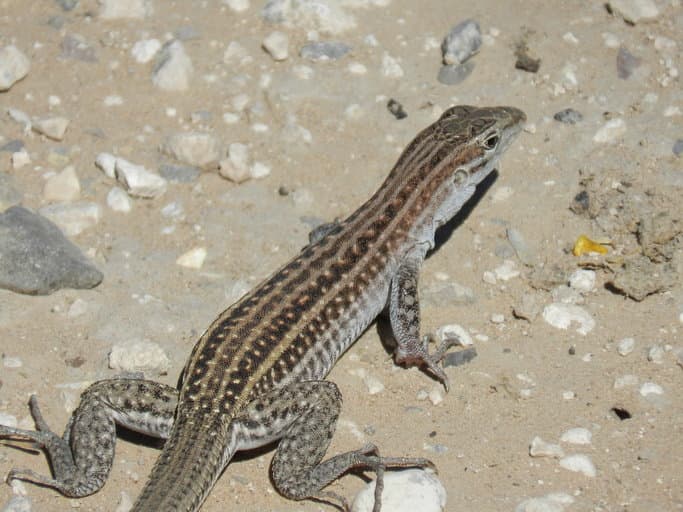
Aspidoscelis exsanguis
The Chihuahuan spotted whiptail (Aspidoscelis exsanguis) is a parthenogenetic lizard native to arid regions of the southwestern United States and northern Mexico. It is characterized by its reddish-brown coloration, six lighter stripes running the length of its body with spotting in between, and a slender build with a long tail. This diurnal and insectivorous species inhabits various dry environments, including deserts and woodlands.
Chihuahuan spotted whiptail
The Chihuahuan spotted whiptail is a parthenogenetic lizard native to arid regions of the southwestern United States and northern Mexico. It is characterized by its reddish-brown coloration, six lighter stripes, and a slender body with a very long tail. This diurnal and insectivorous species inhabits a variety of dry environments, including deserts and woodlands.

Varanus giganteus
The perentie (Varanus giganteus) is one of Australia's largest lizards, inhabiting arid desert regions west of the Great Dividing Range. Known for its shyness and lean build, it features a distinctive creamy-white head and neck with black reticulations, and a yellow or cream body with brown rosettes. This apex predator plays a significant role in Aboriginal cultures as a totemic animal and bush tucker.