
Himalayan agama
The Himalayan agama (Paralaudakia himalayana) is a lizard species native to Central and South Asia, characterized by its depressed head, prominent dorsal scales, and a tail that is roughly 2.5 to 3 times its body length. It inhabits mountainous regions and is typically olive in color, marbled with black and often featuring light spots.
Key Facts
- ›Found in Central and South Asia, including countries like Pakistan, Nepal, and China.
- ›Possesses a depressed head with smooth upper head-scales and enlarged, keeled scales on the vertebral region.
- ›Its tail is rounded, depressed at the base, and significantly longer than its body.
- ›Males can be distinguished by thickened pre-anal scales.
- ›Coloration is typically olive, marbled with black, and often adorned with light spots or a network pattern.

Himalayan Rock Agama
Afghanistan, Pakistan, Kashmir, Nepal, China, Turkmenistan, Tajikistan, Kyrgyzstan, Uzbekistan
- Head Much Depressed; Snout Slightly Longer Than Diameter of Orbit.
- Nostril Lateral, Below the Canthus Rostralis, Slightly Tubular.
- Upper Head-Scales Smooth; Occipital Not Enlarged.
- Small Closely Set Spinose Scales On the Head Near the Ear, and On the Neck.
- Ear Entirely Exposed, Larger Than the Eye-Opening.
- Throat Strongly Plicate; No Gular Pouch.
- Body Depressed, With A More Or Less Distinct Fold On Each Side of the Back.
- Scales On the Neck and Sides Small, Smooth Or Very Feebly Keeled, Uniform.
- Scales On the Vertebral Region Enlarged, Equal, Roundish-Hexagonal, Imbricate, Smooth Or Very Feebly Keeled.
- Ventral Scales Smooth, A Little Smaller Than the Enlarged Dorsals.
- Limbs Strong, With Compressed Digits.
- Scales On the Upper Surface of Limbs Large and Strongly Keeled.
- Fourth Finger Slightly Longer Than Third; Fourth Toe Considerably Longer Than Third.
- Fifth Toe Extending Beyond First.
- Tail Rounded, Much Depressed At the Base, Covered With Moderate-Sized Strongly Keeled Scales Arranged In Rings.
- Tail Length Equals 2.5 To 3 Times the Distance From Gular Fold To Vent.
- Males With A Double Or Triple Row of Thickened Pre-Anal Scales.
- Olive Above, Marbled With Black, and Generally With Round Light Spots Producing A Network.
- Sometimes Black Spots Form A Festooned Band On Each Side of the Vertebral Line.
- Male's Throat Marbled With Blackish.
About Himalayan agama
The Himalayan Agama: A Resilient Lizard of Central and South Asia
The Himalayan agama, scientifically classified as Paralaudakia himalayana, is a notable species within the agamid family, inhabiting the diverse landscapes of Central and South Asia. This lizard is distinguished by its distinctly depressed head and body, a characteristic that aids in its adaptation to rocky and mountainous terrains.
Physical Characteristics and Appearance
Physically, the Himalayan agama presents a striking profile. Its head is significantly flattened, with the snout being slightly longer than the diameter of its orbit. A key feature is the variation in scale types across its body: the upper head-scales are smooth, while the scales on the vertebral region are enlarged, imbricate, and either smooth or feebly keeled. In contrast, the scales on the neck and sides are smaller and uniform. The limbs are robust, supporting digits that are compressed, and the scales on the upper surface of these limbs are notably large and strongly keeled. The tail is a prominent feature, being rounded, depressed at its base, and covered in rings of moderately sized, strongly keeled scales. Its length is substantial, measuring between 2.5 to 3 times the distance from the gular fold to the vent.
The coloration of the Himalayan agama is typically an olive hue, often intricately marbled with black. This pattern can include round light spots that create a network-like appearance. In some individuals, black spots may form a festooned band along each side of the vertebral line. Males exhibit a distinguishing feature with a double or triple row of thickened pre-anal scales, and their throats are often marbled with blackish tones.
Distribution and Habitat
The geographic distribution of Paralaudakia himalayana spans a wide area across Central and South Asia. It is found in northeastern Afghanistan, northern Pakistan, Kashmir, Nepal, China (specifically Xinjiang), southeastern Turkmenistan, and extends eastward through western Tajikistan to western Kyrgyzstan and eastern Uzbekistan. The type locality, where the species was first scientifically described, is recorded as Leh and Kargil in the Ladakh region.
While specific habitat types are not detailed beyond its natural distribution in mountainous areas, its morphology suggests an adaptation to rocky outcrops, slopes, and potentially arid or semi-arid environments within these regions. The lizard's physical attributes, such as its depressed form and strong limbs, are indicative of a life spent navigating varied terrain.
Source: Wikipedia ↗
Frequently Asked Questions
What is the scientific name of the Himalayan agama?
The scientific name for the Himalayan agama is Paralaudakia himalayana. This binomial nomenclature is used to classify the species within the scientific community.
Where can the Himalayan agama be found?
The Himalayan agama is distributed across Central and South Asia. Its range includes parts of Afghanistan, Pakistan, Kashmir, Nepal, China (Xinjiang), Turkmenistan, Tajikistan, Kyrgyzstan, and Uzbekistan.
What are the physical characteristics of the Himalayan agama?
This lizard has a significantly depressed head with a snout slightly longer than its eye diameter. Its body is also depressed, with enlarged, keeled scales along the vertebral region and smaller scales on the neck and sides. The tail is rounded, depressed at the base, and much longer than the body.
How is the Himalayan agama colored?
The typical coloration of the Himalayan agama is olive above, marbled with black. It often displays round light spots that create a network pattern. Males may also have blackish marbling on their throats.
What is distinctive about the male Himalayan agama?
Male Himalayan agamas can be identified by a double or triple row of thickened pre-anal scales. Their throats may also exhibit a blackish marbled pattern.
Related Lizards

Cnemaspis yercaudensis
The Yercaud day gecko (Cnemaspis yercaudensis) is a species of gecko native to the Shevaroy Hills in southern India. It is found at high altitudes, specifically in the area around Yercaud Town within the Shevaroyan Range. This species is part of the extensive Cnemaspis genus, commonly known as day geckos.
Salt Range gecko
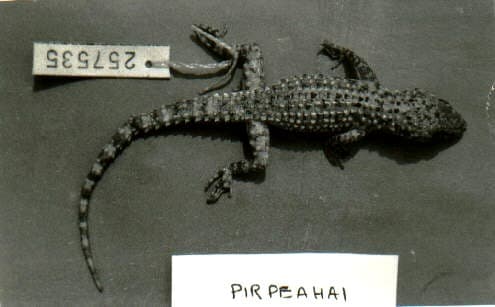
The Salt Range gecko (Cyrtopodion montiumsalsorum) is a species of gecko native to the Salt Range in northern Pakistan. This oviparous lizard belongs to the Gekkonidae family and is distinguished by its scientific name, which refers to its mountainous habitat.
Ablepharus bivittatus
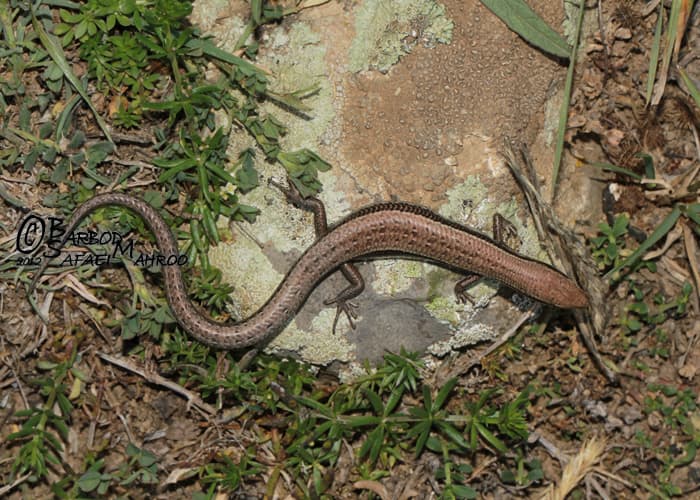
The twin-striped skink (Ablepharus bivittatus) is a species of skink found in mountainous regions of Armenia, Azerbaijan, Turkmenistan, northwestern Iran, and Turkey. It is distinguished by its habitat in high elevations, typically between 2,300 and 3,300 meters.