
Iranian fat-tailed gecko
The Iranian fat-tailed gecko is a nocturnal, ground-dwelling lizard found in parts of the Middle East, including Iraq, Iran, Turkey, and Syria. It is characterized by a fatter tail with spots and a distinct light vertebral stripe bordered by black stripes. Its diet primarily consists of insects, though it may also consume smaller vertebrates.
Key Facts
- ›Native to Iraq, Iran, Turkey, and Syria.
- ›Nocturnal and ground-dwelling.
- ›Possesses a fatter tail with spots.
- ›Features a continuous light vertebral stripe bordered by broken black stripes.
- ›Diet is primarily insectivorous.
- ›Capable of tail shedding (autotomy).

Iranian Eyelid Gecko, Iraqi Eyelid Gecko
Iraq, Iran, Turkey, Syria
- Has A Fatter Tail With Spots.
- Features A Continuous Light Vertebral Stripe Extending From the Occiput To the Base of the Tail.
- the Vertebral Stripe Is Bordered On Each Side By Broken Black Stripes.
Insectivorous, Smaller Vertebrates
Nocturnal, Ground-Dwelling, Autotomy
About Iranian fat-tailed gecko
The Iranian Fat-Tailed Gecko
The Iranian fat-tailed gecko, scientifically known as Eublepharis angramainyu, is a species of nocturnal lizard native to the Middle East. Its natural range includes countries such as Iraq, Iran, Turkey, and Syria. This reptile is characterized by its ground-dwelling habits and a distinctive physical appearance.
Physical Characteristics and Diet
A notable feature of the Iranian fat-tailed gecko is its fatter tail, which is adorned with spots. It also possesses a prominent light vertebral stripe that runs continuously from its occiput to the base of its tail, bordered on either side by broken black stripes. The gecko's diet is primarily insectivorous, consisting of insects, but it is also known to prey on smaller vertebrates.
Behavior and Adaptations
As a nocturnal species, the Iranian fat-tailed gecko is most active during the night. Like many other lizards, it has evolved the ability to shed its tail, a defense mechanism known as autotomy, to escape from predators.
Source: Wikipedia ↗
Frequently Asked Questions
What is the scientific name of the Iranian fat-tailed gecko?
The scientific name of the Iranian fat-tailed gecko is Eublepharis angramainyu. This binomial name is used to classify the species within the scientific community.
Where is the Iranian fat-tailed gecko found?
The Iranian fat-tailed gecko is native to Iraq, Iran, Turkey, and Syria. These countries represent its natural geographic distribution.
What does the Iranian fat-tailed gecko eat?
The diet of the Iranian fat-tailed gecko is primarily insectivorous, meaning it feeds on insects. However, it may also consume smaller vertebrates.
What are the distinctive physical features of the Iranian fat-tailed gecko?
This gecko is known for its fatter tail, which is adorned with spots. It also displays a continuous light vertebral stripe running from its occiput to the base of its tail, with broken black stripes on either side.
Is the Iranian fat-tailed gecko active during the day?
No, the Iranian fat-tailed gecko is a nocturnal species. This means it is primarily active during the night.
Can the Iranian fat-tailed gecko shed its tail?
Yes, like most lizards, the Iranian fat-tailed gecko has the ability to shed its tail as a defense mechanism. This process is known as autotomy.
Related Lizards
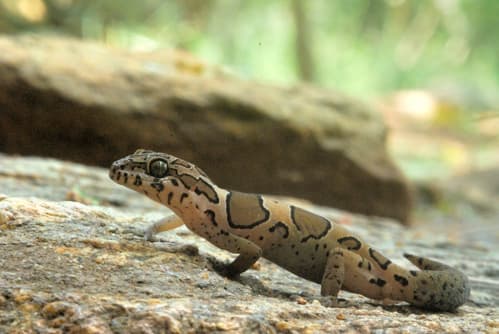
Geckoella collegalensis
Geckoella collegalensis, also known as the Kollegal ground gecko or forest spotted gecko, is a species of gecko native to South India. It is primarily ground-dwelling, found in forests along hilly tracts, and is nocturnal and insectivorous. This species is often confused with Cyrtodactylus speciosus.
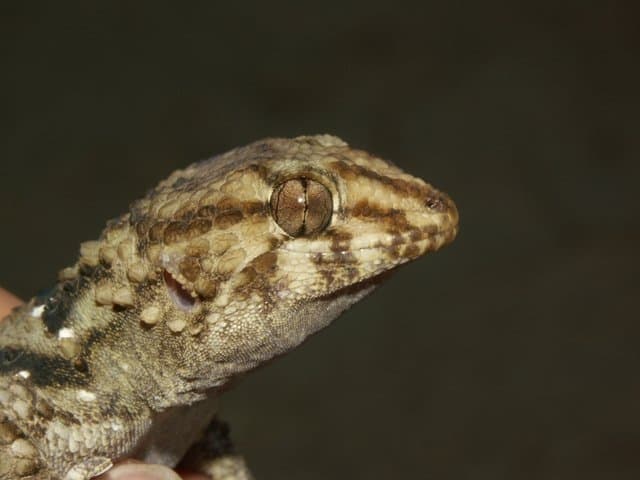
Bibron's sand gecko
Bibron's sand gecko, also known as Bibron's thick-toed gecko, is a moderate-sized lizard native to southern Africa. It is characterized by a stocky build, brown coloration with beaded patterns and black crossbars, and a white or light brown belly. This species is notable for its use in bioastronautic research and its territorial behavior.
Bibron's thick-toed gecko
Bibron's thick-toed gecko, also known as Bibron's sand gecko, is a moderate-sized lizard native to southern Africa, particularly Namibia, South Africa, and Eswatini. It is characterized by its stocky build, beaded brown dorsal pattern with black crossbars, and a white or light brown belly. This species is notable for its use as an animal model in bioastronautic research.