
Kentropyx borckiana
Kentropyx borckiana, commonly known as the Guyana kentropyx, is a species of lizard found in northeastern South America and on the Caribbean island of Barbados. This lizard is characterized by its greenish head and neck, white underside, brown sides, and pinkish underbody. A notable feature of K. borckiana is its reproduction through parthenogenesis, with only female specimens currently known.
Key Facts
- ›Found in Guyana, French Guiana, Suriname, and Barbados.
- ›Grows up to 100 mm (3.9 inches) in snout-to-vent length.
- ›Has a greenish head and neck, white underneath, brown sides, and pinkish underbody.
- ›Distinguished by a gray to pinkish-brown dorsal surface with light lateral stripes bordered by dark bands.
- ›Reproduces asexually through parthenogenesis, with only females known.
- ›Believed to have originated from hybridization between Kentropyx calcarata and Kentropyx striata.

Guyana Kentropyx
Guyana, French Guiana, Suriname, Barbados
- Grows Up To 100 mm Snout-To-Vent.
- Head and Neck Are Greenish.
- Underside Is White.
- Sides Are Brown.
- Underbody Is Pinkish.
- Dorsal Surface Is Gray To Pinkish-Brown.
- Features Light Lateral Stripes Bordered With Dark Bands On the Dorsal Surface.
About Kentropyx borckiana
Kentropyx borckiana: The Guyana Kentropyx
The Guyana kentropyx, scientifically known as Kentropyx borckiana, is a species of lizard belonging to the Teiidae family. This reptile is native to northeastern South America, with documented populations in Guyana, French Guiana, and Suriname. It has also been recorded on the Caribbean island of Barbados, although its status as a naturally occurring species in this location is not definitively established.
Physical Characteristics
Kentropyx borckiana typically reaches a snout-to-vent length of up to 100 mm (approximately 3.9 inches). Its coloration is distinctive: the head and neck are greenish, contrasting with white underparts. The sides of the body are brown, and the underbelly often exhibits a pinkish hue. The dorsal surface, or back, is usually gray to pinkish-brown and is marked by light lateral stripes that are bordered by darker bands, providing a unique pattern.
Reproduction and Taxonomy
A remarkable aspect of Kentropyx borckiana is its reproductive strategy. The species is apparently a rare unisexual clone, reproducing through parthenogenesis. This means that females can produce offspring without the need for fertilization by a male. To date, only female museum specimens of K. borckiana are known to exist, with no male specimens having been identified. It is hypothesized that this parthenogenetic lineage arose from hybridization between two other species within the same genus: Kentropyx calcarata and Kentropyx striata. The specific name, 'borckiana', honors Johann Graf von Borcke, a major in the Prussian Army who presented specimens to the Berlin Museum.
Source: Wikipedia ↗
Frequently Asked Questions
What is the scientific name for the Guyana kentropyx?
The scientific name for the Guyana kentropyx is Kentropyx borckiana. This binomial name designates its specific species within the genus Kentropyx.
Where can Kentropyx borckiana be found?
Kentropyx borckiana is native to northeastern South America, specifically in Guyana, French Guiana, and Suriname. It is also found on the Caribbean island of Barbados, though its native status there is uncertain.
What are the physical characteristics of Kentropyx borckiana?
Kentropyx borckiana has a greenish head and neck with white coloration underneath. Its sides are brown, and its underbody is pinkish. The dorsal surface is typically gray to pinkish-brown and features light lateral stripes bordered by dark bands.
How does Kentropyx borckiana reproduce?
Kentropyx borckiana reproduces through parthenogenesis, a form of asexual reproduction. This means that females can produce offspring without fertilization by a male. Currently, only female specimens of this species are known.
What is the origin of Kentropyx borckiana?
It is believed that Kentropyx borckiana originated from hybridization between two other Kentropyx species: Kentropyx calcarata and Kentropyx striata. This hybridization event likely led to the development of its unique parthenogenetic reproductive capabilities.
Related Lizards

Aspidoscelis laredoensis
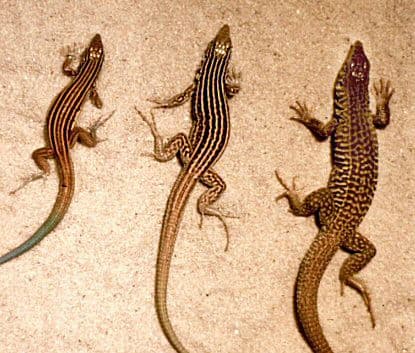
The Laredo striped whiptail (Aspidoscelis laredoensis) is a lizard species native to southern Texas and northern Mexico. It is known for its dark green or brown coloration, distinguished by seven yellow or white stripes extending from head to tail, and a white underside. This species is parthenogenic, meaning females reproduce without fertilization, and it is a fast-moving, diurnal insectivore.
Aspidoscelis neomexicana
The New Mexico whiptail (Aspidoscelis neomexicana) is a unique, all-female lizard species native to the southwestern United States and northern Mexico, notable for its parthenogenetic reproduction. Characterized by its slender body, seven pale yellow stripes, and a blue or blue-green throat, this diurnal lizard inhabits a variety of semi-arid environments.

Aspidoscelis uniparens
The desert grassland whiptail lizard (Aspidoscelis uniparens) is an all-female reptile native to North America, known for its unique parthenogenetic reproduction. These slender lizards are characterized by six yellowish lines running the length of their olive or brown bodies, which fade to a blue or gray tail. They inhabit desert grasslands and low valleys in Arizona, New Mexico, and northern Mexico.