
Large-headed anole
The large-headed anole (Anolis cybotes) is a species of anole found exclusively on the Tiburon Peninsula of Haiti. It is distinguished by the male's unusually large head and typically displays a brownish coloration with lighter stripes along its sides. This species is a medium-sized lizard with males generally growing larger than females.
Key Facts
- ›Endemic to the Tiburon Peninsula of Haiti.
- ›Males are characterized by their notably large heads.
- ›Coloration is often brownish with lighter flank stripes.
- ›Males reach a larger snout-vent length than females.

Tiburon Stout Anole, Hispaniolan Stout Anole
Haiti
- Males Have A Strangely Large Head.
- Often Brownish In Color.
- Features Lighter Stripes On the Flanks.
- Males Grow Up To 79 mm In Snout-Vent Length.
- Females Grow Up To 57 mm In Snout-Vent Length.
About Large-headed anole
The large-headed anole, scientifically known as Anolis cybotes, is a lizard species native exclusively to the Tiburon Peninsula of Haiti. This anole is easily recognized by a distinctive characteristic: the males possess unusually large heads. Its coloration is typically a shade of brown, often adorned with lighter stripes that run along its flanks, providing a degree of camouflage within its natural environment.
Physical Characteristics and Size
This species exhibits sexual dimorphism in size. Adult males of the large-headed anole can reach a snout-to-vent length of up to 79 mm (approximately 3.1 inches). Females are generally smaller, with their snout-to-vent length typically measuring up to 57 mm (around 2.2 inches). These measurements highlight a common pattern in anole species where males often attain larger sizes than their female counterparts.
Distribution and Taxonomy
The natural range of Anolis cybotes is strictly limited to the Tiburon Peninsula. Any reports of this species occurring outside this specific region are generally considered to be misidentifications, likely referring to other closely related anole species that were historically grouped under the Anolis cybotes classification. Its taxonomic family is Dactyloidae, placing it within the broader group of anoles.
Source: Wikipedia ↗
Frequently Asked Questions
Where does the large-headed anole live?
The large-headed anole is found only on the Tiburon Peninsula in Haiti. Reports of this species from other locations are likely misidentifications of similar lizards.
What is distinctive about the male large-headed anole?
A prominent characteristic of the male large-headed anole is its unusually large head, which gives the species its common name.
What does the large-headed anole look like?
This anole species is commonly brownish in color. It often features lighter stripes running along its flanks, and males tend to have a significantly larger head compared to females.
How big do large-headed anoles get?
Males of the large-headed anole can reach a snout-vent length of up to 79 mm (3.1 inches). Females are typically smaller, with a snout-vent length of up to 57 mm (2.2 inches).
Related Lizards
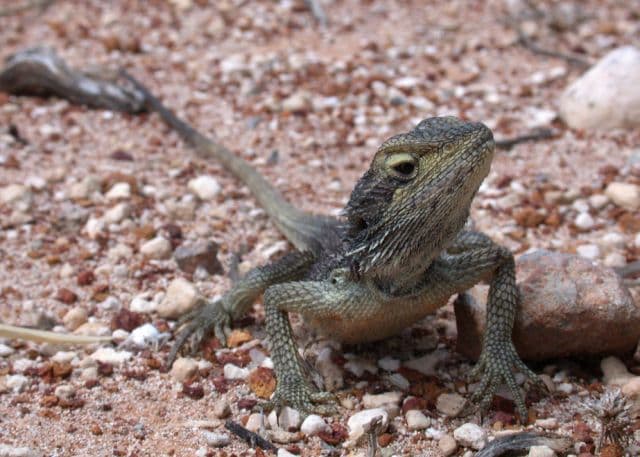
Abrolhos bearded dragon
The Abrolhos bearded dragon (Pogona minor minima) is a small agamid lizard endemic to the islands of the Houtman Abrolhos archipelago off the coast of Western Australia. It is characterized by its smaller size compared to related bearded dragons and inhabits sandy or limestone outcrop environments.

Algerian sand racer
The Algerian sand racer, scientifically known as Psammodromus algirus, is a lizard species found in southwestern Europe and northwestern Africa. It typically inhabits dense bushy vegetation and can be found at high elevations, though it is more common at lower altitudes. This species is characterized by its metallic brownish dorsal coloration with conspicuous white or yellowish stripes.

Amphiglossus decaryi
The rock skink, scientifically known as Flexiseps decaryi, is a species of skink found exclusively on the island of Madagascar. As a member of the skink family, it is characterized by its smooth, overlapping scales and typically elongated body. Its specific ecological niche and behavioral patterns are not extensively detailed in available records.