
Leaf-nosed lizard
The Leaf-nosed lizard, also known as the rhinoceros agama, is a unique reptile endemic to Sri Lanka's montane cloud forests. It is distinguished by a fleshy, leaf-like appendage on its nose, which is typically more pronounced in males. This lizard is diurnal and relies on its coloration for defense rather than agility.
Key Facts
- ›Possesses a distinctive leaf-like appendage on its nose.
- ›Endemic to the wet tropical montane cloud forests of Sri Lanka.
- ›Feeds primarily on insects and other small arthropods.
- ›Diurnal, meaning it is active during the day.
- ›Classified as endangered by the IUCN.
- ›Males often exhibit more green coloration than females.
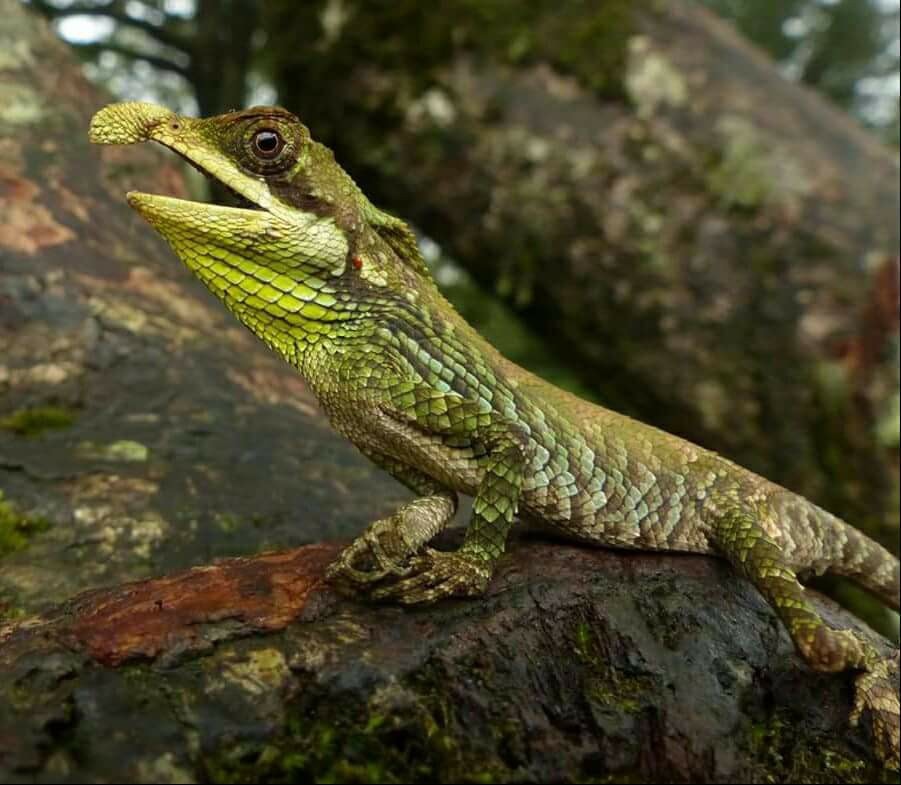
Rhinoceros Agama, Horn-Nosed Lizard, Tennent's Leaf-Nosed Lizard, Pethi An Katussa
Sri Lanka
Montane Cloud Forest, Tropical Forest
- Possesses A Fleshy, Leaf-Like Appendage On the End of Its Nose, Which Is Laterally Compressed With A Bluntly Conical Scale At the Tip.
- Can Reach Lengths of Over 8 Inches , Including the Tail.
- Males Generally Have More Green In Their Coloration Than Females, Though Both Can Change To A Reddish-Brown.
- Females Typically Have A Shorter Nasal Appendage.
- Head Is Oval and Longer Than It Is Wide.
- Dorsum Is Reddish-Brown To Olive Green, With Larger Flank Scales Being More Green.
- Gular Region and Sides of the Neck Display Dark Markings.
- Tail Features 20 Dark Brown Cross-Bands.
- Venter Is Cream-Colored.
- Lamellae Under the Fourth Toe Number 23-30.
Insects, Other Small Arthropods
- Diurnal .
- Relies On Coloration For Predator Avoidance Rather Than Agility.
- Little Is Known About Its Specific Behaviors.
Deforestation, Pesticides, Climate Change, Forest Fires, Bioaccumulation, Illegal Logging, Cardamom Plantations, Coffee Plantations, Tea Plantations, Rubber Plantations, Invasive Weeds
About Leaf-nosed lizard
The Leaf-nosed lizard, scientifically known as Ceratophora tennentii, is a distinctive reptile endemic to the island of Sri Lanka. It is also commonly referred to as the rhinoceros agama or horn-nosed lizard, and in Sinhalese as "Pethi An Katussa." This species is particularly notable for the unique, fleshy, leaf-like appendage that adorns the end of its nose, a feature generally more pronounced in males.
Habitat and Distribution
This lizard inhabits the specific ecological niche of the wet tropical montane cloud forests found in Sri Lanka, primarily observed in regions like the Knuckles mountains. It thrives at elevations ranging from 760 to 1,220 meters (2,490–4,000 feet). While its primary habitat is these specific forest types, it has also been documented in several other forest environments within the country.
Physical Characteristics and Behavior
The Leaf-nosed lizard can grow to lengths exceeding 20 centimeters (over 8 inches) including its tail. Its coloration can vary, with males often displaying more green hues than females, although both sexes possess the ability to shift to a reddish-brown. Unlike many lizards, C. tennentii is not particularly agile and relies more on its camouflage and coloration to avoid detection by predators rather than speed. It is a diurnal species, meaning it is active during daylight hours.
Diet and Reproduction
The diet of the Leaf-nosed lizard consists primarily of insects and other small arthropods. As a sexually reproducing animal, it is oviparous, laying eggs as its method of reproduction.
Conservation Status and Threats
Ceratophora tennentii faces significant threats that have led to its classification as endangered by the IUCN. These threats include extensive deforestation driven by illegal logging and the expansion of plantations for cardamom, coffee, tea, and rubber. The use of pesticides, the impacts of climate change, and forest fires further endanger the species. Following conservation efforts in 2000, which protected areas above 1,067 meters and led to the abandonment of cardamom cultivation, the habitat has been challenged by the proliferation of invasive weeds, such as mistflower and lantana, which can impede natural regeneration.
Source: Wikipedia ↗
Frequently Asked Questions
What is the most distinctive physical feature of the Leaf-nosed lizard?
The most striking feature of the Leaf-nosed lizard is the fleshy, leaf-like appendage located at the end of its nose. This unique structure is often more developed in males compared to females.
Where does the Leaf-nosed lizard live?
This species is found exclusively in Sri Lanka, inhabiting the wet tropical montane cloud forests. It is typically observed at elevations between 760 and 1,220 meters (2,490–4,000 feet) in areas like the Knuckles mountains.
What does the Leaf-nosed lizard eat?
The diet of the Leaf-nosed lizard consists mainly of insects and other small arthropods. They forage for these prey items within their forest habitat.
Is the Leaf-nosed lizard an agile climber?
No, the Leaf-nosed lizard is not considered very agile. Instead of relying on speed or agility to evade predators, it tends to depend on its coloration and camouflage.
What are the main threats to the Leaf-nosed lizard population?
Significant threats to the Leaf-nosed lizard include habitat loss due to deforestation for plantations and illegal logging, the use of pesticides, climate change, and forest fires. Bioaccumulation of toxins also poses a risk.
What is the conservation status of the Leaf-nosed lizard?
The Leaf-nosed lizard is listed as endangered by the International Union for Conservation of Nature (IUCN). This status reflects the significant threats it faces and the decline in its population.
Related Lizards

Phelsuma grandis
Phelsuma grandis, commonly known as the Madagascar giant day gecko, is a diurnal and arboreal species of gecko native to the tropical and subtropical forests of northern Madagascar. These large geckos are characterized by their bright green coloration, often adorned with red dots or bars, and a distinctive red stripe from nostril to eye. They are opportunistic omnivores, feeding on insects, small vertebrates, nectar, and fruit, and are popular as exotic pets.

Furcifer pardalis
The panther chameleon (Furcifer pardalis) is a brightly colored lizard native to Madagascar's tropical forests, known for its vibrant blue, red, green, or orange patterns that vary by geographic locale. These chameleons possess specialized feet for gripping branches and an exceptionally long, rapid tongue for capturing prey. Easily bred in captivity, they are popular pets but are considered challenging to care for, with males generally living longer and exhibiting more striking colors than females.
Madagascan giant day gecko
The Madagascan giant day gecko (Phelsuma grandis) is a large, diurnal lizard native to the tropical and subtropical forests of northern Madagascar. Characterized by its bright green coloration, often adorned with red markings, and a distinctive red stripe from nostril to eye, this species is known for its arboreal lifestyle and territorial nature. It is also recognized for its ability to change color when stressed and its unique method of cleaning its eyes.