
Phelsuma grandis
Phelsuma grandis, commonly known as the Madagascar giant day gecko, is a diurnal and arboreal species of gecko native to the tropical and subtropical forests of northern Madagascar. These large geckos are characterized by their bright green coloration, often adorned with red dots or bars, and a distinctive red stripe from nostril to eye. They are opportunistic omnivores, feeding on insects, small vertebrates, nectar, and fruit, and are popular as exotic pets.
Key Facts
- ›Native to northern Madagascar's tropical and subtropical forests.
- ›Reaches a total length of 9–11 inches (23–28 cm).
- ›Distinctive bright green body with red markings, including a nostril-to-eye stripe.
- ›Diet consists of invertebrates, small vertebrates, nectar, and fruit.
- ›Males are territorial and can be aggressive towards other males and sometimes females.
- ›Breeding season is from December to June, with eggs hatching in 48-80 days.

Madagascar Giant Day Gecko, Giant Day Gecko
Madagascar, Florida, Hawaii, Reunion Island, Mauritius
- Reaches A Total Length of 9–11 Inches .
- Females Are Generally Smaller Than Males.
- Body Coloration Is Bright Green Or, Rarely, Bluish Green.
- A Red Stripe Extends From the Nostril To the Eye.
- Typically Has Red Colored Dots Or Bars On the Back, Which Are Variable and Can Be Absent In Some Individuals.
- Some Specimens May Exhibit Small Blue Spots.
- Adult Specimens May Possess Large Calcium Sacs On Their Necks.
- Young Individuals Often Display More Red Markings Which Fade With Age.
- the Underside Ranges From Creamy White To Eggy Yellow.
- When Stressed, Coloration Darkens To Dark Green With Orange-Hued Red Markings On the Face and Back.
Various Insects, Other Invertebrates, Very Small Vertebrates, Nectars, Soft, Sweet Fruit, Pollen
- Diurnal .
- Arboreal .
- Males Are Territorial and Quarrelsome, Generally Only Allowing Females Into Their Territory.
- Can Move Very Fast When Startled.
- Effective At Escaping Enclosures.
- Lick Their Eyes To Keep Them Clean Due To the Absence of Eyelids.
- May Consume Their Own Young.
- Considered A Threat To Native Biodiversity In Introduced Areas.
About Phelsuma grandis
Phelsuma grandis: The Madagascar Giant Day Gecko
Phelsuma grandis, widely recognized as the Madagascar giant day gecko, is a striking species of diurnal and arboreal gecko native to the tropical and subtropical forests of northern Madagascar. This species belongs to the extensive Phelsuma group, comprising over 70 distinct species and subspecies.
Physical Characteristics
The Madagascar giant day gecko is notable for its substantial size, reaching a total length of 9 to 11 inches (23 to 28 cm), with males typically being larger than females. Its body is predominantly a vibrant green, though some individuals may exhibit a bluish-green hue. A defining feature is a distinct red stripe that extends from the nostril to the eye, and many specimens display red dots or bars on their backs, though the intensity and presence of these markings can vary considerably. Adult geckos may develop prominent calcium sacs on their necks. The underside of the gecko ranges from creamy white to a pale yellow. When agitated or stressed, their coloration can darken significantly, becoming a deep green with more pronounced orange tones in their red markings.
Habitat and Distribution
Primarily found in the northern and northwestern regions of Madagascar, Phelsuma grandis has also been introduced to several other subtropical areas. Populations have been established in Florida and Hawaii, and on islands such as Reunion and Mauritius. In these introduced environments, the species can pose a threat to the native biodiversity, encroaching on the habitats of other day gecko species.
Diet and Behavior
As an opportunistic omnivore, Phelsuma grandis feeds on a varied diet that includes insects, other invertebrates, and occasionally small vertebrates. They also supplement their diet with sweet fruits, nectar, and pollen, showing a preference for red or yellow nectars. Behaviorally, males are known for their territorial nature, often being aggressive towards other males. They possess the ability to move with remarkable speed when startled and are adept at escaping enclosures. Lacking eyelids, they maintain eye hygiene by frequently licking their eyes. Notably, individuals, both in the wild and in captivity, have been observed consuming their own young.
Reproduction
The breeding season for Phelsuma grandis typically spans from December to June. During this period, females are capable of laying multiple clutches of eggs. The incubation period for these eggs varies, generally lasting between 48 and 80 days, influenced by ambient temperature.
Source: Wikipedia ↗
Frequently Asked Questions
What is the scientific name for the Madagascar giant day gecko?
The scientific name for the Madagascar giant day gecko is Phelsuma grandis. This species was elevated from subspecies status to its own species in 2007 due to significant and reliable differences identified through environmental niche modeling.
What is the typical size of Phelsuma grandis?
Phelsuma grandis reaches a total length of 9 to 11 inches (23 to 28 cm). Females are generally smaller than males. Adult specimens may develop large sacs on their necks, which are stored calcium sacks.
What do Madagascar giant day geckos eat?
These geckos have an omnivorous diet, feeding on various insects and other invertebrates. They also consume small vertebrates, soft fruits, pollen, and nectar. Studies indicate a preference for red or yellow colored nectars, a trait considered innate.
What is the habitat of Phelsuma grandis?
Phelsuma grandis is naturally found in the tropical and subtropical forests of northern and northwestern Madagascar. It has also been introduced to several other subtropical locations, including Florida, Hawaii, and Reunion Island, where it can pose a threat to native biodiversity.
Are Madagascar giant day geckos aggressive?
Male Phelsuma grandis can be territorial and quarrelsome, generally not tolerating other males in their vicinity. In captivity, males can sometimes injure females if they cannot escape, necessitating separation. Breeding behavior includes tail or body shaking and vocalizations.
How do Madagascar giant day geckos keep their eyes clean?
Phelsuma grandis geckos lack eyelids. To maintain the cleanliness of their eyes, they frequently lick them.
When do Madagascar giant day geckos reproduce?
The breeding season for Phelsuma grandis typically occurs between December and June. During this period, females can lay multiple pairs of eggs. The incubation period for the eggs ranges from approximately 48 to 80 days, depending on the ambient temperature.
Related Lizards

Madagascan giant day gecko
The Madagascan giant day gecko (Phelsuma grandis) is a large, diurnal lizard native to the tropical and subtropical forests of northern Madagascar. Characterized by its bright green coloration, often adorned with red markings, and a distinctive red stripe from nostril to eye, this species is known for its arboreal lifestyle and territorial nature. It is also recognized for its ability to change color when stressed and its unique method of cleaning its eyes.

Phelsuma cepediana
The blue-tailed day gecko (Phelsuma cepediana), also known as Lacépède's gecko, is a diurnal lizard endemic to Mauritius. This mid-sized gecko is known for its striking coloration, with males displaying vibrant blue tails and red spots, while females are a bright green. It inhabits warm, humid environments on trees and bushes, playing a crucial role as the sole pollinator and seed disperser for the endemic shrub Roussea simplex.
Leaf-nosed lizard
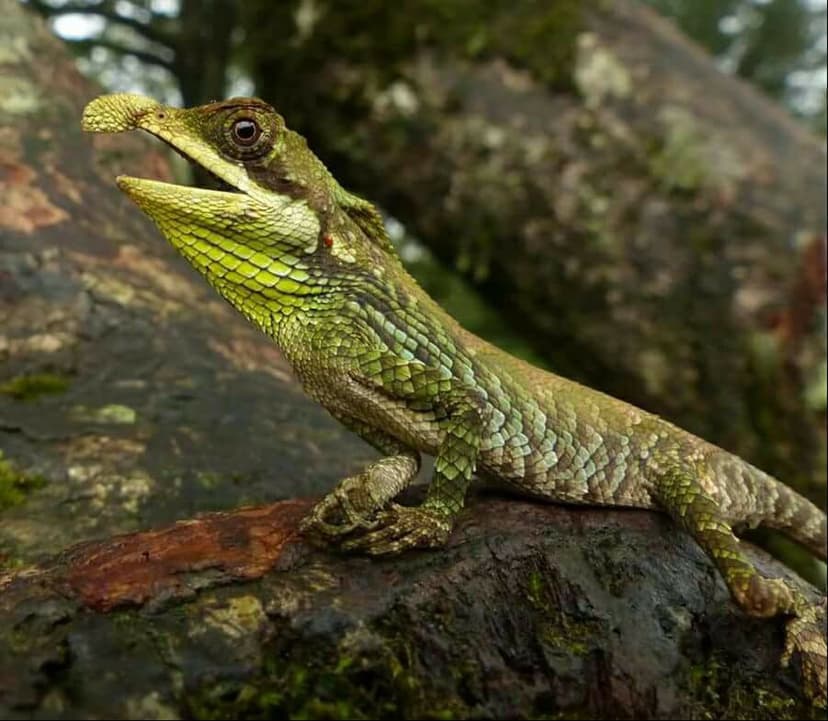
The Leaf-nosed lizard, also known as the rhinoceros agama, is a unique reptile endemic to Sri Lanka's montane cloud forests. It is distinguished by a fleshy, leaf-like appendage on its nose, which is typically more pronounced in males. This lizard is diurnal and relies on its coloration for defense rather than agility.